SwarmAI
A self-evolving, brain-first Agent OS — cognition that compounds every session.
Human directs. AI delivers.
English | 中文



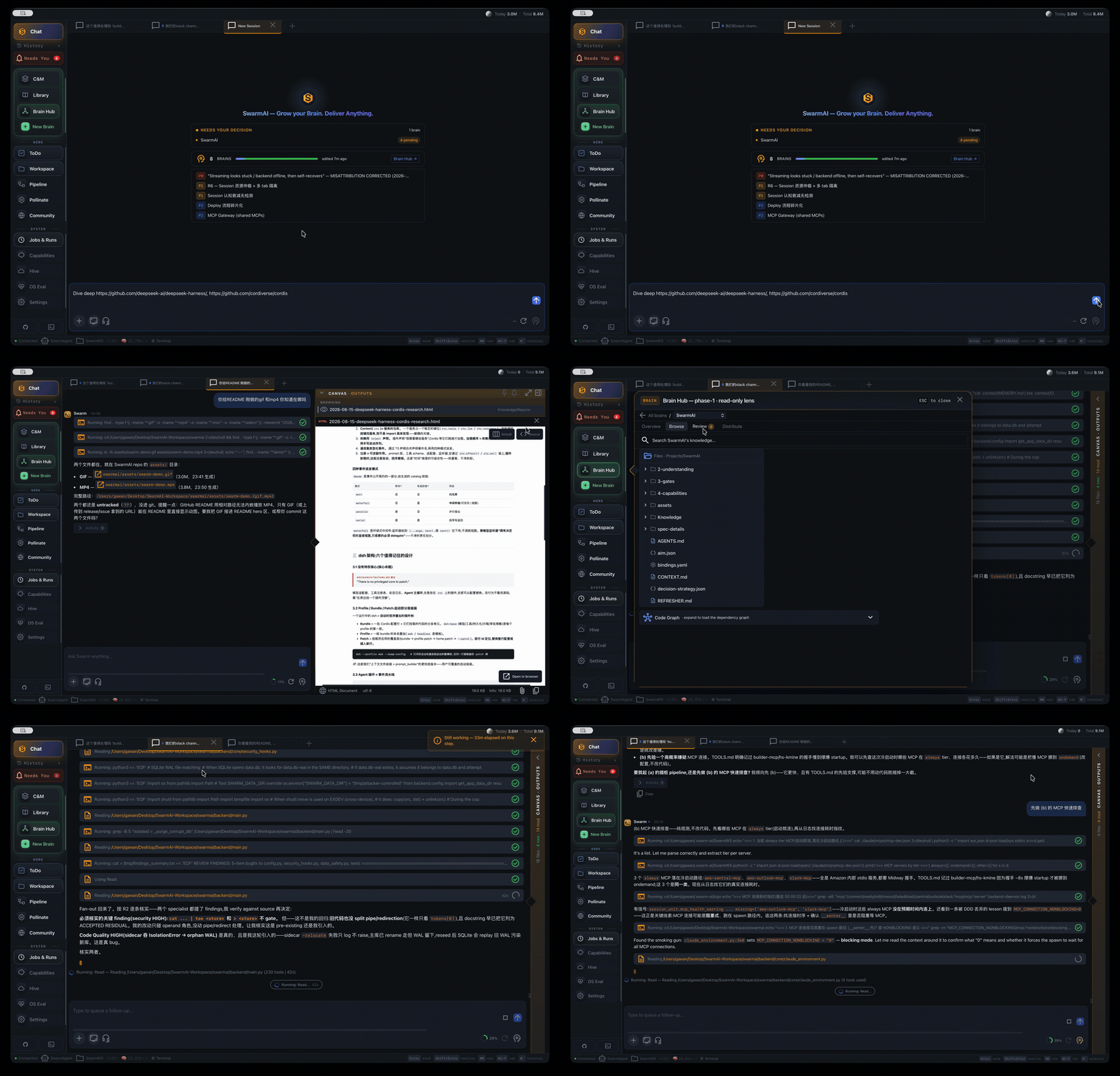
SwarmAI is a self-evolving Agent OS — every interaction sharpens how the system judges, not just what it knows.
Why an Agent OS
Every other AI tool starts each session from zero. SwarmAI doesn't — value compounds. A model answers; a mind persists: continuous across sessions, self-correcting, forgetting what stopped mattering, sharpening its judgment with use. Not a bigger model — the operating system around one.
The Four Ideas
Everything in SwarmAI serves one of four:
🧬 Self-Evolution — it upgrades its own judgment
Most agent-memory projects pile up entries. SwarmAI separates cognition (the OS) from knowledge (the disk): one edited line in SOUL.md shifts judgment more than a thousand memory rows — and every change is a git diff. A recurring mistake doesn't become one more logged lesson; it becomes a gate — a path where the wrong move can't happen. Not aspirational: a dozen-plus live guards sit in security_hooks.py (commit gate, pytest guard, dangerous-command gate). Read the file — the wrong move is blocked in code, not in a guideline. Progress isn't a growing correction count; it's an error class that stops recurring.
🧠 Brain-first — every project is a domain brain
A project isn't a folder of files — it's a brain with one six-section structure (Identity · Knowledge · Gates · Capabilities · Delivery · Refresher), the same for every user and domain. Only what it governs varies: 0..N assets of any kind — a code repo, a data source, a document corpus, a process, or nothing at all. A codebase, a research topic, a consultant's client, even "my wedding" get the same brain. Knowledge sediments in as you work; knowledge that stops mattering decays and dies. Accumulation without elimination is how every memory system rots.
⚙️ Agent OS — the cognition lives between sessions, not in them
Sessions are discontinuous; intelligence shouldn't be. Hooks fire between sessions so the next one starts warm. The system self-heals when a session breaks, cultivates and decays its knowledge on a schedule, and rebuilds each system prompt fresh from governed context files.
🖐️ Proprioception — it inhabits its body, not just answers through it
The desktop app isn't a frontend the agent talks to — it's a body it senses and drives. SwarmAI reads its own live UI state (which overlay is open, which tab is active, what's on the Canvas) and acts on it: opens its own Brain Hub, pushes a report onto the Canvas, flags a decision to your attention channel. It's inspectable in return — TSCC (Thread-Scoped Cognitive Context) shows the real cognition behind a turn: which files loaded, the token budget, every recall hit and its score, the security scan, the full prompt. Most agents are black boxes you send text to; this one has a body you watch move — and inspect while it does.
Quick Start
git clone https://github.com/xg-gh-25/SwarmAI.git && cd SwarmAI
cd backend && uv sync && cp .env.example .env   # edit with your API key
cd ../desktop && npm install && npm run tauri:dev
macOS (Apple Silicon): Or download .dmg from Releases
Requires: Node.js 18+, Python 3.11+, Rust, uv, Claude Code CLI
📖 Full setup guide: QUICK_START.md
Architecture
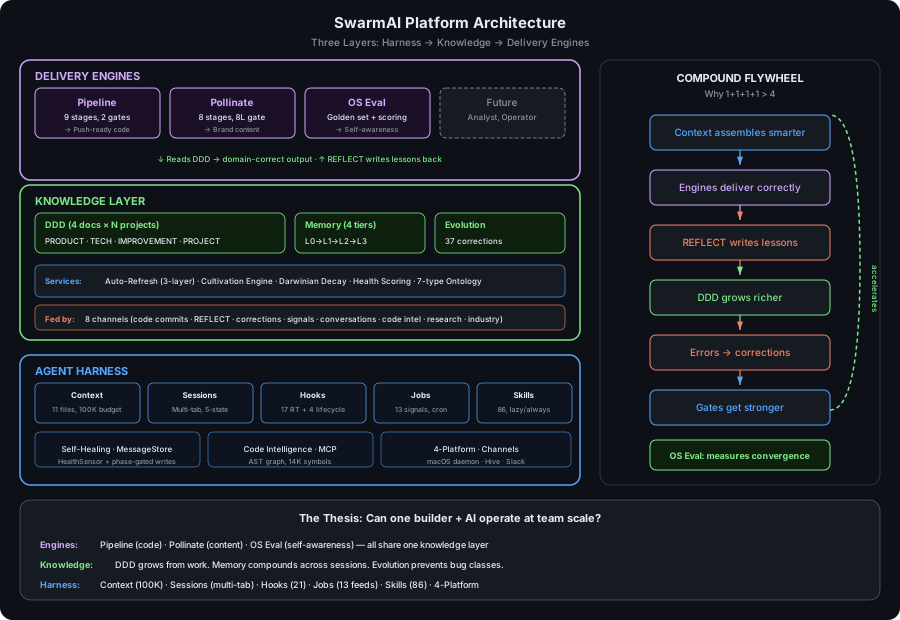
┌─────────────────────────────────────────────────────────────┐
│  DELIVERY ENGINES        Pipeline · Pollinate · Eval        │
├─────────────────────────────────────────────────────────────┤
│  KNOWLEDGE LAYER         DDD (brains) · Memory · Evolution  │
├─────────────────────────────────────────────────────────────┤
│  AGENT HARNESS           Context · Sessions · Hooks · Jobs  │
└─────────────────────────────────────────────────────────────┘
Each engine is independently useful; together they form the loop that makes the system sharper with use. (Click code to read the engine itself — the implementation is the documentation.)
| Engine | What It Does | Read |
|---|---|---|
| Context Management | Governed-file prompt architecture, tiered ownership, live-measured budget | docs |
| Memory | Tiered persistence: DailyActivity → distillation → compound recall (pure-filesystem FTS/BM25) | docs |
| DDD Cultivation | Self-growing domain brains, 7-type × 3-layer ontology, Darwinian decay | docs |
| Self-Evolution | Cognitive L0→L3 patching — recurring error classes become structural gates | docs |
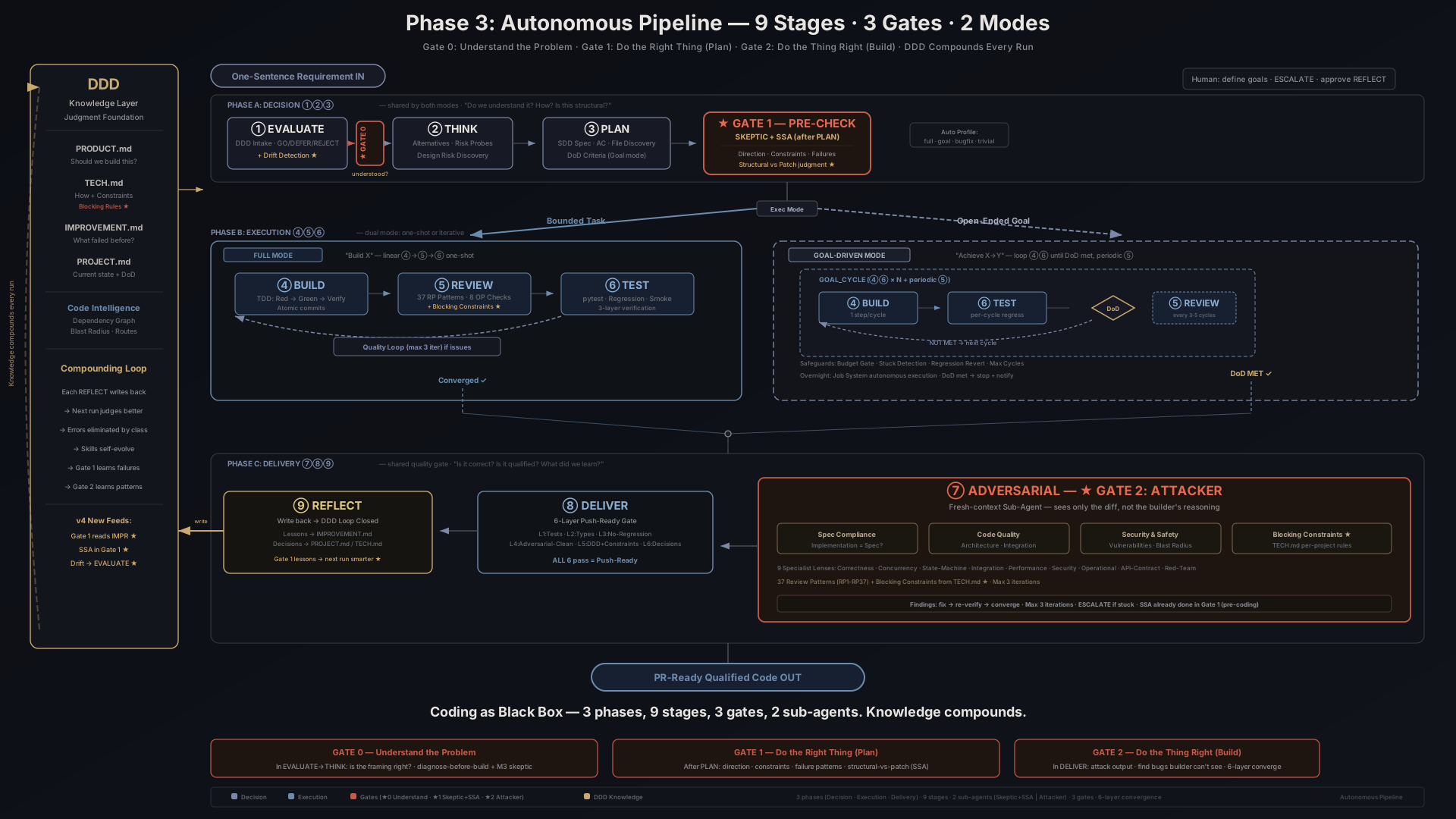
| Autonomous Pipeline | One requirement → push-ready code. 9 stages · 3 gates · 2 modes | docs |
| Pollinate | One message → multi-format content. Same DDD-driven pattern, for media | docs |
| Self-Healing | Invisible recovery: sensors, auto-respawn, the user sees nothing | code |
| Multi-Tab + MessageStore | Concurrent sessions, phase-gated single-writer, cross-tab isolation | code |
| Hooks + Jobs | Between-session hooks + background intelligence. Sessions never cold-start | code |
| Eval | Decoupled, system-level: golden set + git-bound regression gate | docs |
The compound loop: Memory → Pipeline judgment → DDD brains → Evolution → Gates → Memory. Remove one, the rest weaken.
🤖 For AI Agents
Coding in this repo? Start with AGENTS.md — data flow, process topology, conventions, and invariants. It's the agent-facing entry point; this README is the human one.
Design Philosophy
- One-shot qualified delivery is the real token optimization. Cheap models iterate 5×, costing more than one correct pass. Code and content are a black box: input → qualified output.
- Division of labor is a workaround for limited human bandwidth, not good design. One agent, many roles, one knowledge layer. (Sub-agents for adversarial checks ≠ division of labor.)
- Knowledge must eliminate itself. Darwinian decay: unreferenced knowledge retires. A system that can forget beats one that can only remember.
- Evolution is cognitive patching, not data accumulation. We change rules you can
git diff. "Thinks differently" ≠ "knows more." - Quality converges, not just improves. Error classes decrease monotonically. Carefulness doesn't scale; gates do.
- Sessions are discontinuous. Intelligence shouldn't be. Hooks fire between sessions. It gets better through use, not updates.
- If you can't measure it, you didn't build it. Eval + golden set + change-triggered regression, proven in git.
📖 Full thesis + case study: docs/THESIS.md
Stack
Tauri 2.0 (Rust) · React 19 · FastAPI · Claude Agent SDK + Bedrock · SQLite (WAL + FTS5)
Four-platform backend (compile-time isolation): macOS daemon (prebuilt .dmg) · Hive (EC2) · Windows · Linux (source-build).
Resources
| What | Link |
|---|---|
| Design Docs | Platform · Pipeline · Memory · Evolution · Pollinate |
| AI Agent Pitfall Guide | EN PDF · 中文 PDF |
| For AI Agents | AGENTS.md |
| Contributing | CONTRIBUTING.md |
SwarmAI — Human directs. AI delivers.