Full-stack Kubernetes observability —
that can safely fix things, too.
Self-hosted · eBPF traces, logs & metrics, zero instrumentation · a safe MCP interface for AI agents · Apache-2.0 · air-gapped capable



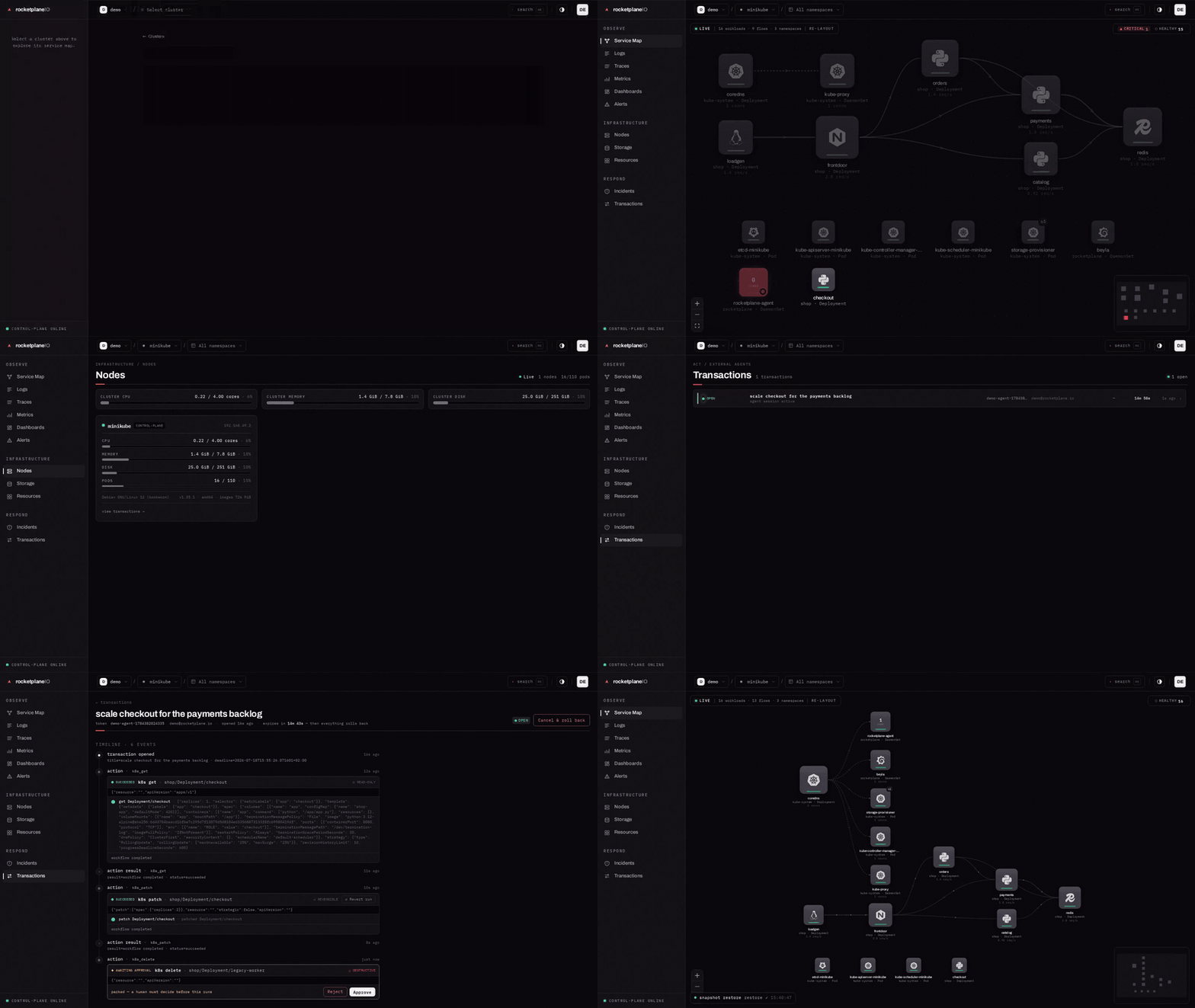
Alpha. The full loop works end-to-end today, developed against minikube. APIs and schemas still change without notice — don't point it at production yet.
Three things you don't get anywhere else
1 · Traces for services you never instrumented
One outbound-only agent plus an eBPF DaemonSet (OTel eBPF Instrumentation, née Grafana Beyla). HTTP/gRPC spans with cross-service context propagation — including compiled Go binaries — plus SQL, Redis and Kafka client spans. No SDKs, no sidecars, no code changes.
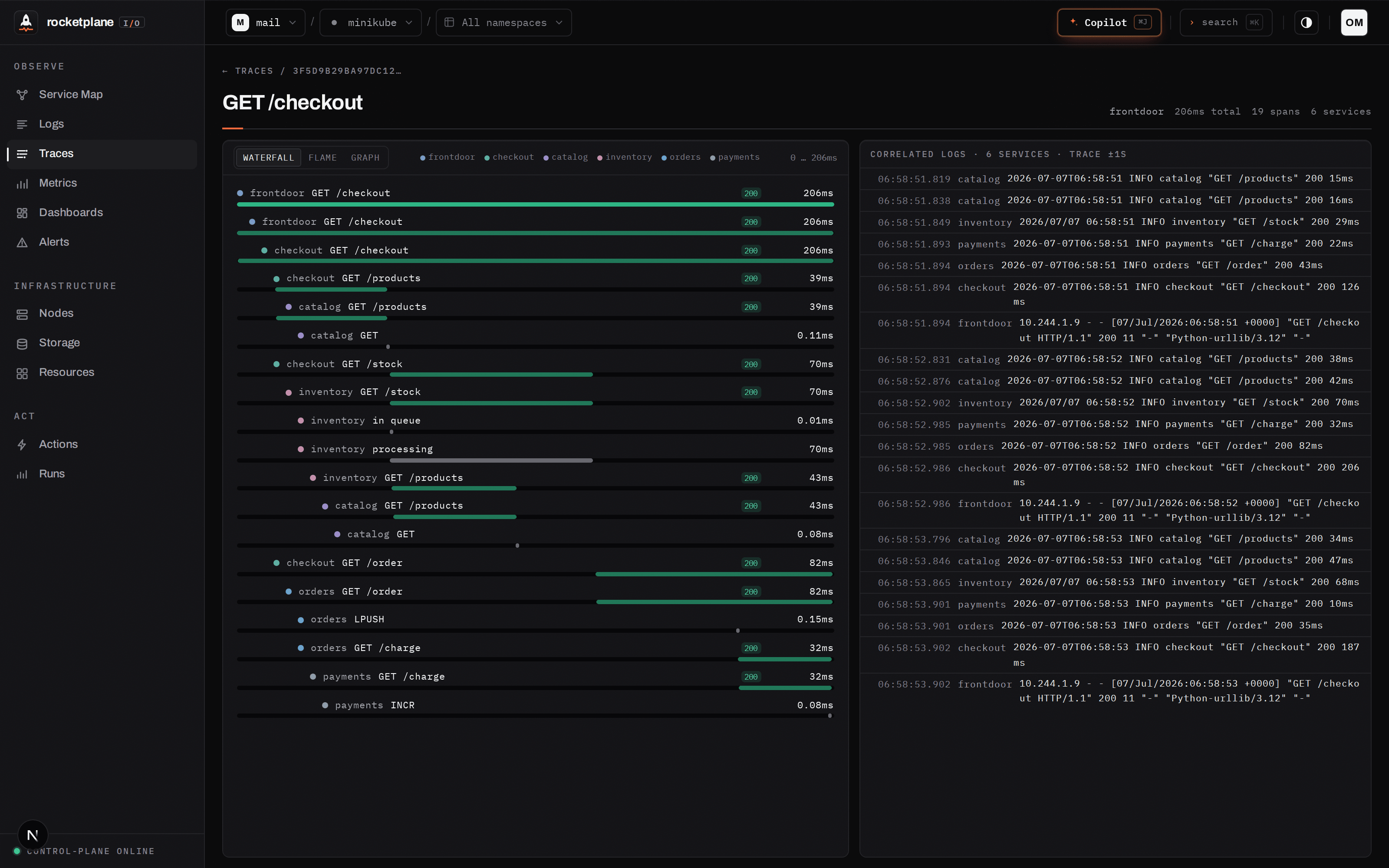
GET /checkout: the failure cascades frontdoor → checkout → catalog,
the exact ERROR log lines are correlated on the right. No SDK in any of these services.2 · Logs, traces, metrics and topology — one dataset, not four tools
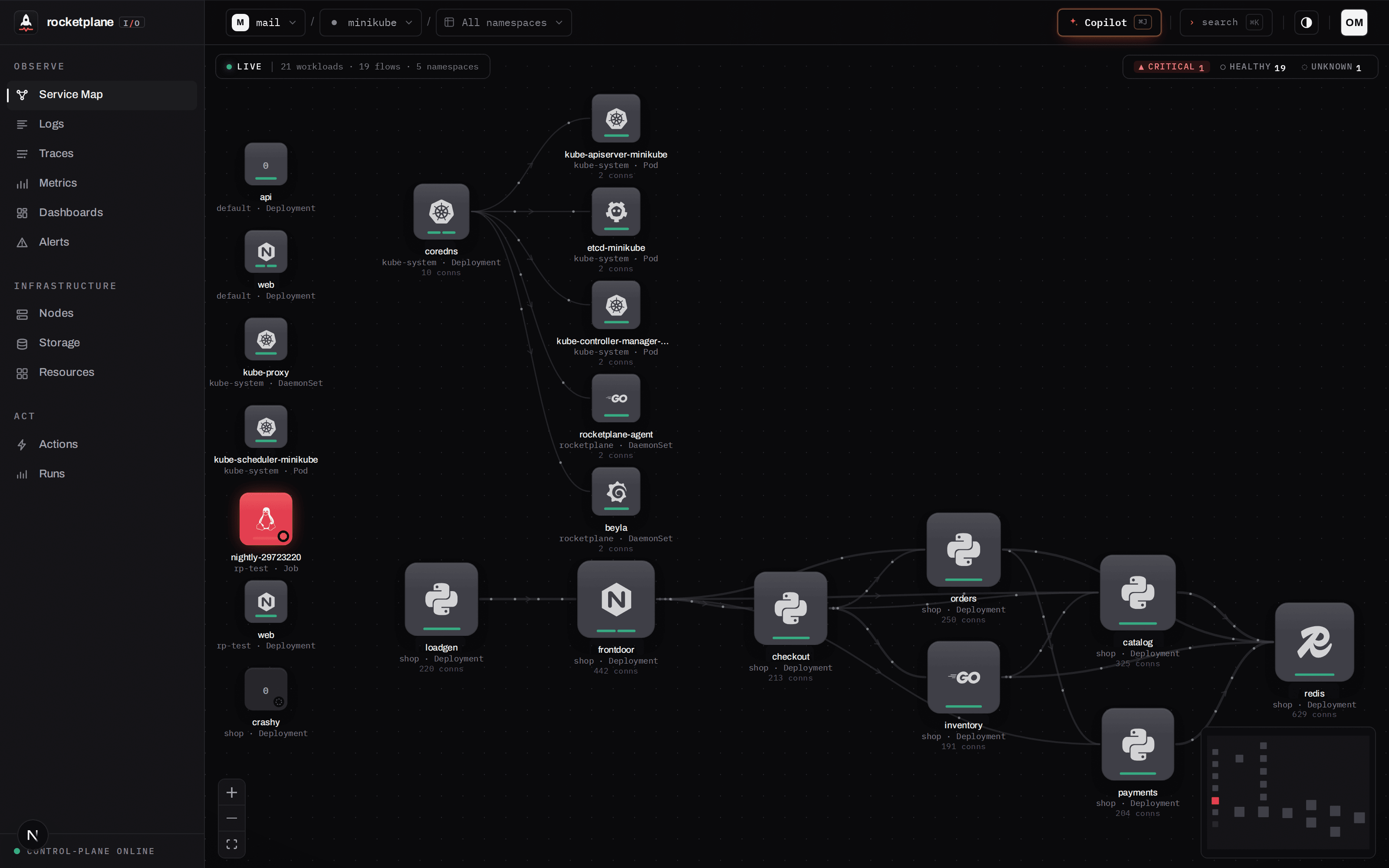
It's not four products bolted together. A log line is two clicks from its distributed trace. The service map is drawn from real eBPF traffic, not a static config — tech logos matched from container images, health live from RED metrics. PromQL runs on the actual Prometheus evaluation engine, embedded, over ClickHouse. And the complete Kubernetes inventory — Services, Ingress, ConfigMaps, policies, volumes — is synced and searchable right beside it. Everything self-hosted; your telemetry never leaves your infrastructure.
3 · And it can fix what it finds — safely
Observability that stops at "here's the problem" leaves the hard part to you. rocketplaneIO
doesn't ship its own AI — it's the MCP interface your existing agent (Claude Code, Cursor,
anything that speaks MCP) connects to. The agent reads everything above, and acts through
kubectl-shaped primitives (k8s_get / k8s_patch / k8s_apply / k8s_delete / k8s_exec /
Starlark workflows) on any resource, CRDs included.
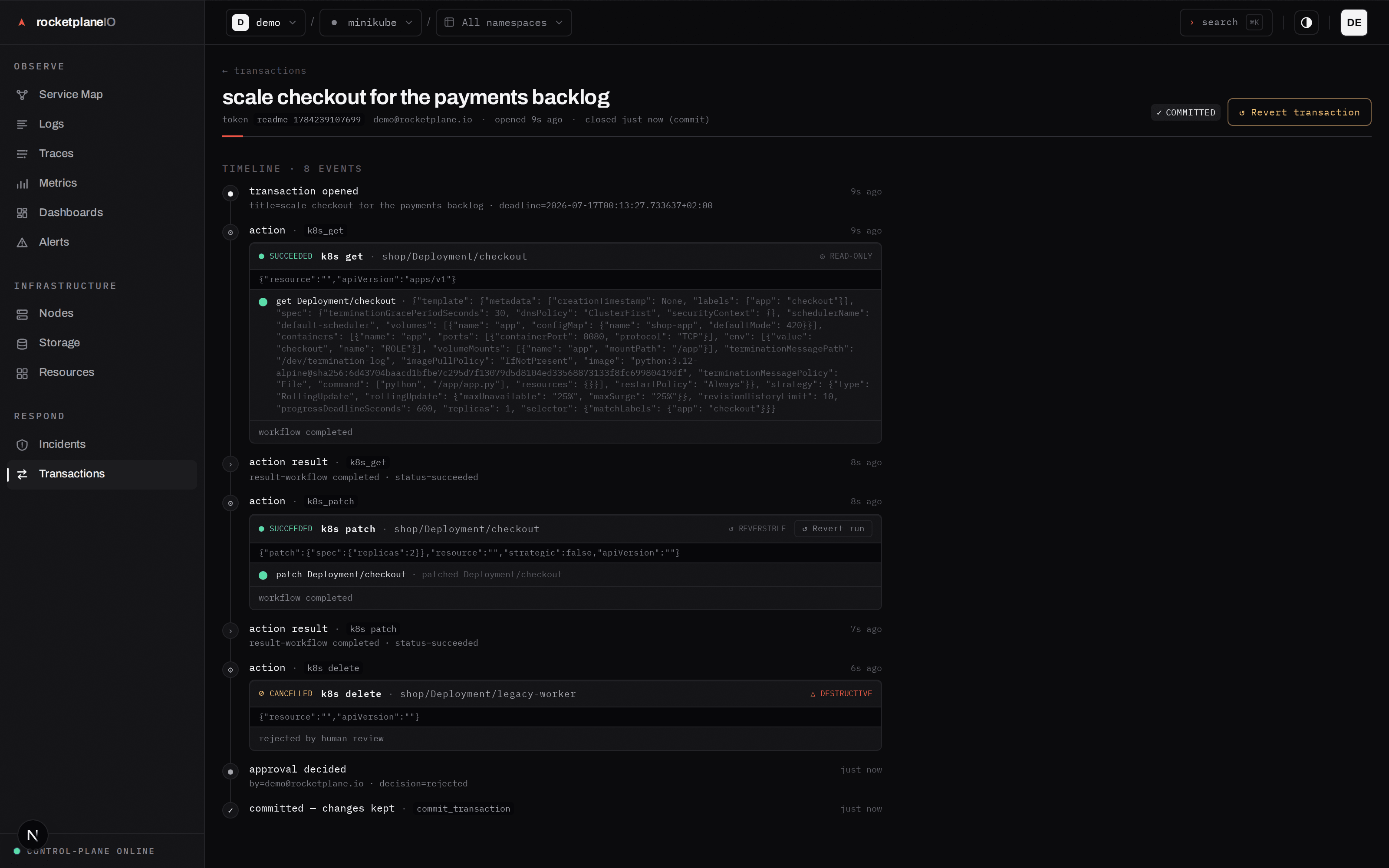
The guardrail is a transaction. Nothing mutates outside one — every change is snapshotted durably before it commits, so cancel, timeout or a later Revert restores every before-state in reverse (LIFO). Each operation is risk-classified by rocketplaneIO, not by the model:
| Level | Examples | Default policy |
|---|---|---|
| ◎ read | k8s_get, k8s_list, logs, traces, PromQL | runs immediately, no transaction |
| ↺ reversible | k8s_patch, k8s_apply (snapshot-backed) | runs inside the transaction |
| ◇ disruptive | k8s_delete on Pods/Jobs | a human approves in the UI |
| △ destructive | any other delete, k8s_exec, workflows, scale-to-0 | a human approves in the UI |
Classification is parameter-aware (replicas: 3 is reversible; : 0 is destructive) and
fail-closed. Disruptive and destructive operations park until a human approves them — and an API
token can never approve its own proposals.
Quick start
You need Docker and a Kubernetes cluster to point it at (minikube is fine).
1 — run the platform (one command)
curl -fsSL https://rocketplane.io/install.sh | sh
That's the whole install: it downloads the compose bundle, generates real secrets,
pulls the published images
and starts everything. The UI comes up on http://localhost:4173 (create the owner
account there), the control plane on :8090. Re-running the same command later is
the update path — secrets are kept, images are bumped to the newest release.
Prefer to see every step? The manual compose variant.
curl -O https://raw.githubusercontent.com/olemeyer/rocketplaneIO/main/deploy/compose/docker-compose.prod.yml
curl -o .env https://raw.githubusercontent.com/olemeyer/rocketplaneIO/main/deploy/compose/.env.example

# REQUIRED: a real session secret — the control plane refuses to start without one.
echo "RP_SESSION_SECRET=$(openssl rand -hex 32)" >> .env

docker compose --env-file .env -f docker-compose.prod.yml up -d
Production mode by default (no anonymous login). For a throwaway localhost trial add
RP_ENV=dev to .env to skip account setup.
2 — connect your cluster
Open the UI, hit Connect cluster — it hands you one copy-paste command that installs the
agent and the Beyla DaemonSet (a rendered kubectl apply, or Helm). When the service map draws
your namespaces and spans appear under Traces, you're live — without touching a line of your
code. The installer auto-detects a LAN address your cluster can dial back to; for a local
minikube that is http://host.minikube.internal:8090.
3 — connect your AI agent
Create an API token under Settings → API keys (role admin for mutations), then:
claude mcp add --transport http rocketplaneio \
  http://localhost:8090/mcp/orgs/<org>/clusters/<cluster> \
  --header "Authorization: Bearer rp_..."
The Settings → MCP tab generates this snippet (and the .mcp.json / Cursor variants) with
your real IDs filled in. From that moment your agent can investigate freely — and every change it
wants to make runs through a transaction you can watch, gate and roll back live under
Transactions.
Images ship as pinned releases (see RP_VERSION in .env);
edge tracks main for the latest unreleased changes. A platform Helm
chart is the next milestone. Want a demo workload? A Python + Redis shop behind
nginx — the one in every screenshot here — ships in
deploy/dev/ (kubectl apply -f deploy/dev/shop-realistic.yaml -f deploy/dev/frontdoor.yaml).
Is it safe?
The section every platform team reads first:
- Outbound-only. The agent dials out over HTTPS; nothing connects into your cluster, nothing listens. Actions are claimed by the agent — never pushed in.
- Auth. In production the dev-login bypass is off: the first account is created at
/setup, or you wire up Google SSO. Sessions are HMAC-signed withRP_SESSION_SECRET, and the control plane refuses to start with a missing or weak one — no forgeable cookies, no shipped default. - Network / TLS. The control plane speaks plain HTTP on
:8090— put it behind a TLS reverse proxy (or the platform Helm chart's ingress) for anything pastlocalhost. The OTLP ingest ports4317/4318are unauthenticated by design; keep them on a trusted network (in-cluster or behind the proxy), not on the public internet. - RBAC, two blocks (
deploy/install.yaml): observe is enumerated read-only; act is deliberately broad — the generic operation set works on any kind, CRDs included. The guardrails are architectural, not a resource list: no mutation outside a transaction, risk classification, human approval for hard operations, durable pre-mutation snapshots, LIFO rollback, full audit. Delete the act block (or setrbac.actions=falsein Helm) for a strictly observe-only agent. - Secrets: the inventory shows names, types and key counts — never values. That restraint is
enforced in agent code; if you'd rather enforce it with RBAC too, delete the one
secretsrule and the agent degrades gracefully. - The agent is fenced, not trusted. It authenticates with an org-scoped API token against the same RBAC you use; mutations demand an admin token AND an open transaction; disruptive and destructive operations park until a human approves them in the UI — and a token can never approve its own proposals. Every tool call, decision and result lands in the transaction timeline.
- eBPF: Beyla runs as a privileged DaemonSet (kernel ≥ 5.8 with BTF). The capture layer is upstream OpenTelemetry tooling — rocketplaneIO is the investigation-and-action loop on top.
- Footprint (measured on single-node minikube under continuous synthetic load — indicative, not a production benchmark): the rocketplaneIO agent is one lightweight pod at ~2m CPU and ~10Mi memory, cluster-wide. Beyla is the real cost and scales with request volume — ~0.02 core idle, spiking to ~0.25 core under load, ~280Mi memory per node (bounded; its default limit is 512Mi). One agent for the cluster, one Beyla per node.
What else is in the box
Alerts with auto-remediation · PromQL on ClickHouse · full K8s inventory · approval gate · logs · nodes
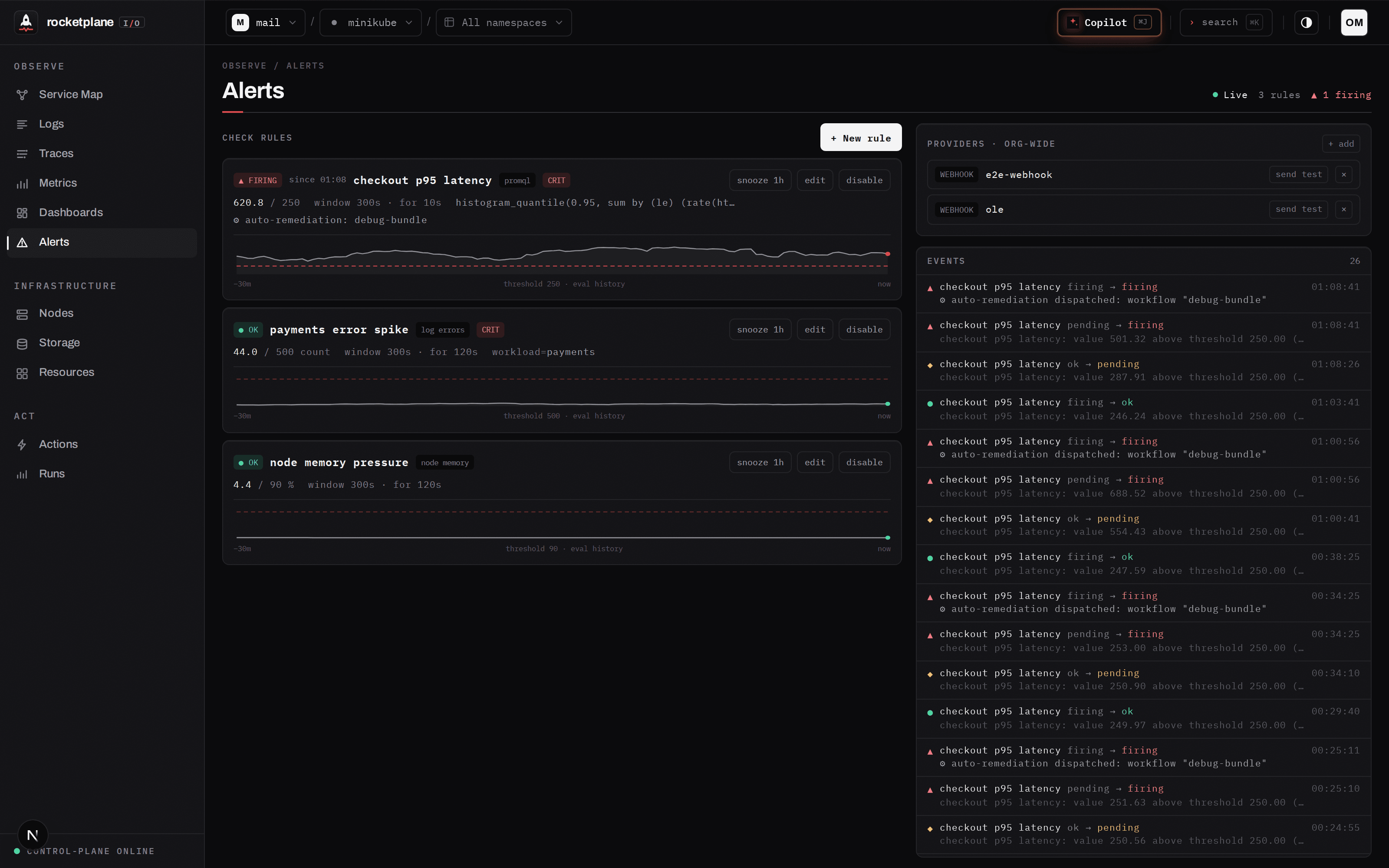 Alerts — typed checks or PromQL conditions with
 for-durations and
sparklines. A firing rule can dispatch a remediation workflow: once per transition, fully audited,
still subject to verify-or-rollback.
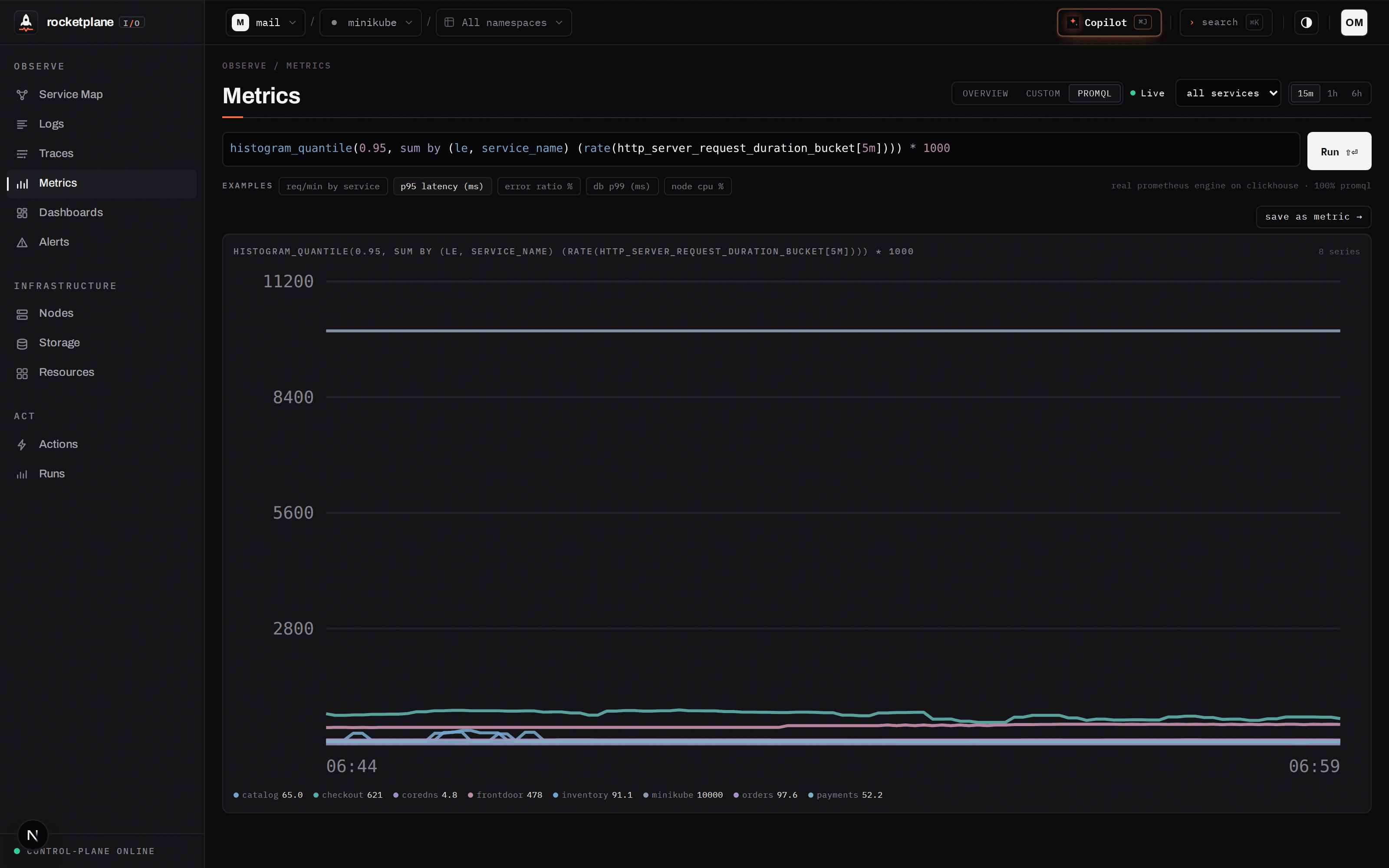 PromQL — the actual Prometheus evaluation engine, embedded and pointed at ClickHouse
(internal/promqlx); editor built on
codemirror-promql. Custom metrics are named PromQL expressions, validated at save.
PromQL — the actual Prometheus evaluation engine, embedded and pointed at ClickHouse
(internal/promqlx); editor built on
codemirror-promql. Custom metrics are named PromQL expressions, validated at save.
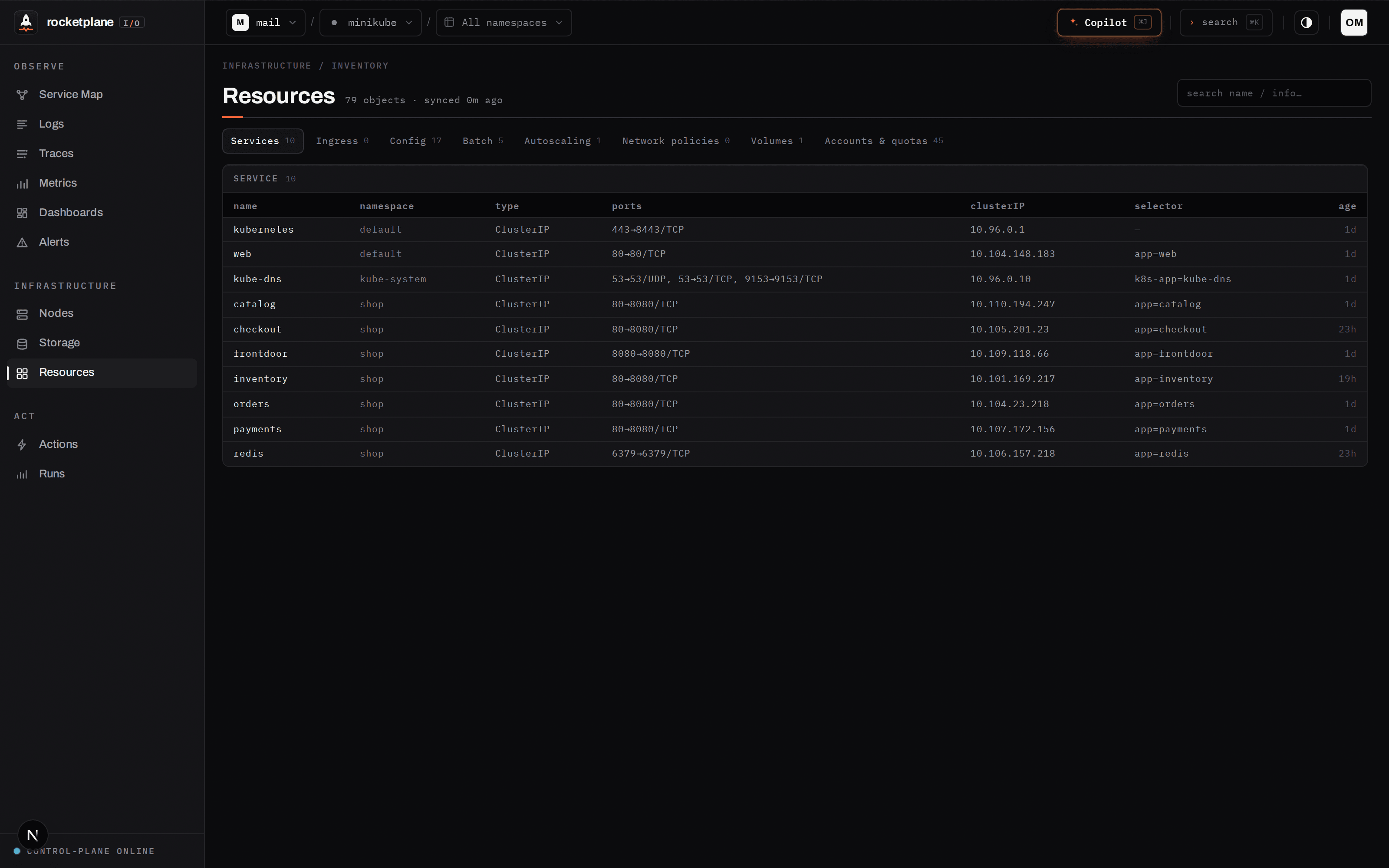 Resources — the complete cluster inventory (Services, Ingress, ConfigMaps, batch,
policies, volumes, quotas), synced every 60s. The same data an agent reads via
Resources — the complete cluster inventory (Services, Ingress, ConfigMaps, batch,
policies, volumes, quotas), synced every 60s. The same data an agent reads via
k8s_list.
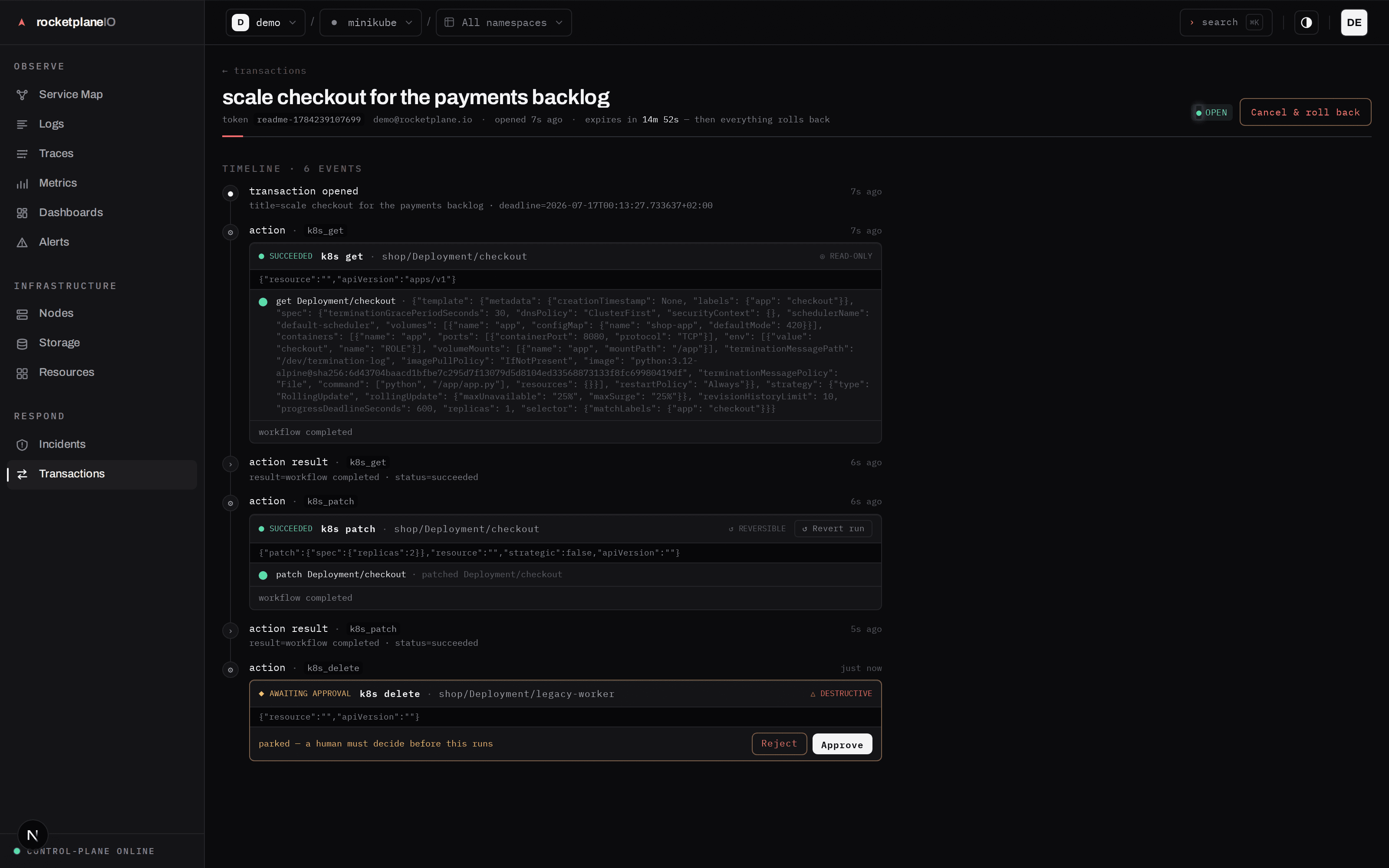 Approvals — a destructive operation proposed by an external agent parks as
awaiting approval; the agent waits, you decide. Approve releases it to the cluster,
reject cancels it — either way it's on the timeline forever.
Approvals — a destructive operation proposed by an external agent parks as
awaiting approval; the agent waits, you decide. Approve releases it to the cluster,
reject cancels it — either way it's on the timeline forever.
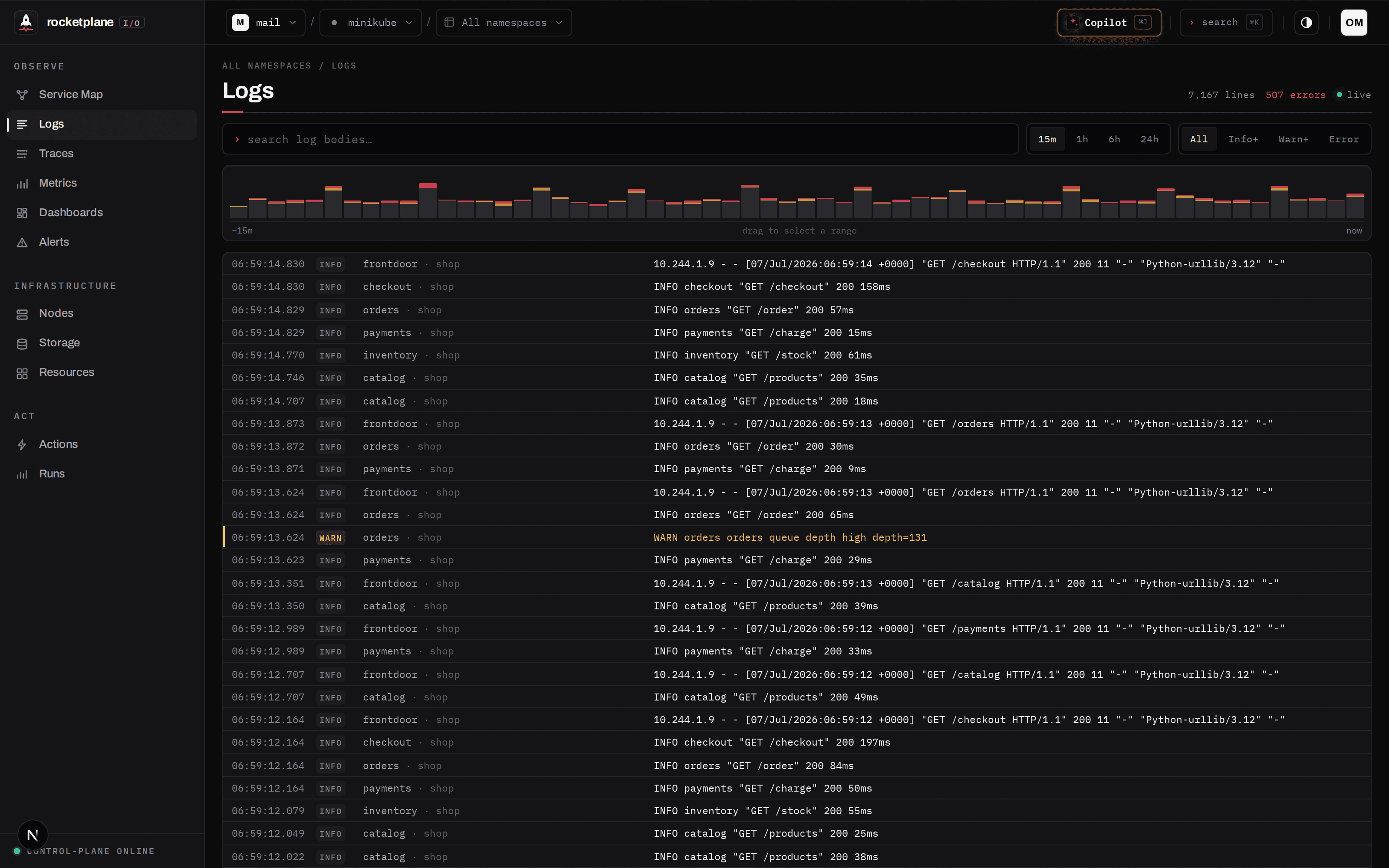 Logs — severity histogram, brushing, and the two-click path to the distributed
trace.
Logs — severity histogram, brushing, and the two-click path to the distributed
trace.
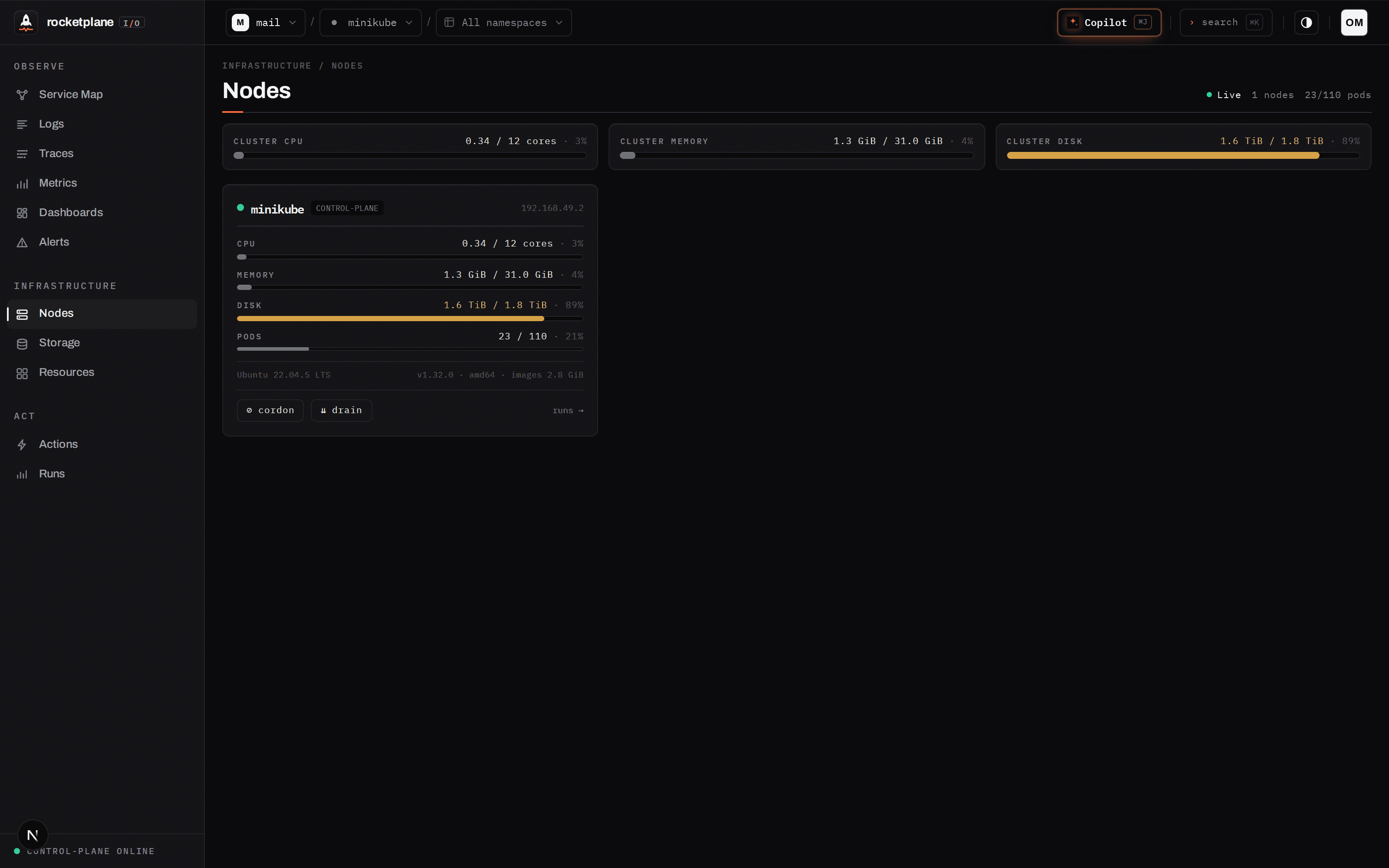 Nodes — kubelet-level stats for every node: CPU, memory, disk pressure and
schedulability at a glance.
Nodes — kubelet-level stats for every node: CPU, memory, disk pressure and
schedulability at a glance.
The UI follows a strict instrument-panel design system (RETICLE) — healthy is calm, only anomalies speak.
Under the hood
 YOUR CLUSTER   agent (Go, outbound-only, enumerated RBAC)      beyla eBPF DaemonSet
                topology · logs · inventory · action pipelines   HTTP/gRPC/Go · SQL/Redis/Kafka
                        │ HTTPS                                          │ OTLP
                        ▼                                                ▼
 CONTROL PLANE  control plane (Go, single binary)                OTel collector → ClickHouse
                MCP endpoint (Streamable HTTP) · transactions + approval gate
                API · auth/orgs · alert evaluator · operation queue · rollback reaper
                embedded Prometheus engine (PromQL → ClickHouse) · SSE broker
                        │
 DATA           PostgreSQL (state, rules, transactions, runs)  ·  ClickHouse (logs, traces, metrics)
 ACCESS         web (Next.js) — service map · transactions · logs · traces · metrics · alerts · incidents
The MCP endpoint lives in the control plane (/mcp/orgs/{org}/clusters/{cluster}, Streamable
HTTP, stateless — no sticky sessions across replicas). Read tools cover logs, traces (incl.
single-trace waterfalls and trace↔log correlation), PromQL, the service map and any Kubernetes
object; the mutating tools are the transaction-gated primitives above. Auth is a bearer API
token; every tool call reuses the exact HTTP handlers, validation and RBAC the browser uses.
Monorepo layout
├── agent/                      # in-cluster agent (Go): sync, logs, inventory, snapshot substrate + generic restore
├── services/controlplane/      # control plane (Go): API, auth, alerts, MCP endpoint, PromQL engine
│   └── internal/
│       ├── api/                #   REST + SSE + mcp_* (Streamable HTTP, tools, transactions, approvals)
│       ├── promqlx/            #   embedded Prometheus engine on ClickHouse
│       └── alerts/ · telemetry/ · events/ · store/ · migrations/
├── apps/web/                   # Next.js UI (RETICLE design system)
└── deploy/                     # compose (platform + dev stores), helm chart, install.yaml, demo shop
Develop from source
Prereqs: Go 1.25+, Node 22+ with pnpm, Docker.
git clone https://github.com/olemeyer/rocketplaneIO && cd rocketplaneIO

docker compose -f deploy/compose/docker-compose.yml up -d          # dev data stores + collector
go run ./services/controlplane/cmd/controlplane                    # control plane on :8090
cd apps/web && pnpm install && pnpm dev                            # UI on :4173
Building the platform images yourself (what CI publishes):
docker build -t rocketplaneio/controlplane -f services/controlplane/Dockerfile .
docker build -t rocketplaneio/web          -f apps/web/Dockerfile .
docker build -t rocketplaneio/agent        -f agent/Dockerfile .
Status
| Works end-to-end today | On the roadmap |
|---|---|
| eBPF traces incl. compiled Go, log→trace correlation | Tagged releases + platform Helm chart |
| Live service map, PromQL + custom metrics on ClickHouse | Hosted demo |
| Full K8s inventory, alerts with auto-remediation | Production-scale overhead benchmarks |
| MCP endpoint: transactions, classification, approval gate | Multi-user RBAC hardening |
| LIFO snapshot rollback on cancel/expiry — CRDs included | Namespace-scoped transaction policies |
| Transaction timeline, revert at run and transaction level | |
Published multi-arch images (edge) + agent install.yaml |
Contributing
Reports from real clusters are the contribution we want most — open an issue. See CONTRIBUTING.md. If this resonates, a star helps others find it.