qm
A multiplayer agent harness for work. In Slack and on the web.
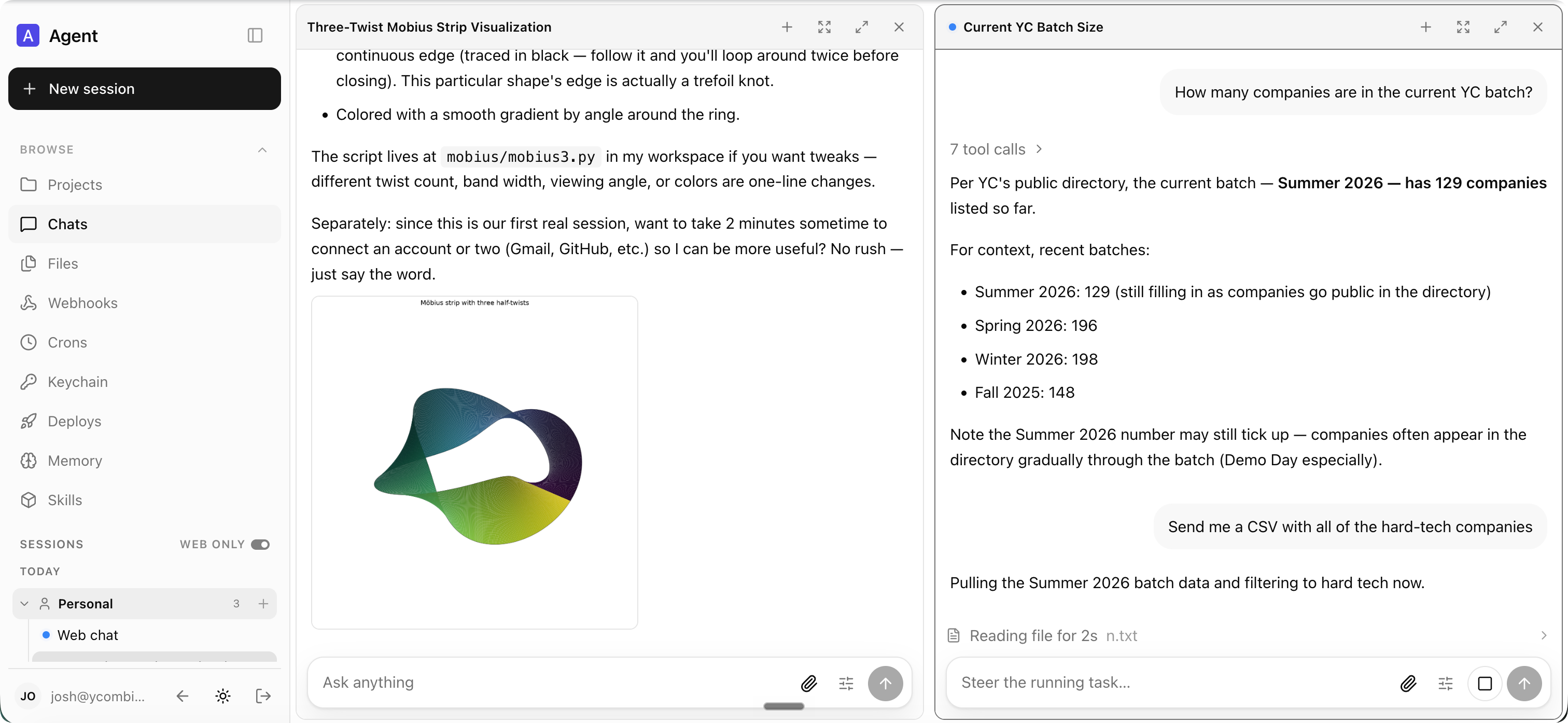
Setup
Tell your coding agent of choice Let's deploy https://github.com/yc-software/qm. From here, it should follow the deployment guide in this repo.
What is QM?
Most agents are designed like personal assistants. You can make one work for a whole company, but it quickly gets complex. QM is designed for startups. Employees each get their own isolated workspace and work independently without affecting each other, and they can also collaborate with the agent in channels, group messages, and projects.
Each person and each room has its own scoped memory, files, keychain view, permissions, crons, web apps, and durable sandbox.
It's built with open source in mind. Pick your own harness and model and switch between them — Pi, OpenCode, Codex, and Claude Code all drive the same core, so a deployment isn't tied to any single vendor.
Features
- Personal and shared scopes. People customize the agent to be theirs, and still work with it collaboratively in Slack channels and projects.
- Slack and web. The same identity and configuration carries between Slack and the web app.
- Admin control. Set org-level configuration, a security posture, and which harnesses and models are available.
- Web apps. Spin up custom internal apps and publish them to the right people.
- Shared skills. Skills are scope-owned and shareable by grant, with admin-gated promotion to the whole org and skill packs imported from git repositories.
- Background work. Crons, watches, and inbound webhooks run work while nobody's watching.
What you can do with it
- Search internal notes, email, documents, databases, and the web together
- Retrieve information from your company brain
- Build internal apps, publish them to the right people, and keep their data current
- Learn your writing voice from past sends, then triage your inbox on a schedule — labels and reply drafts included
- Work in an existing repository: run tests, open PRs, monitor CI, check system logs
- Track a project in a shared channel and post updates and follow-ups
Architecture
flowchart LR
  DB[("Postgres<br/>sessions · memory · queue")]

  subgraph CORE["Headless core"]
    API["API · identity · policy · scheduler"]
    LOOP["Agent loop<br/>(Pi, OpenCode, Claude Code)"]
    API <--> LOOP
  end

  SBX["Per-scope sandbox<br/>files · tools · logged-in services"]

  DB <--> API
  LOOP <--> SBX
Every turn runs through a central core, which can use a variety of models and harnesses
to generate the response. A Postgres persistence layer holds user data, session history,
and other durable state. The agent has a small, fixed tool surface; one of those tools is
execute, which runs commands in the scope's own isolated sandbox — its durable computer,
where installed tools stay installed. The web UI, the admin panel, and the public portal
are optional plugins over the core's HTTP API;
Slack is an optional in-process plugin that core starts
and supervises through a direct service client.
The core runs TypeScript directly on Node and uses Fastify for HTTP. The Slack plugin uses Bolt; the web UI builds with Vite and renders with Lit.
The core itself is generic. Everything specific to one company — org config, custom tools
and skills, sandbox image, infrastructure — lives in a deployment directory that the
qm CLI validates and deploys. Every substrate (harness, session
store, sandbox, memory) sits behind an interface, so production implementations swap in
via one wiring file.
Security and secrets
QM's approach follows local coding agents like OpenCode, Codex, and Claude Code: the agent acts as the person it's working for, with their credentials and permissions, and everything it does is audited. An org picks one security posture, which narrower scopes can only tighten:
- Strict — every harness tool call pauses for human approval, except the two no-effect turn enders.
- Auto (default) — a classifier screens provenance-labelled external data and tool results before they reach the model; a deployment can point that at its own screening proxy.
- Dangerous — no content screening, no pauses between tool calls.
The predeclared command policy — approval rules and hard denials for things like recursive deletes or destructive SQL — applies in every posture, Dangerous included.
SECURITY.md has the threat model, the operator assumptions, and the
known limitations.
Deploy it for your org
Create an organization-owned deployment repository that depends on @yc-software/qm:
npm exec --yes --package=@yc-software/qm@latest -- \
  qm init . --org <slug> --target <fly-or-aws>
npm install
Initialization materializes a deployment skill for an agent and walks through
infrastructure, web sign-in, connector credentials, optional Slack access, deployment,
and live verification — no source checkout required. Each deployment runs in the
operator's own cloud account; initialization does not generate or enable deployment CI,
and this repository has no production deployment workflow. See
deployment.md for the details.
Contributing
We take contributions as human-written text, not code — see
CONTRIBUTING.md. Describe the change you'd like informally in a
.txt or .md file in adrs/, and if we're aligned we'll handle the
implementation. Report vulnerabilities privately — see SECURITY.md,
not a public issue.
Customize your instance
The deployment repository above carries config and a sandbox layer, and never needs a source checkout. Some organizations want the opposite trade: the whole codebase in one place, so engineers and coding agents read core and customizations together, while the customizations themselves stay private. For that, keep a private fork: a standalone private repository whose history begins as a clone of qm and whose core stays identical to upstream.
Populate it once, then clone it to work in:
gh repo create <org>/qm-private --private

git clone --bare git@github.com:yc-software/qm qm-seed.git
git -C qm-seed.git push --mirror git@github.com:<org>/qm-private
rm -rf qm-seed.git

git clone git@github.com:<org>/qm-private
git -C qm-private remote add upstream git@github.com:yc-software/qm
Create the private fork with a plain clone, as shown above, and never with GitHub's fork feature. The word "fork" here names the concept — a downstream copy that diverges deliberately and merges from upstream — not GitHub's Fork button. A GitHub fork inherits the visibility of the repository it came from, so a fork of a public repository cannot be made private. A GitHub fork also shares one object network with the repository it came from, so commits pushed to the fork stay fetchable by SHA from the public side. Many organizations disallow forking private repositories as well. A plain clone has none of these problems, and it costs one thing: the clone is an ordinary repository, so upstream's CI workflows run live in your own account. Expect to supply the secrets those workflows need, or disable the ones you do not want running.
Everything specific to your organization goes in deploy/layers/<org>/ — config, sandbox
tools and skills, plugin images, infrastructure — in the same shape qm init produces. See
deploy/layers/README.md. Core stays byte-identical to
upstream, which is what keeps merges small.
Two skills maintain the boundary in both directions. update-qm merges upstream qm into
the private fork and opens the sync PR; upstream-pr sends an organization-agnostic fix back to
qm, cutting the branch from upstream/main and checking the outgoing diff, commit
messages, and screenshots for organization identifiers before it pushes. Nothing under
deploy/layers/ ever travels upstream.
Going deeper
docs/getting-started.md— first run, end to endcli/README.md— theqmCLI and the deployment directory contractdocs/deploy-directory.md— the deployment directory in full.env.example— every knob, documented in placeplugins/— the surfaces (Slack, web UI, admin, portal)
License
Except where otherwise noted, QM is available under the MIT License.