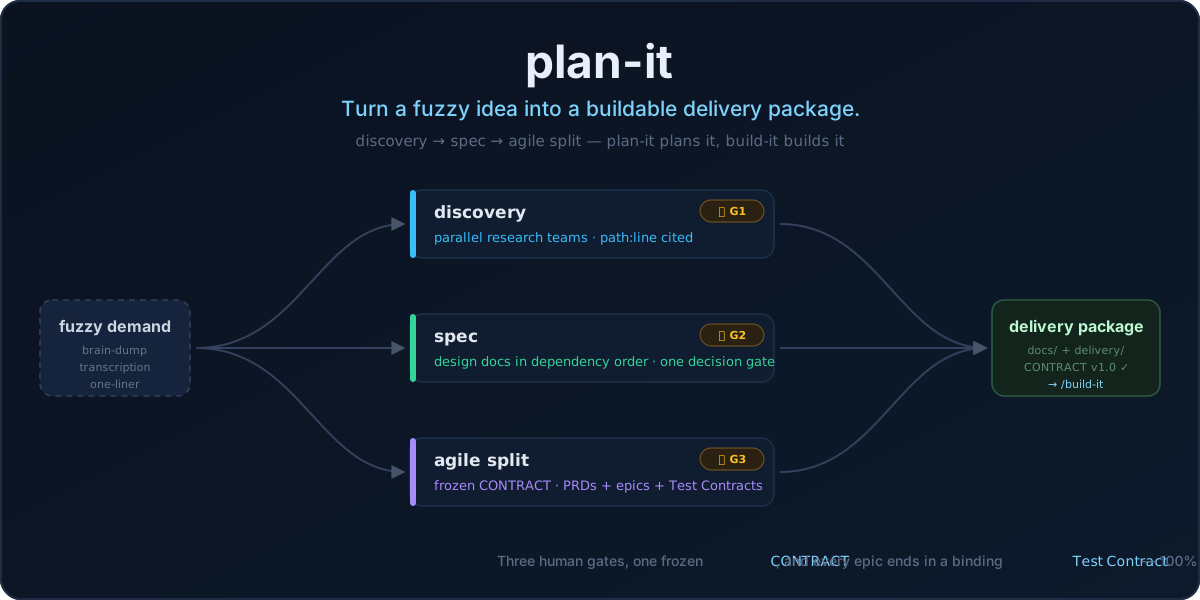
plan-it
Turn a fuzzy idea into a buildable delivery package.
Hand it a brain-dump, a transcription, or a one-liner.
Get back specs, PRDs, epics — and a binding Test Contract per epic.
The planning front-end to /build-it: plan-it plans it, build-it builds it.





Install · Why · How it works · The Test Contract · What's inside · Platforms
[!NOTE] Built for agentic delivery — the disciplined front-half of the lifecycle that ends exactly where an autonomous build agent begins.
Everyone has learned that agents can build. What still fails, quietly and expensively, is the step before: turning "here's roughly what I want" into something an agent can build unattended. Paste a fuzzy idea straight into a build agent and it invents the missing decisions, greenfields code that already exists, builds one component against a schema another component doesn't share, and reports "done" on work nobody defined a test for.
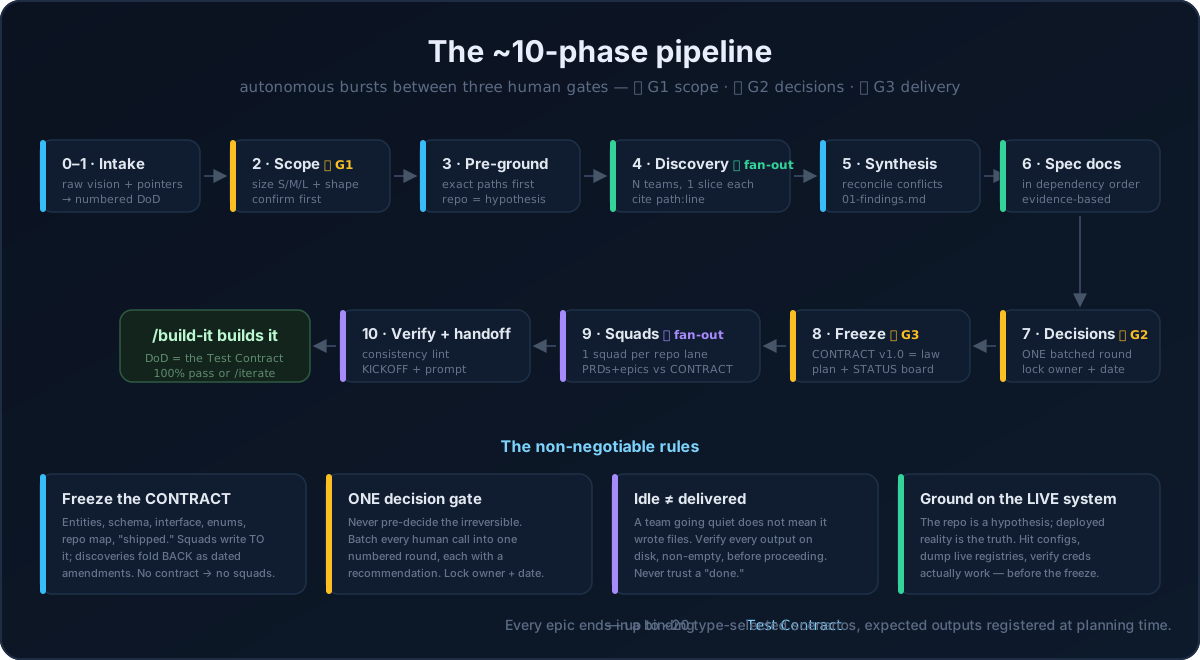
plan-it is that missing step, packaged as one command. It runs a ~10-phase discovery → spec → agile-split pipeline: it pre-grounds itself in your actual codebase (and the live system, not just the repo), fans out parallel research teams that must cite path:line for every claim, authors the design docs in dependency order, pauses at one batched human-decision gate, freezes a shared CONTRACT, then fans out squad teams to write PRDs + epics against it — each epic ending in a binding Test Contract the build must pass 100% before "done."
The bottleneck it kills
You describe a feature in three paragraphs and dispatch an agent overnight. In the morning: it picked a database schema in one file and a different one in another, "rebuilt" a service that was already deployed, made four irreversible architecture calls you never saw, and its report says everything works — verified against mocks it wrote itself.
None of that is a capability problem. It's a planning problem: no frozen contract for parallel work to agree on, no single gate where the human injects the decisions only a human can make, and no pre-registered definition of what "working" even means. plan-it fixes all three structurally — with a frozen CONTRACT.md that squads write to, one numbered decision round with a recommendation attached to every item, and a Test Contract authored at planning time, so the build agent inherits its Definition of Done instead of improvising one.
Installation
plan-it ships as both a Claude Code plugin and a portable SKILL.md (the workflow, on any agent). Pick your tool.
[!TIP] Universal installers understand the
SKILL.mdstandard and drop the skill into the right place for 70+ tools — use these if your agent isn't listed below:npx skills add DevOtts/plan-it -a <agent> # e.g. -a cursor, -a codex ; add -g for global gh skill install DevOtts/plan-it # GitHub CLIPeek first with
npx skills add DevOtts/plan-it --list.
Claude Code · native
# 1. Register the marketplace
/plugin marketplace add DevOtts/plan-it

# 2. Install the plugin (plugin-name@marketplace-name)
/plugin install plan-it@devotts
Then invoke it with /plan-it <your idea, brain-dump, or transcription>. On
Claude Code the skill can also drive the Agent tool for its research and
squad fan-outs — the full parallel experience. (Skills-CLI alternative:
npx skills add DevOtts/plan-it -a claude-code.)
Cursor
npx skills add DevOtts/plan-it -a cursor # add -g for a global install
Codex · OpenAI Codex CLI
npx skills add DevOtts/plan-it -a codex
# or:  gh skill install DevOtts/plan-it
VS Code + GitHub Copilot
npx skills add DevOtts/plan-it -a github-copilot
Others · OpenCode · Windsurf · Zed · Gemini CLI · Cline · Amp · Warp …
npx skills add DevOtts/plan-it -a <agent>
Run npx skills add DevOtts/plan-it --list, then target your agent.
[!NOTE] On agents without a subagent/team mechanism, the fan-out phases degrade gracefully to sequential research — same pipeline, same gates, same artifacts, just slower. See docs/installation.md.
How it works
Three autonomous bursts, three human gates, one frozen contract.
  /plan-it  ─────────────►  docs/ + delivery/  ─────────────►  /build-it
  (discovery → spec → plan)   (the buildable package)            (builds it)
- Intake & DoD lock (Phases 0–1). Accept the demand in any form — brain-dump, transcription, one-liner, pointers to sessions and repos. Restructure it into a numbered, individually verifiable Definition of Done for the planning job itself.
- Scope governor (Phase 2, ⏸ G1). Pick size (S/M/L) and shape (from 5+ packaging shapes: multi-doc program, single-file PRD, research→locked-architecture, numbered PRD platform, refactor catalog…). A feature doesn't get a 4-squad org; a brownfield refactor doesn't get a greenfield vision doc. Confirm before burning effort.
- Pre-ground + discovery (Phases 3–5). Locate exact paths first, then fan out
parallel research teams — one non-overlapping slice each, every claim cited to
path:line, findings staged to disk immediately. For plans touching a running system, ground against the live system, not the repo: hit configs, dump live registries, verify credentials actually work. Contradictions get adjudicated, not averaged. - Spec authoring (Phase 6). Design docs in dependency order — findings → vision & architecture → data contract → components → roadmap. Never greenfield when code exists; every doc maps what's already built and how to promote it.
- The decision round (Phase 7, ⏸ G2). Every judgment call a human must make — repo topology, hosting, naming, build-vs-buy — batched into one numbered round, each with a recommendation attached. Answers get locked into the docs with owner + date.
- Freeze & fan out (Phases 8–9, ⏸ G3). Freeze
delivery/CONTRACT.mdv1.0 — canonical entities, schema, interface, enums, repo map, the definition of "shipped." Then one squad team per repo lane writes PRDs + epics against it. Cross-cutting discoveries fold back as dated amendments (v1.0 → v1.1), so squads can't drift. - Verify + handoff (Phase 10). A consistency lint (counts add up, every goal
has a test, IDs coherent across files), then the package:
KICKOFF.mdplus the exact copy-paste launch prompt for the build agent.
Five rules are enforced, not suggested: freeze the CONTRACT before parallel work · batch human decisions into ONE gate · idle ≠ delivered — verify every agent's output on disk · ground on the live system before the freeze · run the machine, not the prose. Full methodology in docs/methodology.md.
The deterministic core (v2)
v1's control flow lived entirely in prose — the exact "prose control flow" failure mode David Khourshid names in Beyond the Prompt: Goodbye Slop, Welcome Determinism: step-by-step instructions in markdown that you hope the agent follows, and sometimes it won't. v2 applies his "deterministic core, agentic shell" pattern to the pipeline itself:
| Piece | What it is |
|---|---|
machine.json | The pipeline as an explicit XState v5-compatible statechart — 15 states, 3 human gates, guarded transitions, an amendment self-loop. Paste it into stately.ai/viz to see it. |
.plan-it/state.json | Every run persists its position: current state, gate approvals (owner + date), contract version, verified-artifact registry. Crash, compaction, or a fresh session → resume from the machine, not the transcript. |
scripts/gate-check.mjs | The guards as exit codes (zero-dep Node): verify (idle ≠ delivered), freeze (no contract → no squads), handoff (consistency lint), state (gates recorded). A non-zero exit blocks the transition. |
The fuzzy phases — discovery, synthesis, authoring, judgment — stay LLM-at-the-node. Non-determinism at the edges, determinism at the core. And the same discipline flows into what plan-it plans: every confusing workflow found in discovery must get an explicit model in the CONTRACT ("Core-logic models"), so the build agent inherits structure instead of prose. On agents that can't run Node, everything degrades to plain JSON files and manual checks — the script is an accelerator, not a dependency.
v2.1 goes one step further on Claude Code plugin installs: a PreToolUse
hook (scripts/hooks/planit-guard.mjs) hard-blocks writes to PRD/epic
deliverables while the run's CONTRACT is unfrozen — the rule stops being an
instruction the model follows and becomes something the harness refuses, with
the deny reason (and the fix) returned to the model. Fail-open by design: it
never interferes with non-plan-it work.
The Test Contract
The single thing that most raises delivered code quality: every epic ends by generating its own test contract — up to ~20 concrete, type-selected use-cases/scenarios with expected outputs registered at planning time — and the feature is not "done" until 100% of them pass.
| Implementation | Test types the contract selects |
|---|---|
| CRUD / REST API | use-cases (happy + edge) + e2e, via API and UI |
| Skill / prompt / LLM function | use-cases with expected output — real vs expected |
| Agent / stateful / multi-step | stress scenarios: async, fan-out, escalation, recursion |
| Pure logic / library | unit + property-based invariants |
| Data pipeline / migration | golden values + idempotency/rollback |
| Load/abuse surface | stress / adversarial |
This is Specification by Example (Gojko Adzic) + ATDD/BDD for code, and
Eval-Driven Development for LLM features — authored at planning time so the
cases are a binding contract, not an afterthought. And it's the bridge to the
build: /build-it's Definition of Done is this contract. No partial ship,
no VERIFIED-on-a-mock — a case whose real target is unreachable is reported
IMPLEMENTED-NOT-VERIFIED, never a fake green.
What's inside
| Component | Role |
|---|---|
plan-it skill | The ~10-phase pipeline: intake, scope governor, pre-grounding, discovery fan-out, spec authoring, decision gate, contract freeze, squad fan-out, lint + handoff. |
machine.json | The pipeline's explicit statechart (XState v5-compatible) — the source of truth the skill prose explains. |
scripts/gate-check.mjs | Executable guards: verify · freeze · handoff · state. Exit code decides whether the pipeline advances. |
hooks/ + scripts/hooks/planit-guard.mjs | v2.1 hard enforcement (plugin installs): a PreToolUse hook that denies PRD/epic writes while the run's CONTRACT is unfrozen. Fail-open — never touches non-plan-it work. |
references/machine.md | The deterministic core explained: state-file schema, resume protocol, degrade-gracefully rule. |
references/templates.md | Doc + delivery skeletons, and the 5+ packaging shapes with the use-case→shape map. |
references/formats.md | The composable atomic formats: decision log, governance blocks, the 4 test-case grammars, test-tier matrix, DoD ladder, honest run-report. |
references/playbooks.md | Advanced moves: discovery modes, brownfield/refactor templates, scale-out batch PRD generation, the executable GitHub-board split. |
The output of a run is a package your build agent consumes:
docs/                          delivery/
  01-current-state-and-findings  CONTRACT.md      ← frozen v1.0, the law
  02-vision-and-architecture     00-program-plan.md
  03-data-model-and-contract     STATUS.md        ← the live board
  0N-…                           prds/prd-N-*.md
                                 epics/epics-N-*.md  ← each ends in a Test Contract
                                 KICKOFF.md + launch prompt
plan-it × build-it
They're two halves of one lifecycle, designed to compose:
plan-it | build-it | |
|---|---|---|
| Job | discovery → spec → agile split | goal + DoD → verified delivery |
| Runs | guided, with 3 human gates | unattended, overnight |
| Output | the delivery package + launch prompt | working code + honest per-criterion report |
| The bridge | authors the Test Contract | adopts it as its Definition of Done |
Each also works standalone: plan-it's package is plain markdown any agent (or
human team) can execute; build-it accepts any well-formed goal + DoD.
The third leg — review-it: plan-it
plans, build-it builds, review-it verifies. The Test Contract plan-it authors
per epic is exactly what review-it's contract-qa mode runs against the finished
build — independent verification with an 11-rule gate catalog (no self-graded
green), closing the plan → build → review triangle.
Status
3.0.1 — packaging patch: the plugin now installs from the shared DevOtts
marketplace (/plugin install plan-it@devotts, alongside build-it) and the
version is bumped to 3.0.1 for parity. No pipeline or enforcement changes.
3.0.0 — the field-hardened core line and the public debut of v3. Where v2
made the pipeline deterministic (2.0.0 explicit statechart with persisted run
state + executable gate guards; 2.1.0 hard gate enforcement via a PreToolUse
hook on Claude Code plugin installs — see
The deterministic core), v3 makes the delivery
package hard to fake: every mechanism below ships as a machine-checked
invariant with a binding Test Contract case, and all v3 verbs/states are strictly
additive over v2 (verified by gate-check machine-diff against the v2
baseline). Three layers land together in this debut:
- Enforcement floor — the founder mandates (FD-1 test-convention discovery + registration; FD-2 pre-freeze case review) and six write-time invariants: W1 contract hygiene, W2 environment preflight (ENV-FACTS probe manifest), W3 model-tier enforcement (no hardcoded model IDs), W4 status vocabulary, W5 computed-never-typed tallies, W6 kickoff pinning + packaging parity — plus mirror integrity across the root↔plugin tree.
- Enforcement reach — running v3 against a real external project (not plan-it's own dogfood) surfaced two silent freeze-guard bypasses; both are closed fail-closed (E1 freeze checks key off a discoverable run root, not an invocation flag or the dogfood path; E2 the inline-code stripper handles line-wrapped spans), with the protected v2 core still byte-identical.
- Adversarial depth (D4) — the crown-jewel dimension. A new
adversaryverb, wired as a hard gate (adversaryGatebetweenverifyandhandoff), makes Test-Contract failure-mode depth an exit code, not prose: it demands modeled failure states (D-A1), recovery transitions (D-A2), failure states asserted as cases (D-B1), test-hooked governance rules (D-B2), and five cascade classes each covered-or-waived (D-B3). A genuinely linear/CRUD contract declares no state machine and the gate is N/A — no over-reach; silent absence fails closed. In a blind head-to-head against a v2-authored package (same fuzzy brief, same model, labels swapped across two judges + an adversarial checker), v3 wins D4, 5 vs 3 — breaking the prior tie on the exact dimension this line targets.
The underlying pipeline, gates, packaging shapes, and Test Contract discipline
are unchanged from 1.0.0 and were reverse-engineered from real multi-squad
planning runs — including the live-grounding rules, which trace one-for-one to
failures where a repo-derived assumption contradicted the deployed system.
Validate locally before relying on it:
claude plugin validate .                    # the marketplace
claude plugin validate ./plugins/plan-it    # the plugin
Security considerations
- No secrets to install or run. The skill reads your repo and writes markdown.
- Live-grounding checks credentials work — it never stores them. Findings reference where a credential lives, not its value.
- Everything it produces is plain markdown in your repo, reviewable and diffable before any build agent touches it.
Platform compatibility
The pipeline is a SKILL.md, so it installs anywhere the open
Agent Skills standard reaches.
| Platform | Status | What you get |
|---|---|---|
| Claude Code | ✅ Native | Plugin: the skill + parallel research/squad fan-outs via the Agent tool |
| Cursor | ✅ Supported | Skill; fan-outs degrade to sequential research |
| VS Code + GitHub Copilot | ✅ Supported | Skill; sequential mode |
| Codex | ✅ Supported | Skill; sequential mode |
| OpenCode · Windsurf · Zed · Cline · Amp · Warp · Gemini CLI · …50+ | ✅ Supported | npx skills add DevOtts/plan-it --list |
Legend — ✅ Native: full parallel experience with subagent fan-outs. ✅ Supported: same pipeline, gates and artifacts; research runs sequentially where the host has no subagent mechanism.
License
MIT — see LICENSE and plugin.json. Use it, fork it, ship with it.
Built by DevOtts.