Pad
Project Management for the agent era.





Website · Docs · Blog · Changelog · Reddit · X · Bluesky
One binary. Local-first. No accounts required. Pad gives you a CLI, a web UI, and an AI agent skill — all backed by SQLite, all running on your machine. Your project data stays on your laptop — unless you take it to Pad Cloud.
Quick Start
brew install PerpetualSoftware/tap/pad
cd your-project
pad init                    # configure, auth, workspace, AI skill — all in one
pad server open             # opens the web UI at localhost:7777
pad init is the smart entry point — it auto-detects what's needed, walks you through each step, and is safe to re-run anytime (it skips finished steps and prints a status summary).
Then, in a fresh agent session in your project, say:
/pad onboard
Your new workspace ships with the canonical onboard playbook auto-activated. The agent walks an interview, inspects your codebase if it has shell access, and adapts your workspace's collections, conventions, roles, and playbooks to match the project. It's the fastest way to go from empty workspace to "okay, this is mine."
Why Pad?
Tools like Linear, Jira, and Notion are built for teams on the cloud. Pad is built for developers on their machine — and for the AI agents working alongside them. When you do want your projects on every device or a teammate on the board, Pad Cloud hosts the same product with sync, workspace invites, and role-based access.
| Pad | Linear / Jira | Notion | |
|---|---|---|---|
| Setup | pad init | Create account, invite team, configure | Create account, pick template |
| AI agents | Native /pad skill for 7+ tools | Third-party integrations | Third-party integrations |
| Data | Local SQLite you own — or opt-in Pad Cloud | Their cloud | Their cloud |
| Offline | Full functionality | Read-only cache at best | Limited |
| CLI | First-class | Afterthought | None |
| Price | Free, open source | Per-seat pricing | Per-seat pricing |
Features
For Developers
CLI that doesn't get in your way. Create tasks, search items, check status — without leaving the terminal.
pad item create task "Fix OAuth redirect" --priority high
pad item create idea "Real-time collaboration" --category infrastructure
pad item list tasks --status in-progress
pad item search "authentication"
pad project dashboard                   # Project dashboard
pad project next                        # What should I work on?
pad server info                         # How this client is connected to Pad
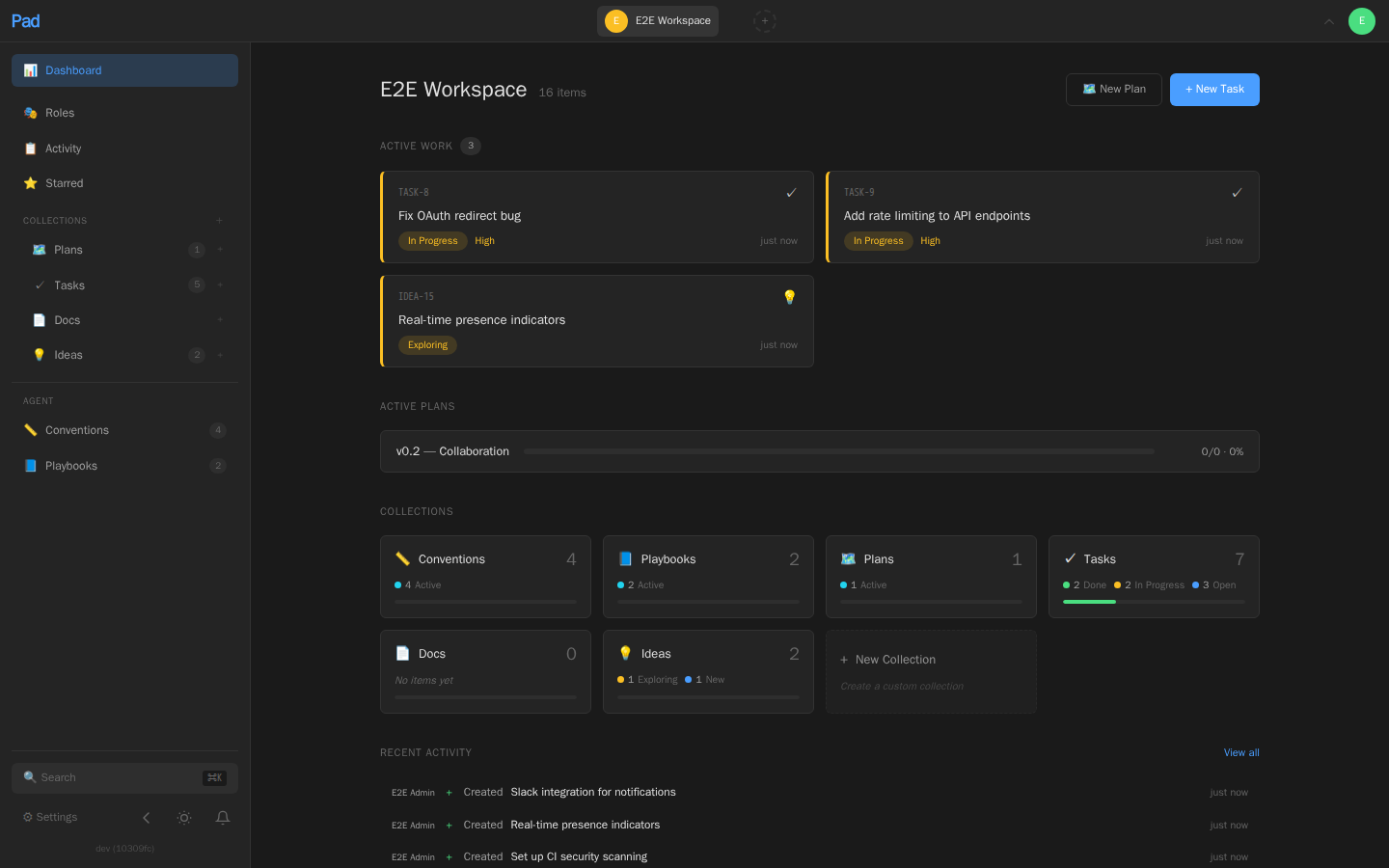
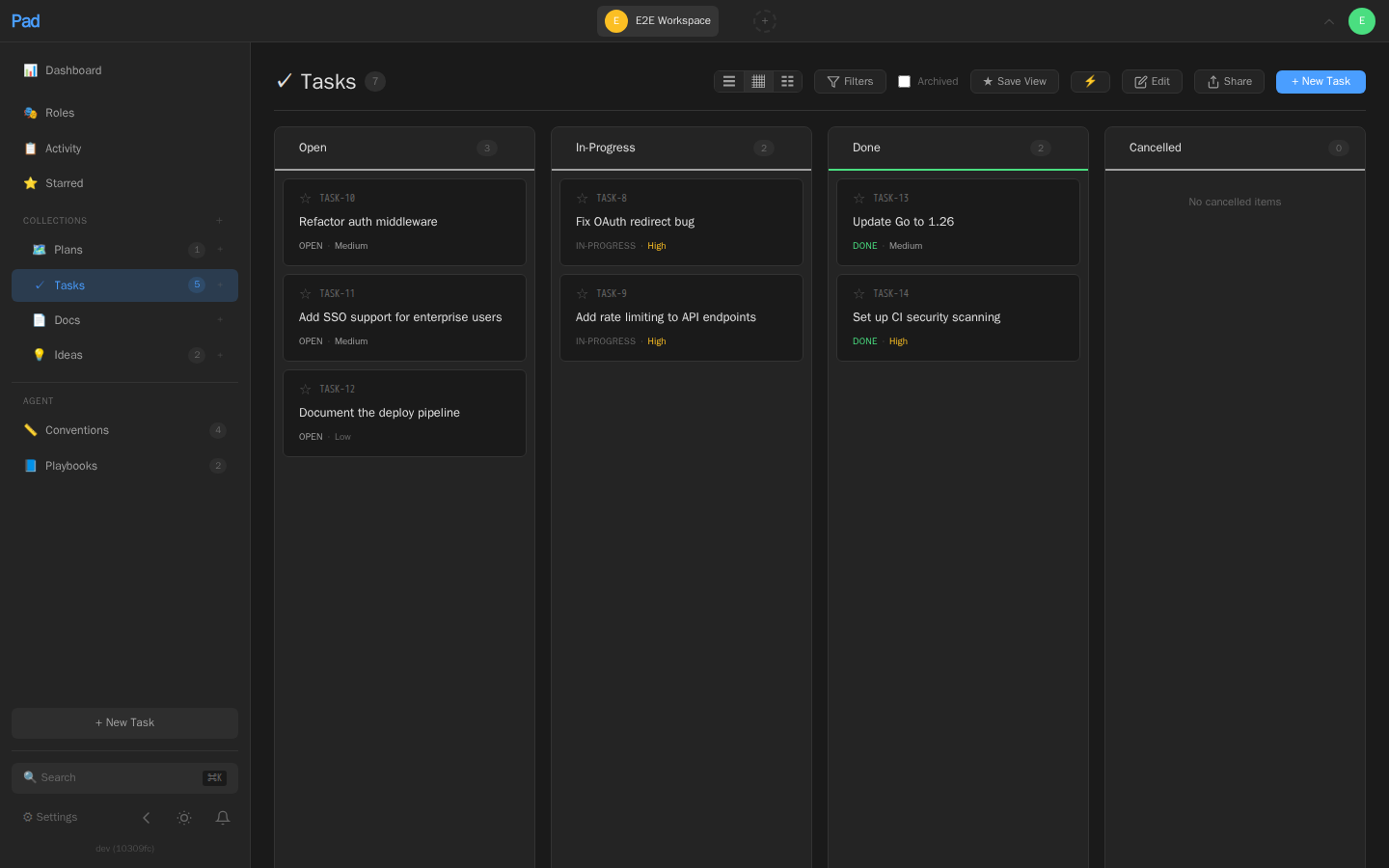
Web UI that stays out of your way. A clean, dark-themed interface at localhost:7777 with:
- Board, list, and table views — drag-and-drop between status columns
- Keyboard navigation —
j/kto move,Enterto open,Escto go back,Cmd+Kto search - Rich text editor — Tiptap-based with markdown, formatting toolbar, and auto-save
- Wiki-links — type
[[Title]]to link between items - Real-time updates — agent creates a task in the terminal, it appears in the browser instantly (via SSE)
- Dashboard — collection overview, active work, plan tracking, activity feed
For AI Agents
Your agent becomes a project partner. Install the /pad skill once, and your AI coding tool can read, create, and update project items through natural language.
pad agent install # Auto-detects your tools and installs the skill
Works with Claude Code, Cursor, Windsurf, Codex, OpenCode, GitHub Copilot, Amazon Q, and JetBrains Junie.
Then just talk to your project:
> /pad what should I work on next?
> /pad I finished the OAuth fix
> /pad create a task to add rate limiting
> /pad let's brainstorm about the API redesign
Conventions and playbooks teach agents how your project works:
- Conventions — trigger-based rules like "run tests before marking a task done" or "use conventional commits"
- Playbooks — multi-step workflows like "when implementing a feature: read the spec, create a branch, write tests first, then implement". Playbooks can declare a kebab-case
invocation_slugso users can invoke them directly:/pad ship PLAN-42,/pad release 0.5.0. Freshstartupworkspaces ship a genericshipplaybook out of the box.
pad item create convention "Run tests before completing tasks" \
  --field trigger=on-task-complete \
  --field scope=all \
  --field priority=must
Agents load relevant conventions automatically. All agent actions are attributed in the activity feed, so you always know what the AI changed.
Onboard agents to a new codebase:
Open an agent session in the workspace directory and run /pad onboard. The agent walks an interview, detects your build/test/CI tooling, and adapts your workspace's collections, conventions, roles, and playbooks to match the project. Works for any agent that speaks Pad — Claude Code, MCP-only agents, etc.
Collections & Custom Fields
Pad organizes work into collections — typed containers with structured fields.
Built-in collections:
| Collection | Purpose |
|---|---|
| Tasks | Work items with status, priority, assignee, effort, due date |
| Ideas | Feature ideas with impact and category |
| Plans | Project milestones with progress tracking |
| Docs | Documentation, decisions, reference material |
| Conventions | Project rules that guide agent behavior |
| Playbooks | Multi-step workflows for agents to follow |
Create your own with typed fields — select, text, date, number, url, relation, checkbox:
pad collection create "Bug Reports" \
  --fields "severity:select:low,medium,high,critical; browser:text; reproducible:checkbox"
Items get reference numbers automatically (TASK-5, BUG-12) and can be moved between collections with field migration.
Installation
Homebrew (macOS and Linux)
brew install PerpetualSoftware/tap/pad
Build from Source
git clone https://github.com/PerpetualSoftware/pad
cd pad
make build
cp pad ~/.local/bin/   # or /usr/local/bin/
Requires Go 1.26+ and Node.js 22+. Alternatively, nix develop provides a shell with the exact Go and Node versions pinned — see the Nix section below.
The go install github.com/PerpetualSoftware/pad/cmd/pad@latest path is not supported for the full Pad binary, because the web UI must be built and embedded during the source build.
Docker
docker run -p 127.0.0.1:7777:7777 -v pad-data:/data ghcr.io/perpetualsoftware/pad
This publishes Pad to localhost:7777 on the host machine, which is the recommended default for local use.
First run — create the first admin. Open http://localhost:7777 and you'll hit a setup page asking for a bootstrap token. On first start with no users, Pad logs a one-time setup URL to stderr (captured by docker logs) — grep it and open the printed link:
docker logs <container> 2>&1 | grep -A6 'Pad first-run setup'
# → http://<your-host>:7777/setup#token=<one-time-token>
Open that URL, create your admin account, and the token is consumed (the banner stops appearing). If you'd rather stay on the CLI, docker exec -it <container> pad auth setup works too — running inside the container counts as loopback, which the bootstrap gate allows. On a network you already trust, set PAD_BYPASS_SETUP_TOKEN=true to skip the token and create the admin straight from http://<your-host>:7777/setup (only safe when the port isn't reachable from the open internet).
Single user, more than one device? Publish to all interfaces so you can reach Pad from your phone, tablet, or another machine on the same LAN, Tailscale network, or home VPN:
docker run -p 7777:7777 -v pad-data:/data ghcr.io/perpetualsoftware/pad
For multi-instance deployments, Pad supports Postgres + Redis via docker-compose.yml — see docs/deployment.md for the full setup.
Nix
Run without installing:
nix run github:PerpetualSoftware/pad
Or install into your profile:
nix profile install github:PerpetualSoftware/pad
A flake devShell (Go, Node, and friends, pinned to the same versions CI uses) is also available for contributors:
nix develop
A
nixpkgspackage (nix-shell -p pad/environment.systemPackages) is planned but not yet merged upstream. Until then, use thegithub:PerpetualSoftware/padflake reference above.
Binary Download
Pre-built binaries for macOS, Linux, and Windows are available on the releases page.
Pad Cloud (hosted)
Don't want to run anything? Pad Cloud is the managed option — same product, same CLI, same /pad skill, free during beta. Sign up on the web, then connect a project directory:
pad init --url https://app.getpad.dev --workspace my-workspace
Self-hosting stays first-class: the binary is unchanged and no features are Cloud-only.
Upgrading Pad
Pad ships a new binary on a roughly weekly cadence. Upgrades are designed to be boring: install the new binary and restart. Database migrations run automatically at startup, only the ones your database is missing are applied, and each migration commits atomically (a failed migration rolls back cleanly and is retried next boot).
The one rule: only ever move forward. Newer binaries know how to migrate an older database; older binaries do not understand a newer schema. Since Pad added its schema-ahead guard, a downgraded binary that finds a database newer than itself refuses to start rather than silently running old code against a newer schema (which can corrupt data):
database schema is newer than this pad binary: ... This almost always means the
binary was DOWNGRADED (e.g. brew/docker rollback) ... Upgrade pad back to a build
that includes those migrations, or re-run with `pad start --force`.
To recover, reinstall the newer binary (brew upgrade pad, pull the newer Docker tag, etc.). If you have intentionally downgraded and accept the risk, start with pad start --force (or set PAD_ALLOW_SCHEMA_AHEAD=1) to override the guard.
Automatic pre-migration snapshot (SQLite). Whenever a SQLite-backed instance has pending migrations to apply, Pad first copies the database file to pad.db.pre-<version> next to it. If an upgrade ever goes wrong, stop the server and copy that snapshot back over pad.db. This is a convenience net, not a backup strategy — keep your own backups (see docs/backup.md). PostgreSQL instances are skipped here; use pg_dump or a provider snapshot before upgrading.
Recommended upgrade flow:
# 1. Back up first (SQLite shown; see docs/backup.md for Postgres)
pad db backup -o pad-backup-$(date +%Y%m%d).db

# 2. Stop the server, install the new binary, restart
#    (migrations + the pre-migration snapshot run automatically on start)
brew upgrade pad        # or: docker pull, binary download, make install

# 3. Confirm it's healthy
pad --version
curl -s localhost:7777/api/v1/health
Getting Started
1. Set up Pad
cd ~/projects/myapp
pad init "My App"
pad init is the smart entry point that handles everything in one command:
- Configures this client's connection (local server, remote, or Docker)
- Auto-starts the local server
- Creates the first admin account on a fresh local install (Docker / remote hosts run
pad auth setupon the server instead) - Logs you in if needed
- Creates or links a workspace for the current directory (writes
.pad.toml) - Installs the
/padskill for any AI tools detected in the project
Run from your project root. Safe to re-run anytime — it skips finished steps and prints a status summary if nothing's needed.
Choose a template with --template, or omit it for an interactive picker grouped by category (Software / People / …):
pad workspace init --list-templates                   # See the full catalog grouped by category
pad init "My App" --template scrum                    # Scrum-style with sprints
pad init "My App" --template product                  # Product management focused
pad init "My Hiring" --template hiring                # Company-side: requisitions, candidates, interview loops, feedback
pad init "Job Search" --template interviewing         # Candidate-side: applications, interviews, companies, contacts
pad init "My App" --template blank                    # Custom: system collections only — let /pad onboard build the rest
Pad ships templates for software (startup / scrum / product), people workflows (hiring, interviewing), and a custom blank template — system collections (Conventions, Playbooks) only, with the /pad onboard playbook as its sole seeded content. blank is the entry point for the agent-driven /pad onboard flow: it walks you through shaping collections, conventions, and roles to match your actual project. Reserved categories for research, content, operations, and personal use await their first templates, so the same project-management primitives fit well beyond code projects. There's also a hidden demo template — the startup layout pre-loaded with realistic sample data — that's kept out of the picker but can be built explicitly with --template demo.
2. Start working
# From the CLI
pad item create task "Set up CI pipeline" --priority high
pad item create idea "Add WebSocket support" --category infrastructure
pad project dashboard

# From the web UI
pad server open              # Opens localhost:7777 in your browser

# From your AI agent
# Just use /pad in Claude Code, Cursor, etc.
3. Teach your agents the rules
In an agent session inside the workspace:
/pad onboard
The agent walks an interview, detects your tooling, and adapts the workspace's collections, conventions, roles, and playbooks. To browse the library directly:
pad library list --type conventions  # Pre-built conventions you can adopt
pad library list --type playbooks    # Pre-built multi-step workflows
4. Optional — connect a desktop AI app via MCP
Pad ships an MCP (Model Context Protocol) server so Claude Desktop, Cursor, Windsurf, Claude Code, or Codex can manage items, plans, ideas, and dependencies as native tools, read workspace state by URL, and load multi-step workflows as prompts.
pad mcp install claude-desktop   # or: cursor, windsurf, claude-code, codex, --all
# Restart the client; pad shows up as the "pad" MCP server.
pad mcp install writes each client's native config: JSON mcpServers for
Claude Desktop / Cursor / Windsurf, a project-local .mcp.json in the current
directory for claude-code, and an [mcp_servers.pad] table in
~/.codex/config.toml (TOML) for codex. Because Claude Code's config is
project-scoped, it's install-on-request only — --all and pad mcp status cover
the per-user clients (including Codex) and skip it.
Tool catalog (v0.25) — ten resource × action tools plus pad_set_workspace (eleven total), no flat verb explosion. Undeclared input keys are rejected with a structured error rather than silently dropped. pad_item create/update accept field values as a fields object (the same shape reads return) as an equivalent to the dedicated params / field: ["key=value"]. pad_item.list accepts unparented: true (mutually exclusive with parent) to select items with no parent or implements relationship, and is summary-shaped by default on both transports (full: true opts into complete content bodies):
| Tool | Actions |
|---|---|
pad_item | create, update, delete, get, list, move, restore, link, unlink, deps, star, unstar, starred, comment, list-comments, backlinks, bulk-update, note, decide, export, import, history |
pad_workspace | list, members, invite, storage, audit-log, create, claim, deleted, restore |
pad_collection | list, create, update, delete |
pad_project | dashboard, next, ready, stale, standup, changelog, report, activity |
pad_role | list, create, update, delete |
pad_search | query |
pad_playbook | list, get, run |
pad_library | list, get, activate |
pad_attachment | list, show |
pad_meta | server-info, version, tool-surface, bootstrap |
pad_set_workspace | session-default workspace pinning (response embeds the bootstrap blob) |
Plus resources at pad://workspaces, pad://workspace/{ws}/dashboard,
pad://workspace/{ws}/items, pad://workspace/{ws}/items/{ref},
pad://workspace/{ws}/collections,
pad://workspace/{ws}/attachments/{id} (bounded image bytes),
pad://workspace/{ws}/bootstrap,
and pad://_meta/version.
Stability contract — two version constants, both advertised in the
initialize handshake under capabilities.experimental.padCmdhelp and
capabilities.experimental.padToolSurface (and queryable at
pad://_meta/version):
cmdhelp_version: "0.1"— CLI help-tree contract (used at dispatch time)tool_surface_version: "0.25"— MCP tool catalog contract (v0.5 addedpad_library; v0.6pad_item.backlinks; v0.7pad_itemexport/import; v0.8pad_workspacedeleted/restore; v0.9 madepad_item.listsummary-shaped by default with a default+max result cap; v0.10 enforced the draft-playbook gate server-side onpad_playbook.runwith anallow_draftescape hatch; v0.11 added the read-onlypad_attachmenttool (list/show); v0.12 addedpad_project.activity(agent-accessible non-streaming activity feed); v0.13 addedpad_projectready/stale(agent-oriented backlog + attention queries); v0.14 addedpad_itemhistory+ optimistic concurrency (TASK-2022); v0.15 added thepad_item.listunparentedparameter (TASK-2096); v0.16 made an empty-stringassigned_user_id/agent_role_idCLEAR the assignment instead of being silently dropped, so an agent can finally unassign an item (TASK-2571); v0.17 carried that to the LOCAL STDIO transport by teaching the CLI to lift those keys onto their columns instead of into the fields blob (BUG-2583); v0.18 addedclear_assigned_user/clear_agent_rolebooleans — the canonical, schema-discoverable way to unassign, backed by new--clear-assigned-user/--clear-agent-roleflags onpad item update(IDEA-2584); v0.19 added aclear_parentboolean — the canonical, schema-discoverable way to detach an item from its parent, backed by a new--clear-parentflag onpad item update(BUG-2078); v0.20 gave every tool an explicit annotation block derived from the catalog’s read-only knowledge — fully-read-only tools advertisereadOnlyHint: true/destructiveHint: false, all-additive-write tools (pad_workspace,pad_library) dropdestructiveHint, overwrite/delete-capable tools stay conservatively destructive,openWorldHint: falseeverywhere — replacing mcp-go’s defaults that marked every tool destructive (BUG-2302), and madepad_item.listsummary-shaped on the remote HTTP transport too, with a declaredfullboolean as the opt-in for complete bodies on both transports (BUG-2305); v0.21 boundedpad_item.history, which was unbounded on every surface —limitnow covers it (default 50, max 300, the NEWEST N; nooffset, because reverse-patch storage makes only a newest-end window cheap), applied in the catalog action so it lands on both transports, and summary mode now asks the server to skip patch resolution rather than resolving bodies the dispatcher discards (BUG-2608); v0.22 stoppedpad_item.movedestroying an item’s system metadata — implementation notes, decision log, linked PR and convention data now survive a move, any field the destination schema has no home for is REPORTED in the move’s activity entry rather than vanishing, and afieldsetter naming one of those reserved keys is refused withmalformed_overrideinstead of writing it (BUG-2674); v0.23 closed the same door on the ordinary update — afieldsetter namingimplementation_notes,decision_logorconventionis now refused on every transport at once (validation_erroron HTTP, surfaced to MCP clients asvalidation_failed); the one gate covers the CLI, remote MCP and stdio MCP at once because all three lower afieldsetter into the samefields_patch;github_pris deliberately exempt ON UPDATE (move and copy still refuse it), sincepad github linkcannot run on remote MCP and refusing it would leave those agents with no door at all (that door is itself broken — BUG-2696); item CREATE stays open, deliberately, because its full-fieldspayload is shared with Pad’s own writers. v0.23 also added the retry-hostilestored_state_unreadableerror code so an agent told its target item’s stored data is unreadable stops instead of retrying a permanent failure (BUG-2627 / BUG-2675); v0.24 made thepad_itemfieldsobject a real write form on create/update — reads returnfieldsas a native object, and writing that shape back was a silent no-op (accepted, never mapped, dropped while the PATCH still bumpedupdated_at) — merging it into the same path asfield/the dedicated params with conflicting duplicate keys refused, and made input validation strict across all catalog tools: undeclared top-level keys now fail with a structured error instead of being silently dropped (#1066); v0.25 madepad_library.activateresolve its DESTINATION collection from the target’s declared artifact kind (SPEC-5 collection traits) rather than the literalconventions/playbooksslugs, so activating into a workspace that renamed either collection lands correctly instead of failing not-found with the collection sitting right there (BUG-2702); a lookup ERROR is now surfaced rather than silently falling back to the canonical slug, because falling back on an error means writing to a slug nothing was confirmed about (TASK-2657); seeinternal/mcp/version.gofor the full changelog)
External agents pin against these so a future rename doesn't break them
silently. Errors come back as structured envelopes ({error: {code, message, hint, available_workspaces, ...}}) with a closed code
taxonomy — 17 codes as of v0.23, enumerated in
internal/mcp/errors.go. Branch on code, not on message text; a code
you don't recognize is possible, and stored_state_unreadable in
particular means STOP rather than retry.
Full guide at getpad.dev/mcp/local — install paths, action enums per tool, error taxonomy, troubleshooting.
On Pad Cloud? Skip the install: add https://mcp.getpad.dev as a remote
MCP server in Claude Desktop, Claude.ai, Cursor, or Windsurf and sign in with
OAuth — same tool surface, no local binary. Setup guide at
getpad.dev/mcp/remote.
CLI Reference
pad auth configure                    Configure how this client connects to Pad
pad auth setup                        Initialize the first admin account
pad auth login                        Sign in
pad auth whoami                       Show current user

pad server start                      Start the Pad API server
pad server stop                       Stop the Pad server
pad server info                       Show client, connection, and local server status
pad server open                       Open web UI in browser

pad workspace init [name]             Initialize workspace in current directory
pad workspace link <workspace>        Link current directory to an existing workspace
pad workspace list                    List all workspaces
pad workspace switch <workspace>      Switch active workspace
pad workspace context                 Show structured workspace context
pad workspace context set --file X    Update structured workspace context from JSON
# Workspace onboarding: run `/pad onboard` from an agent session inside the workspace
pad workspace members                 List workspace members
pad workspace invite <email>          Invite a workspace member
pad workspace join <code>             Accept an invitation
pad workspace export                  Export workspace data
pad workspace import <file>           Import workspace data

pad project dashboard                 Project dashboard
pad project next                      Recommended next task
pad project ready                     Query actionable next items
pad project stale                     Query stalled or attention-worthy items
pad project standup [--days N]        Daily standup report
pad project changelog [--days N]      Release notes from completed items
pad project watch                     Real-time activity stream
pad project reconcile                 Reconcile item and PR state

pad item create <coll> "title"        Create item (task, idea, plan, doc, ...)
pad item list [collection]            List items (filters: --status, --priority, --all)
pad item show <ref>                   Show item detail
pad item open <ref>                   Open item in web UI
pad item update <ref>                 Update item fields
pad item delete <ref>                 Delete item
pad item move <ref> <collection>      Move item between collections
pad item edit <ref>                   Open item in $EDITOR
pad item search "query"               Full-text search across all items
pad item comment <ref> "text"         Add comment to an item
pad item comments <ref>               View item comments
pad item note <ref> "summary"         Append an implementation note to an item
pad item decide <ref> "decision"      Append a decision log entry to an item
pad item block <src> <target>         Create dependency
pad item blocked-by <item> <blk>      Mark item as blocked
pad item deps <ref>                   Show dependencies
pad item unblock <src> <target>       Remove dependency
pad item related <ref>                Show direct relationships for an item
pad item implemented-by <ref>         Show incoming implementers for an item
pad item bulk-update --status X       Batch update multiple items

pad collection list                   List collections with item counts
pad collection create <name>          Create a custom collection

pad library list                      Browse convention and playbook library
pad library activate <title>          Activate a convention or playbook

pad agent install [tool]              Install /pad skill for AI coding tools
pad agent status                      Show supported tools and installation status
pad agent update                      Update installed tool integrations

pad github link [item-ref]            Link current branch's PR to item
pad github status [item-ref]          Show PR status for linked items
pad github unlink <item-ref>          Remove PR link from item

pad webhook list             List workspace webhooks
pad webhook create <url>     Create webhook
All commands accept --format json for machine-readable output and --workspace to target a specific workspace.
Shell completion
pad ships completion scripts for bash, zsh, fish, and PowerShell:
# Bash — current session only
source <(pad completion bash)
# Bash — persistent
pad completion bash > /etc/bash_completion.d/pad                   # Linux
pad completion bash > $(brew --prefix)/etc/bash_completion.d/pad   # macOS (Homebrew)

# Zsh (make sure compinit runs in your ~/.zshrc)
pad completion zsh > "${fpath[1]}/_pad"

# Fish
pad completion fish > ~/.config/fish/completions/pad.fish

# PowerShell (append the output to your $PROFILE)
pad completion powershell | Out-String | Invoke-Expression
Beyond command and flag names, completion is context-aware: collection arguments (e.g. pad item list <TAB>) complete against your workspace's collections, --workspace completes configured workspace names, and --status / --priority complete their valid values.
Authentication
Pad runs without authentication by default for frictionless local use. For local installs, pad init creates the first admin account inline. The lower-level commands are useful when you're hosting a Pad server (Docker / remote) and need to set up auth on the server host directly:
pad auth setup         # Initialize the first admin account (server host, non-local mode)
pad auth login         # Sign in
pad auth whoami        # Show current user
pad auth logout        # Sign out
Once a user exists, all API requests and web UI access require authentication. Credentials are stored in ~/.pad/credentials.json. Multiple users can be invited to workspaces with role-based access control (owner, editor, viewer).
Authenticating with an environment token
Set PAD_TOKEN to a Pad API token (minted under Settings → API tokens in the web UI) to authenticate without pad auth login:
PAD_TOKEN=pad_xxxxxxxx pad item list
PAD_TOKEN takes precedence over credentials saved by pad auth login — the same convention as gh's GH_TOKEN. This is useful for CI, scripts, and machines where several AI agents share one CLI install but should act as different Pad users: give each agent its own token in its process environment, and the credential store is never touched. pad auth whoami reports the token's identity (with an Auth: PAD_TOKEN environment override line), and pad auth login/logout warn when the override is active — they manage the stored credentials, which the override bypasses. Deliberately, pad auth logout never invalidates the PAD_TOKEN session itself: it signs out the stored session only, and the env token's lifecycle belongs to wherever it was minted (revoke it under Settings → API tokens).
pad workspace members               # List workspace members
pad workspace invite user@example.com
pad workspace join <code>
Architecture
┌──────────────────────────────────────────────┐
│              pad (single binary)              │
│                                               │
│  ┌──────────┐  ┌──────────┐  ┌────────────┐  │
│  │   CLI    │  │  REST    │  │  Embedded  │  │
│  │ (Cobra)  │  │  API     │  │  Web UI    │  │
│  └────┬─────┘  └────┬─────┘  │ (SvelteKit)│  │
│       │    HTTP      │        └────────────┘  │
│       └──────────────┤                        │
│                ┌─────▼─────┐                  │
│                │  SQLite   │                  │
│                │  + FTS5   │                  │
│                └───────────┘                  │
└───────────────────────────────────────────────┘
- Go backend — chi router, SQLite via modernc.org/sqlite (pure Go, no CGO), FTS5 full-text search, SSE for real-time updates
- SvelteKit frontend — Svelte 5, Tiptap editor, drag-and-drop, adapter-static, embedded via
go:embed - Single binary — serves the API and web UI, runs on macOS, Linux, and Windows
- Workspace-per-project — each project gets its own workspace linked by a
.pad.tomlfile
Self-hosted, all data lives in ~/.pad/pad.db. Your data. Your machine. No telemetry, no accounts required — cloud only if you opt in.
Community
- r/getpad — how-tos, roadmap discussion, and notes from the agents that run Pad's own workspaces
- GitHub Issues — bugs and feature requests
- X / Bluesky — release announcements
Contributing
See CONTRIBUTING.md for the development guide.
make build      # Build web UI + Go binary
make test       # Run Go tests
make dev-web    # SvelteKit dev server with hot reload
make install    # Build, install to ~/.local/bin, restart server
Security
See SECURITY.md for reporting vulnerabilities.