
ForgeDock
Point it at an issue and get a merged, reviewed PR; point it at a milestone and get parallel pipelines with conflict-aware scheduling.
LLMs generate the code. ForgeDock owns everything else — state, scheduling, recovery, review, and memory — as durable, inspectable structure on the GitHub you already have. Issues are the queue. PRs are the ledger. Annotations are the memory. Deterministic orchestration for autonomous software engineering.
ForgeDock (not ForgeRock) — this project is unrelated to ForgeRock's identity and access management platform.





One /orchestrate runs a whole milestone. Agents pick up issues in parallel, drive each through investigate → build → review, and flip the GitHub labels to merged — live.
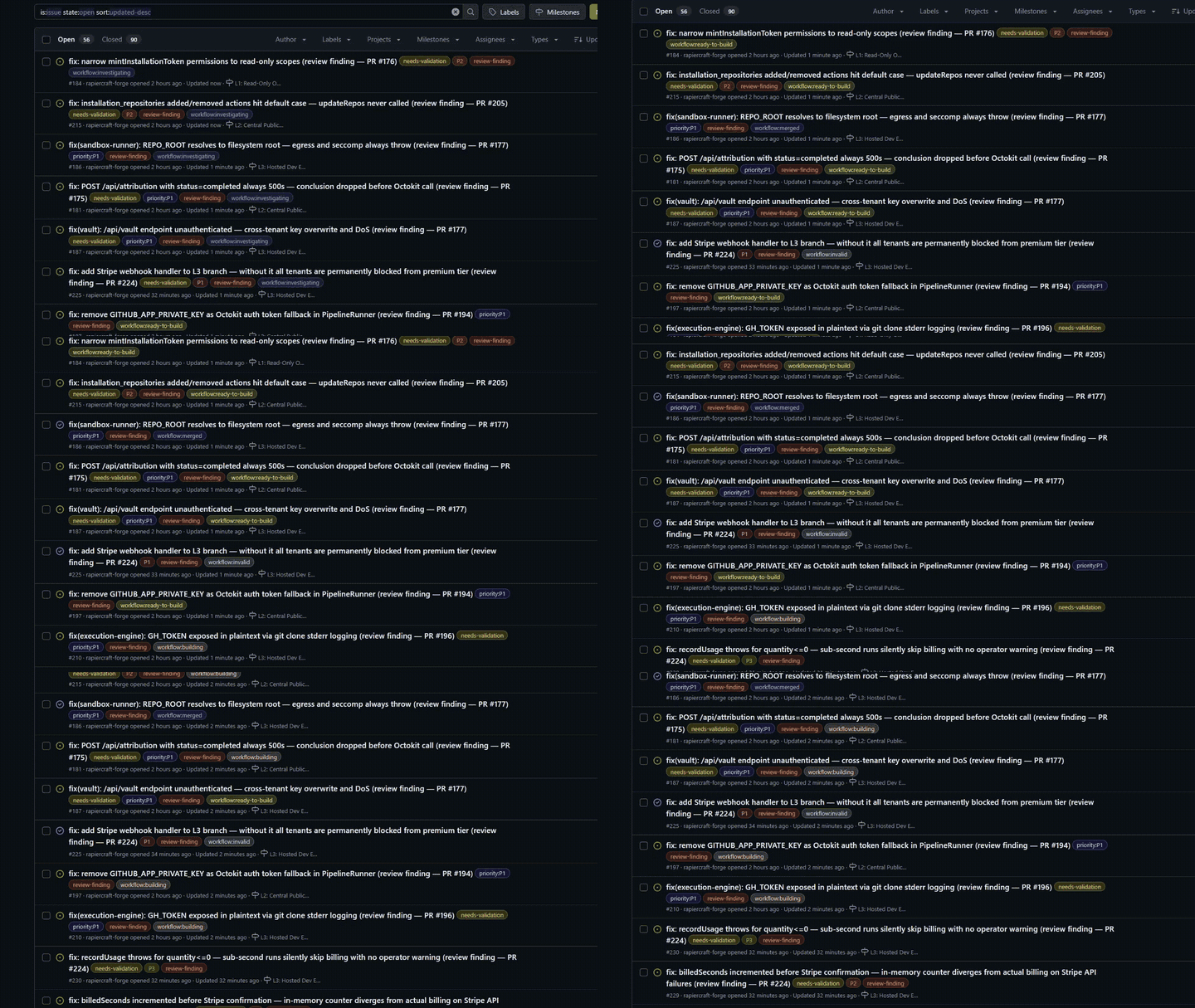
This repository builds itself with ForgeDock. In its first 30 days (June 4 → July 4, 2026): 693 issues filed, 605 closed, 603 PRs merged — median 56 minutes from open to merged-and-closed. 57% of those issues were filed by the pipeline itself; 49% are findings its own review agents raised, filed, and then fixed. Every run leaves a public audit trail — click through the receipts, or count them yourself:
gh issue list -R RapierCraftStudios/ForgeDock --state closed --limit 1000 --json number --jq 'length'
A single run, up close — a real one, issue #1230:
$ /work-on #1230        "orchestrate: Layer 5 co-change signal is dead code"

  ✓ investigate    CONFIRMED/HIGH — feature shipped 3h earlier (PR #1204) reads a
                   never-populated variable; the co-change query can never fire
  ✓ build          fix branch, 1 file
  ✓ review         caught a defect in the fix itself: stray backticks in the grep
                   meant every git-log pathspec silently matched zero commits —
                   "the fix would not have actually worked." Corrected.
  ✓ merged         30m 37s → staging

  filed by the pipeline's own staging review. fixed before a human read it.
Try it in 30 seconds — on a throwaway repo, nothing to lose
Requires for this demo: Claude Code (subscription or ANTHROPIC_API_KEY) · GitHub CLI (authenticated) · Node.js ≥ 18.
npx forgedock demo # spins up a risk-free demo repo and shows you the pipeline end to end
Ready to use it for real? npx forgedock walks you through one continuous setup: it checks your environment, installs the slash commands, reads your repo, and hands you a single annotated forge.yaml to review — you press Enter once.
⭐ If ForgeDock saves you time, star the repo — it's the whole marketing budget.
Your AI coding agent forgets everything after every session. It re-explores the codebase from scratch, re-makes mistakes that were already fixed, and has no idea why the code it's touching looks the way it does. ForgeDock fixes that by making GitHub itself the memory — every pipeline stage writes structured findings that every later agent reads.
Without ForgeDock vs. With ForgeDock
| Without ForgeDock | With ForgeDock |
|---|---|
| Agent starts every session blind — no context from prior work | Agent reads structured investigation, root cause, and history straight from GitHub |
| The same bugs get reintroduced across PRs | Review agents surface known pitfalls from past PRs before you commit |
| A crash or compaction loses the run | State lives on GitHub and in an event-sourced run log — the pipeline resumes where it stopped |
| You write the issue, plan the fix, open the PR, and review it | /work-on #42 → investigated, built, reviewed, merged |
| Review depends on whoever has capacity | 9 domain-specialist agents (security, billing, DB, concurrency…) review every PR |
| One task at a time, serialized by your attention | /orchestrate runs a whole milestone — many issues in parallel, each its own full pipeline |
The idea in one paragraph
AI agents have no lookback. They don't know a function was shaped by a bug fix in #347, that an approach was tried and reverted in PR #891, or that three other files need the same change. Context window isn't the bottleneck — memory is. But GitHub already stores everything an agent needs: commits, PRs, issues, blame, cross-references. It's a citation graph; agents just don't use it as one. ForgeDock makes every stage write machine-readable annotations to issues and PRs, and every downstream agent read them. The gh CLI becomes the query interface to institutional memory. The result: agents that follow structured data, not vibes.
┌──────────────────────────────────────────────────────────────────┐
│                     GITHUB (Knowledge Graph)                     │
│                                                                  │
│  Issues:  FORGE:INVESTIGATOR → FORGE:CONTEXT → FORGE:ARCHITECT   │
│           → FORGE:TRAJECTORY (the run's full audit trail)        │
│  PRs:     FORGE:BUILDER → structured review FINDING blocks       │
│  Links:   git blame → commit → PR → issue → related issues       │
│                                                                  │
│  Every agent reads this. Every agent writes to it.               │
│  Nothing is lost between conversations.                          │
└──────────────────────────────────────────────────────────────────┘
Watch the machine work
Not a staged demo — these are real, public runs on this repository. Open any of them and read the full trail:
- #1230 — the pipeline's staging review caught dead code in a feature the pipeline had shipped three hours earlier; review then caught a bug in the fix itself. Intent to merged: 30 minutes.
- #1172 — review found an
ANTHROPIC_API_KEYexfiltration path in the headless runner (an in-process file read bypassed the env scrub), with exact line evidence. Fixed and merged in 18 minutes, with regression tests. A later re-review found a second-order bypass of the first fix (#1243) — the pipeline red-teams its own fixes. - #952 — the investigator closed the pipeline's own proposal as INVALID with receipts: the deliverable had already shipped weeks earlier. Zero code written, 34 minutes, full explanation.
- #1256 — decomposition that respects the existing graph: it created only the two net-new sub-issues no open issue already claimed, then sequenced three existing issues into the dependency order.
- #1322 — a heavyweight feature (the durable execution engine itself): 9 TDD tasks, whole-branch review caught two Criticals pre-merge, merged in under 2 hours.
And the part that makes it compound — the context phase citing past bugs by number before a line is written (from #1196):
"
commands/orchestrate.mdhas a dense review-finding history from PR #1081/#1107/#1126… associative-array declaration mistakes (#1113), array-element removal via pattern substitution corrupting partial matches (#1108)… the new Layer 5 subsection should not introduce a competing edge-direction convention that could reintroduce a cycle class."
Numbers on this page are point-in-time (2026-07-04), from this repository's first 30 days of dogfooding. A reproducible cost-per-issue benchmark is a hard gate on our own launch plan — #1264: no estimated efficiency claims.
Orchestrate an entire milestone
/work-on ships one issue. /orchestrate ships a milestone. It decomposes the milestone into dependency-ordered waves and runs a full /work-on pipeline on each issue in parallel — investigating, building, reviewing, and merging many at once, while GitHub labels track every agent's state live. On this repo's record day, that meant 29 issues taken to merged inside a single hour.
Scheduling is conflict-aware before it is parallel. Five detection layers decide what may run concurrently: same-file overlap, directory proximity, shared-module fan-in, a conservative fallback when file extraction is low-confidence, and historical co-change coupling mined from git log — files that changed together in the past are assumed to conflict now. Database-touching issues are always serialized. The resulting graph is cycle-checked (Kahn's algorithm) and executed in topologically sorted waves; overlapping work is expressed as ordinary Depends on #N edges anyone can read.
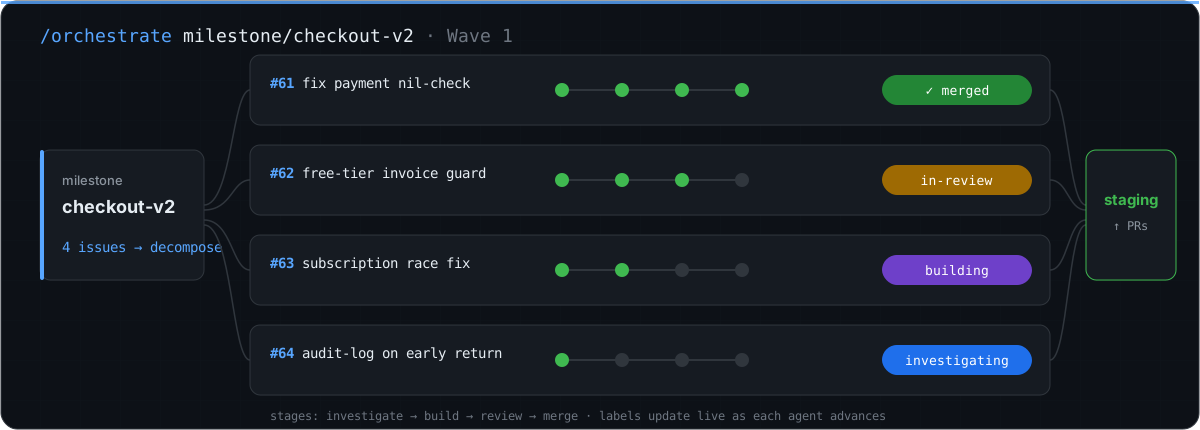
/orchestrate milestone/checkout-v2 # decompose → conflict-aware waves → merged PRs
How it works
Each stage reads the structured output of the stages before it and writes its own findings back:
Issue → Investigate → Context → Architect → Build → Quality Gate → Review → Merge
              └──────────── each stage reads & writes GitHub ────────────┘
| Stage | Reads | Writes |
|---|---|---|
| Investigate | Issue body, git blame, related issues/PRs | FORGE:INVESTIGATOR — verdict, root cause, affected files, severity |
| Context | Historical findings from related PRs, known pitfalls | FORGE:CONTEXT — institutional memory for this module |
| Architect | Investigation + context | FORGE:ARCHITECT — ordered plan, code paths, risks |
| Build | Everything above | FORGE:BUILDER — branch, commits, files changed |
| Quality Gate | Builder output, domain-specific checks | gate results, recorded in the run's trajectory |
| Review | PR diff, contract, gate results | FORGE:REVIEW_STARTED on the issue; per-agent findings as structured FINDING blocks on the PR |
| Close | All of the above | FORGE:TRAJECTORY — the full audit trail of the run |
GitHub as the database. Every annotation is wrapped in an HTML comment (<!-- FORGE:INVESTIGATOR -->) that makes it machine-parseable. When an agent starts — even in a brand-new conversation after compaction — it queries the issue via gh and reconstructs full context from these tags. Workflow labels (workflow:investigating, workflow:in-review, workflow:merged…) track state, and the pipeline resumes from whatever state GitHub reports. The annotation format is an open standard — see the FORGE Annotation Protocol.
Durable by design. Headless runs are backed by a real execution engine, not prompt-hope: every phase transition is appended to an event-sourced, crash-safe run log, mirrored to the issue as a compact FORGE:STATE index, and guarded by leases so two agents can never own the same issue. Kill the process mid-run and restart it — the engine reconciles local state against GitHub (GitHub wins), adopts branches and PRs that already exist instead of re-running the LLM, and escalates to needs-human after bounded retries instead of looping. Phase selection is a pure rule-based state machine: the engine, not the model, decides what happens next. The headless core shipped in PR #1326; wiring the interactive path onto the same engine is in progress (#1323–#1325).
Domain-specialist review. Every PR is reviewed by agents with deep, narrow expertise — Security, Auth & Access Control, Billing Integrity, Database, Concurrency, Frontend, API, Performance, Infrastructure. Findings carry a confidence level, and a reproduction gate keeps them honest: a finding only blocks if the reviewer traced an actual code path or input that triggers it — pattern-match suspicions are downgraded, not merged into noise. Findings above the severity threshold are automatically filed as new issues that enter the same pipeline: on this repo, that loop produced 49% of all issues ever filed.
It measures itself. /pipeline-health correlates every prompt change against review-finding rates, build failures, and manual fix-up commits, then files its own report — including failing grades — as an issue. /autopilot pulls production signals (errors, CI failures, stale issues, analytics), files issues from them, and optionally runs /work-on on the top ones. The pipeline also invalidates its own bad ideas: proposals that turn out to be already-shipped or wrong are closed workflow:invalid with the reasoning attached (example).
Built for the ways agents fail
Every mechanism above exists because autonomous agents fail in predictable ways. The skeptics are right about the failure modes — the answer is structure, not optimism:
| "We've all seen this go wrong…" | The mechanism |
|---|---|
| Parallel agents just turn typing time into reading time | Review is a pipeline stage: domain specialists with confidence ratings and a reproduction gate — not a pile of raw diffs |
| Agents game their own checks (or delete the tests) | Builders never grade their own work — the quality gate and reviewers are separate agents reading the diff cold |
| Third retry = increasingly creative excuses | Engine-owned state machine: bounded retries, then escalation to needs-human |
| One runaway agent wrecks the codebase | 1 issue = 1 agent, bounded by decomposition; conflict-aware scheduling; isolated worktrees |
| No institutional memory — "it can't read the Slack thread from 2023" | Every run writes citable annotations to GitHub; the context phase quotes past bugs by number |
| No way to tell when an agent drifts | A FORGE:TRAJECTORY receipt on the issue records what every phase actually did |
| Humans rubber-stamp 95%-good output | Specialist review raises the floor before a human looks at the PR |
| The economics are opaque | ForgeDock runs on your existing Claude account — it resells no compute and takes no per-task cut. Cost-per-issue benchmarks are tracked in the open (#1264) |
Commands
The core loop:
| Command | What it does |
|---|---|
/work-on | Full issue lifecycle: investigate → build → quality gate → review → merge |
/orchestrate | A whole milestone in parallel — conflict-aware waves, one pipeline per issue |
/issue | Creates pipeline-ready GitHub issues |
/milestone | Create, manage, and ship milestones |
/review-pr | Context-aware PR review with domain-specialist agents |
/quality-gate | Pre-commit checks, gated by the domains your change actually touches |
/test-gate | Acceptance verification against running code before anything deploys |
Observe & recover — the durable-state story, as commands:
| Command | What it does |
|---|---|
/pipeline-status | Fleet view of every in-flight issue, straight from workflow labels |
/pipeline-resume | Resume an interrupted run from whatever state GitHub reports |
/diagnose | Trace why a run failed, from its annotations |
/explain | Translate the FORGE annotations on any issue into plain language |
/replay | Replay a past run's full audit trail |
/changelog | Release notes assembled from merged PRs and trajectory receipts |
Ops:
| Command | What it does |
|---|---|
/deploy-info | Staging vs. main diff with risk assessment |
/rollback | Automated revert PR for production incidents |
/autopilot | Production signals → triaged issues → fixes |
/security-audit | Multi-phase security posture audit |
/cleanup | Sweeps stale issues, branches, worktrees |
More ship today (web-property analytics, browser QA sweeps, self-benchmarking) — see the full command reference. A leaner, tiered install that keeps the core loop front and center is planned in #1257.
Install
Requirements: Claude Code or OpenCode · GitHub CLI (authenticated) · Node.js ≥ 18.
npx forgedock # checks your environment, installs commands into ~/.claude/commands/ (available in every Claude Code session on this machine), detects your repo, and hands you a reviewed forge.yaml
For OpenCode, install namespaced native commands without changing your provider
or user-owned settings. When migrating an older ForgeDock adapter, it removes
only exact ForgeDock-managed legacy entries from opencode.json:
npx forgedock opencode install
# restart OpenCode, then: /forge/work-on <issue>
See OpenCode support for architecture, token-loading rules, current parity boundaries, and lifecycle commands.
Install is always global, to ~/.claude/commands/. --global is still accepted on the command line for backward compatibility but has no effect — there's no other install location to opt out of.
Want engine-mode dispatch?
npx forgedockis transient — theforgedockbinary isn't persisted in PATH after install./orchestrateand/autopilotuse agent dispatch mode by default, which is fully functional. To enable engine-mode dispatch (forgedock run-issue) with its durable phase table and fail-closed review gate, runnpm install -g forgedockinstead.
One command does everything: it checks your environment, installs the slash commands into Claude Code, detects your repo (owner, branches, paths), and hands you a single annotated forge.yaml to review — press Enter to accept. Run npx forgedock init any time afterward to re-generate the config only.
Installing also registers a SessionStart hook, so every Claude Code session
in a forge-managed directory starts already knowing ForgeDock runs it.
Per-directory control: npx forgedock enable / disable / status.
Then just open Claude Code and run /work-on <issue>.
Cost: ForgeDock is free and open-source. It orchestrates sessions on your Claude account — no compute resold, no per-task markup. A typical
/work-onrun on a straightforward bug costs about what a 15–20 minute manual Claude Code session does.
Other install options & commands
Claude Code plugin marketplace (Claude Code v2.1.143+):
/plugin marketplace add RapierCraftStudios/ForgeDock
/plugin install forgedock@forgedock
Commands then appear as /forgedock:work-on, etc. You still run npx forgedock init to generate forge.yaml.
Headless / CI: the pipeline also runs outside Claude Code. npx forgedock run work-on <issue> --dry-run previews the assembled prompt and tool plan. npx forgedock run picks an execution backend automatically (--backend auto, the default): if the Claude Code CLI (claude) is installed and already authenticated (Pro/Max subscription or a CLI-managed key), it drives the command through that — no separate ANTHROPIC_API_KEY required. Otherwise it falls back to the Anthropic API directly (ANTHROPIC_API_KEY required). Force either path explicitly with --backend cli / --backend api (or FORGEDOCK_BACKEND=cli|api) — the API backend is what CI environments without an interactive claude login should use. npx forgedock run-issue <issue> executes the same command specs on the durable engine (event-sourced run log, leases, crash-safe resume).
Explicit install command:
npx forgedock install           # installs into ~/.claude/commands/
npx forgedock install --global  # same thing — --global is accepted but is a no-op
Maintenance:
npx forgedock update      # relink commands + refresh the SessionStart hook
npx forgedock enable      # turn ForgeDock on for this directory
npx forgedock disable     # turn ForgeDock off for this directory
npx forgedock status      # show ForgeDock's state for this directory
npx forgedock doctor      # installation health check with fix hints
npx forgedock report      # 30-day pipeline impact receipts (--md for Markdown, --json for scripting)
npx forgedock uninstall   # remove commands, the hook, and tracked copies
npx forgedock help        # show everything
Running
npx forgedockfrom inside this repo uses the local working tree. From your own project, usenpx forgedock@latestto pin the published release.
A note on install location
ForgeDock briefly experimented with a project-scoped-by-default install mode. It was backed out after causing a "split-brain" bug (detect assumed project-scoped while the installer still wrote globally — #1589), so every version you'd realistically install today only ever writes to ~/.claude/commands/. --global is still accepted as a flag for old scripts/muscle memory, but it changes nothing.
If you're carrying an older --global habit in scripts or CI, it's harmless to leave it — npx forgedock --global and npx forgedock do exactly the same thing.
For companies
The core is AGPL-3.0 and stays that way: engineers run the full pipeline on their own Claude account, forever free.
Two things are for sale:
- A commercial license — for organizations that need ForgeDock inside proprietary workflows or products without AGPL copyleft obligations. Contact support@rapiercraftstudios.com.
- The fleet layer (in development) — org-wide observability over every pipeline run: the receipts on this page, live, across all your repos, plus policy controls and audit-grade provenance for autonomous merges. We're onboarding a small group of design partners — see ForgeDock for Companies for details and intake.
Where it's going
Month one built the execution layer. The open roadmap — tracked in the five-foundations epic (#1320) — is about earning trust while unattended:
- Durability — engine-owned state instead of prose-owned state. Headless core shipped (PR #1326); interactive wiring in progress.
- Verification — an outcome-based acceptance gate and a graded eval corpus, so "done" is machine-checkable before anything claims success. Per-release pipeline scorecards are published in
docs/eval/; model upgrades follow the model-release playbook. - Learning — per-codebase memory that compounds across runs.
- Economics — per-run cost accounting and risk×cost dispatch decisions.
- Provenance — signed, replayable records of every autonomous change.
Marketing is held to the same standard: #1264 gates our own launch on measured cost-per-issue benchmarks — no estimated claims.
Show your support
Using ForgeDock in your pipeline? Add the badge — each one is a backlink and a signal to other developers:
[](https://github.com/RapierCraftStudios/ForgeDock)

Star History
Docs & community
- GitHub Is Already Your Agents' Memory — the canonical argument: why GitHub is the right place for agent memory, how FORGE annotations make it machine-readable, and how to adopt the protocol without ForgeDock
- Getting Started in 5 Minutes
- How the Knowledge Graph Works
- What Are Those FORGE Comments? — 2-minute explainer for annotations you meet in the wild
- FORGE Annotation Protocol — the open standard for AI context passing (CC-BY-4.0)
- ForgeDock vs. Manual Claude Code Workflows
- ForgeDock vs. DeepWiki, AGENTS.md, and Cursor Memories
- Command Learning Path — which commands to learn first
- Complete Command Reference
- Troubleshooting & Recovery
- Pipeline Eval Scorecards — per-release published results for every model/Claude Code upgrade
- Model-Release Upgrade Playbook — how to validate a new model before adopting it
Contributing: PRs welcome — every change goes through a PR, tested against 3+ scenarios, using conventional commits (fix(command):, feat(command):). License: AGPL-3.0 — free to use, modify, and distribute; network use of modifications must be open-sourced under the same license. Commercial licenses are available for proprietary use — see COMMERCIAL-LICENSE.md.
Built and dogfooded in production by RapierCraft Studios.