
agent-inspect
Local-first evidence for TypeScript AI agents
See what your agent did.
Catch the wrong path in CI.
Keep the evidence local.
AgentInspect turns TypeScript agent runs into readable execution trees, deterministic trajectory checks, and portable Evidence v2—without requiring an account, collector, or default upload.
Capture once. Debug, prevent, and share from the same local trace.
No account · no collector · no default upload · metadata-only by default


npm install agent-inspect
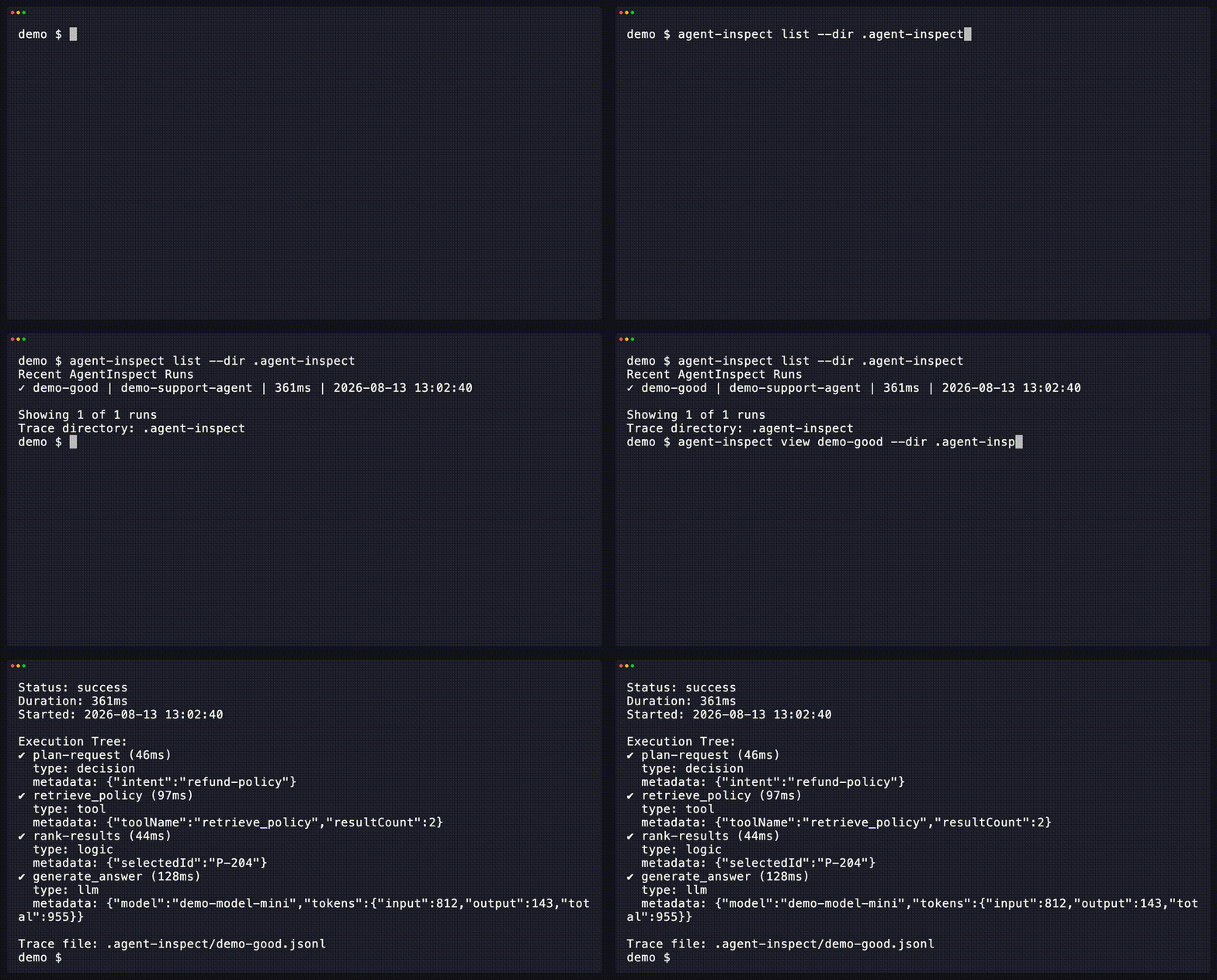
Agent code rarely fails as one function call. It plans, retrieves, calls tools, invokes a model, retries, and produces side effects. Flat logs show fragments. AgentInspect keeps the run as local JSONL and gives you one evidence loop from the same trace.

One trace. Three jobs.
Debug — read the execution path
See nested steps, tool calls, LLM calls, model and token metadata, durations, errors, and the first causal failure without sending the trace to an AgentInspect service.
npx agent-inspect view <run-id> --dir .agent-inspect --summary
npx agent-inspect report <run-id> --dir .agent-inspect
npx agent-inspect explain <run-id> --dir .agent-inspect
Use manual instrumentation, official adapters, supported standards files, or structured logs you already emit.
Prevent — fail CI on the wrong trajectory

Checks are deterministic and provider-free: the same trace and rules produce the same result. Start with a preset, then extend it with the expectations that matter to the workflow.
npx agent-inspect check <run-id> --dir .agent-inspect \
  --preset trajectory \
  --required-tool retrieve_policy \
  --fail-on-observation failed
A passing check exits 0; a rule failure exits 1. Invalid configuration and unreadable/unsupported inputs use separate documented exit codes. Use TraceContract, suites, cohorts, Vitest/Jest reporters, or --evidence-on fail when the workflow needs more than one CLI check.
Share — create reviewable offline evidence

npx agent-inspect verify-safe <run-id> --dir .agent-inspect
npx agent-inspect bundle <run-id> --dir .agent-inspect --profile share --out ./evidence
npx agent-inspect bundle verify ./evidence
verify-safe is a best-effort local assessment and can report SAFE, SAFE WITH WARNINGS, UNSAFE, or UNKNOWN. bundle writes a redacted artifact and manifest; bundle verify rechecks the listed file hashes offline. “Share-checked” is not compliance certification—review the artifact before attaching it to a PR, incident, or support handoff.
First local trace
The generated demo is synthetic, keyless, and local. npm install agent-inspect does not copy repository examples; init writes them into the project.
npm install agent-inspect
npx agent-inspect init --yes
node examples/agent-inspect-demo.mjs
npx agent-inspect list --dir .agent-inspect
Copy the printed run ID, then inspect it:
npx agent-inspect view <run-id> --dir .agent-inspect --summary
npx agent-inspect check <run-id> --dir .agent-inspect --preset trajectory
npx agent-inspect verify-safe <run-id> --dir .agent-inspect
For a fixed good/regression/PII walkthrough with stable run ids (demo-good, demo-regression, demo-pii), use the canonical keyless showcase. The richer blessed starters cover framework-specific paths.
Use it with your stack
| Stack | Install / command | Start |
|---|---|---|
| Custom functions or classes | agent-inspect | Getting started |
| LangChain / LangGraph | agent-inspect + @agent-inspect/langchain | LangGraph guide |
| AI SDK | agent-inspect + @agent-inspect/ai-sdk | AI SDK guide |
| OpenAI Agents JS | agent-inspect + @agent-inspect/openai-agents | Local processor guide |
| Existing structured logs | npx agent-inspect logs ... | Log-to-tree quickstart |
| OpenInference / OTLP JSON | npx agent-inspect open ... | Standards |
| Vitest / Jest CI | @agent-inspect/vitest / @agent-inspect/jest | CI artifacts |
See support levels for Stable, Supported, Beta, Preview, and Experimental surfaces.
Programmatic trajectory checks
import { openTraceFile } from "agent-inspect/readers";
import {
  defineTraceContract,
  evaluateTraceContractRead,
} from "agent-inspect/checks";

const read = await openTraceFile("./trace.jsonl");
const contract = defineTraceContract({
  run: { requireCompleted: true },
  tools: { required: ["retrieve_policy"] },
});

const result = evaluateTraceContractRead(read, contract);
if (result.status !== "pass") process.exitCode = 1;
The full API also exposes TraceFacts for bounded, logical analysis of supported traces. See programmatic trace analysis.
Where AgentInspect fits
AgentInspect owns the laptop-to-PR evidence loop. It complements hosted observability, production trace retention, and broad eval platforms rather than replacing them.
| Need | Best fit |
|---|---|
| Inspect one local TypeScript agent run immediately | AgentInspect |
| Enforce deterministic tool/order/completion expectations in CI | AgentInspect |
| Attach a redacted, hash-verifiable offline artifact | AgentInspect |
| Monitor a production fleet with hosted dashboards and retention | Hosted observability / APM |
| Manage prompts, datasets, and online LLM-judge experiments | Eval / prompt platforms |
See the factual comparison guide.
Safety and network behavior
- Traces are local JSONL under
.agent-inspect/orAGENT_INSPECT_TRACE_DIR. - Capture is metadata-only by default; raw prompts and outputs require opt-in.
- Write-time redaction is enabled by default. The
redactcommand creates a separate redacted copy and does not mutate its source. - Core capture and inspection do not require an AgentInspect account, collector, or default upload.
- Redaction and
verify-safeare best-effort controls, not privacy, security, or compliance certification. - Optional MCP, standards export, and customer-owned Studio surfaces are explicit and have their own network boundaries.
- AgentInspect is not a chain-of-thought recorder.
Read network behavior, no-egress policy, and safe trace sharing.
Optional coding-agent loop
@agent-inspect/mcp-server exposes configured local evidence to an MCP client through bounded, read-only tools. It is optional and currently Preview; the core debug/check/evidence loop does not require it.
npx agent-inspect mcp configure --client cursor
Review the generated dry-run configuration and the coding-agent loop guide before enabling it.
Package family (18-package fixed release group)
| Group | Packages |
|---|---|
| Core product | agent-inspect, @agent-inspect/redact |
| Framework integrations | @agent-inspect/ai-sdk, @agent-inspect/openai-agents, @agent-inspect/langchain |
| Testing and evaluation | @agent-inspect/harness, @agent-inspect/eval, @agent-inspect/vitest, @agent-inspect/jest |
| Safety analysis | @agent-inspect/guardrails, @agent-inspect/circuit |
| Developer surfaces | @agent-inspect/viewer, @agent-inspect/tui, @agent-inspect/mcp, @agent-inspect/mcp-server |
| Local/team optional surfaces | @agent-inspect/index-sqlite, @agent-inspect/studio |
| Extension SDK | @agent-inspect/adapter-sdk |
The root package is enough for custom capture, the CLI, checks, and Evidence workflows. Install optional packages only for the integration or surface you use. agent-inspect-vscode is currently in the repository and is not presented as a published Marketplace extension.
What it is not
- A maintainer-hosted SaaS or production APM replacement
- Hosted trace retention, a team dashboard service, or a prompt registry
- An LLM-as-judge or dataset platform by default
- A replay engine, automatic remediation system, or compliance certification
Status and documentation
Current published baseline: 6.17.2 · persisted schema 1.0 · Node.js >=20 · MIT.
Legacy v0.1 and v0.2 traces remain readable. Check the npm badge and changelog for the current published version.
- First trace in five minutes
- CLI reference
- Trace contracts
- Evidence format
- Use cases
- Demos and screenshots
- Full documentation index
Contributing
See CONTRIBUTING.md, good first issues, and GitHub Discussions.
Redact and review traces before posting them in issues or pull requests.