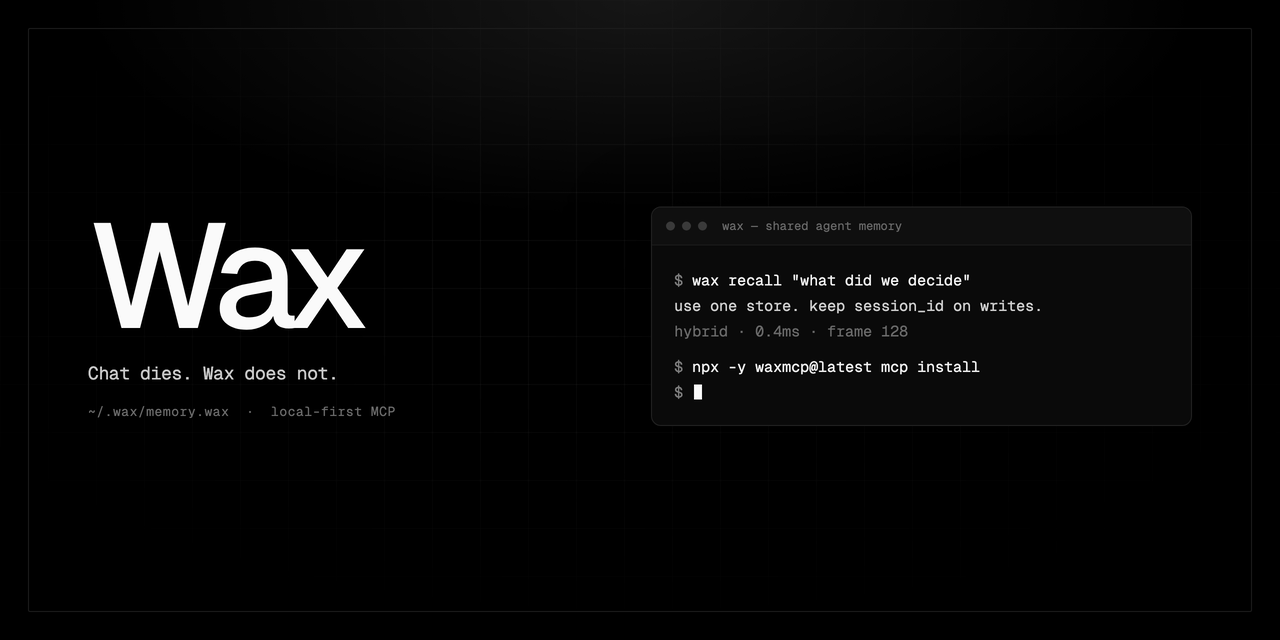
Single File Memory layer memory for every agent that runs on Apple Silicon
One .wax file. Foundation Models, Claude, Cursor, Codex, Hermes — same store.
Sync with iCloud, or AirDrop the file.




English · Español · Français · 日本語 · 한국어 · Português · 中文
What is Wax?
Wax is a local-first shared memory layer. It allows any AI to have a single file memory engine with access to vector search, photo and video rag, optimized for Apple Silicon
That store is one file: ~/.wax/memory.wax. No hosted vector DB. Memory, Decisions, facts survive the chat, the app, and the reboot.
Same Mac, many agents. For those using multiple different agents, Wax points each host at the file (or at one local HTTP server). They share memory instead of each keeping a private brain.
Another Mac Or iPhone Device Put the file in iCloud Drive and both machines see the same store, or AirDrop memory.wax like any other document.
~/Library/Mobile Documents/com~apple~CloudDocs/Wax/memory.wax   # iCloud
# or
AirDrop  memory.wax  →  ~/.wax/memory.wax
Agent setup: Agent Quick Start · host snippets: wax-mcp-hosts.md
Also a Swift engine
The Engine is Swift Native. Embed it in an iOS or macOS app when you want on-device RAG without standing up a server.
import Wax

let memory = try await Memory(at: url)
try await memory.save("The user prefers dark mode and uses Vim keybindings.")
let results = try await memory.search("What editor does the user like?")
// → "The user prefers dark mode and uses Vim keybindings."
What you can build
- Shared agent memory — one store across every MCP client on the machine.
- Carry it — iCloud the file between Macs, or AirDrop it.
- Personal knowledge — semantic search over notes and clips, still on disk.
- On-device RAG — ship memory inside an app, no cloud dependency.
Choose Your Path
| 🤖 Every agent on this Mac | ⌨️ CLI | 🛠️ Swift app |
|---|---|---|
| You want: Claude, Cursor, Codex, Hermes sharing one local memory. Sync the file with iCloud or AirDrop. | You want: A command-line store you can script. | You want: The same engine inside an iOS/macOS app. |
| Get started: Agent Quick Start ↓ | Get started: CLI Quick Start ↓ | Get started: Swift Quick Start ↓ |
Swift Quick Start
1. Add Wax to your project
Swift Package Manager
// Package.swift
dependencies: [
    .package(url: "https://github.com/christopherkarani/Wax.git", from: "0.2.22")
]
Or in Xcode: File → Add Package Dependencies → https://github.com/christopherkarani/Wax.git
2. Copy-paste this into your app
import Foundation
import Wax

let url = URL.documentsDirectory.appending(path: "agent.wax")

// Open a memory store
let memory = try await Memory(at: url)

// Save something
try await memory.save("The user is building a habit tracker in SwiftUI.")

// Recall it later — works even if the app was killed
let results = try await memory.search("What is the user building?")
if let best = results.items.first {
    print("Found: \(best.text)")
    // → "Found: The user is building a habit tracker in SwiftUI."
}

try await memory.close()
SwiftUI example
import SwiftUI
import Wax

struct ContentView: View {
    @State private var result = "Searching…"

    var body: some View {
        Text(result)
            .task {
                do {
                    let url = URL.documentsDirectory.appending(path: "agent.wax")
                    let memory = try await Memory(at: url)

                    try await memory.save("The user is building a habit tracker in SwiftUI.")
                    let context = try await memory.search("What is the user building?")

                    result = context.items.first?.text ?? "Nothing found"
                    try await memory.close()
                } catch {
                    result = "Error: \(error.localizedDescription)"
                }
            }
    }
}
CLI tool (main.swift)
import Foundation
import Wax

@main
struct AgentMemory {
    static func main() async throws {
        let url = URL.documentsDirectory.appending(path: "agent.wax")
        let memory = try await Memory(at: url)

        try await memory.save("The user is building a habit tracker in SwiftUI.")

        let results = try await memory.search("What is the user building?")
        if let best = results.items.first {
            print("Found: \(best.text)")
        }

        try await memory.close()
    }
}
Prefer a checked-in harness over pasting snippets? Run the demo — Resources/WaxDemo exercises the public Memory APIs on macOS 26.
Looking to store persistent facts and long-term reasoning? Structured memory (entities and facts) is available today through the MCP server tools (entity_upsert, fact_assert, facts_query, …) described in the Agent Quick Start. The Swift-level structured memory API is package-internal for now; see Structured Memory (contributor documentation).
Run the demo
Resources/WaxDemo is a small Swift package that stress-tests the public Wax APIs (save/search durability, embeddings, Foundation Models, error paths).
Requires macOS 26 (the demo package declares that platform; Foundation Models mode needs Apple Intelligence where available).
cd Resources/WaxDemo
swift run WaxDemo --mode all
Useful modes:
| Mode | What it runs |
|---|---|
memory | Save → search → close → reopen → search |
framestore | Low-level frame create/put/read/delete |
embeddings | Built-in MiniLM + hybrid/vector search |
fm | Foundation Models memory session (or a clear unavailable message) |
errors | Validation / WaxError paths |
all | Everything above (default) |
swift run WaxDemo --mode memory
swift run WaxDemo --mode fm --keep --store /tmp/wax-demo.wax
--keep leaves the .wax file on disk; --store PATH picks the file location.
Source: Resources/WaxDemo.
CLI Quick Start
1. Install
# Build from source (requires Swift 6+)
git clone https://github.com/christopherkarani/Wax.git
cd Wax
swift build -c release

# The binary is now at .build/release/wax-cli
cp .build/release/wax-cli /usr/local/bin/
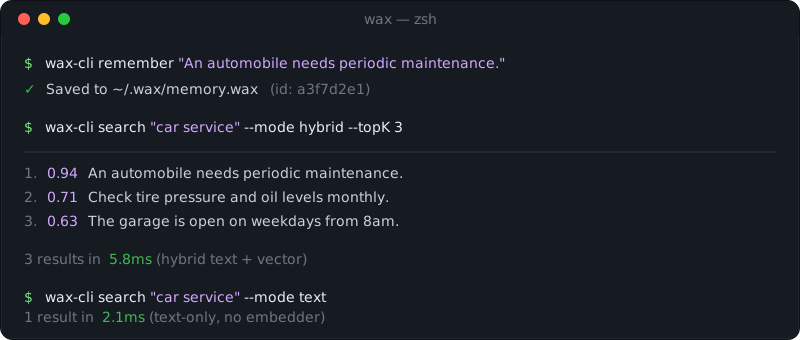
2. Remember and recall from the terminal
# Save a memory
wax-cli remember "An automobile needs periodic maintenance."

# Search it back
wax-cli search "car service" --mode hybrid --topK 3

# Simple text-only search (no setup required)
wax-cli search "car service" --mode text

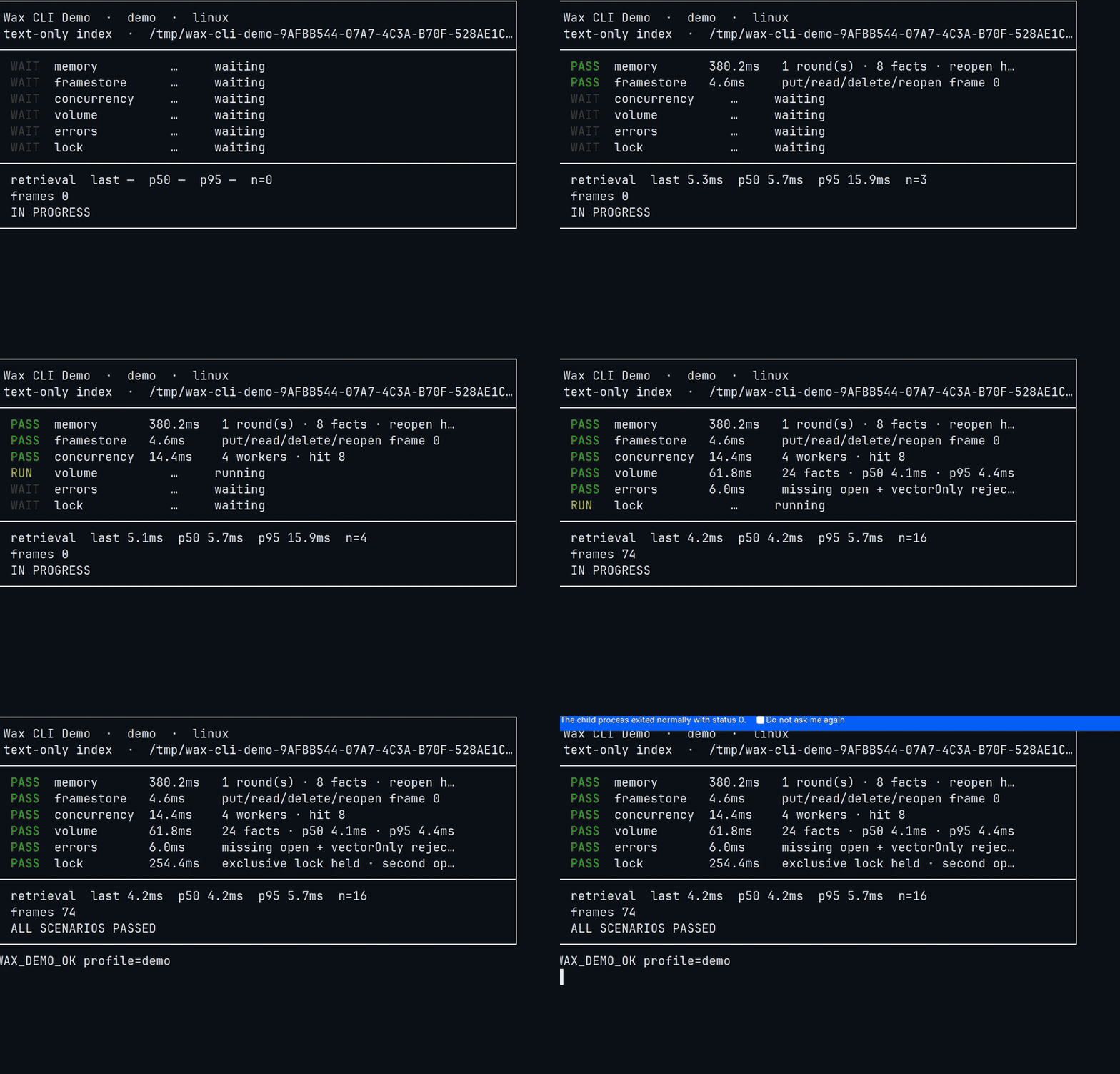
# Linux / cloud TUI demo + public-API stress (text-only; no MiniLM claim)
wax-cli demo --run
wax-cli demo --stress --run
The dashboard tracks retrieval time live (last / p50 / p95 / n) on every successful Memory.search.
On Linux, build wax-cli without -DGRDBCUSTOMSQLITE (that flag breaks GRDB's system SQLite overlay):
swift build --product wax-cli --traits default,MCPServer
BIN="$(swift build --product wax-cli --show-bin-path --traits default,MCPServer)/wax-cli"
"$BIN" demo --run
"$BIN" demo --stress --run
# Hold each TUI frame for a recording or live walkthrough
"$BIN" demo --run --pace-ms 1500 --hold-ms 4000
For long-running sessions, start the daemon:
wax-cli daemon --store-path ~/.wax/memory.wax
Then send JSON-line commands:
{"id":"1","command":"remember","content":"An automobile needs periodic maintenance."}
{"id":"2","command":"search","query":"car service","mode":"hybrid","topK":3}
{"id":"3","command":"shutdown"}
[!NOTE] Vector search requires the embedder. If it's unavailable, hybrid/vector commands fail loudly instead of silently falling back to text-only mode.
Agent Quick Start
Give your AI coding assistant (Claude Code, Cursor, Codex, Hermes, OpenClaw, Windsurf) a persistent memory that survives across sessions.
Installing the server is not enough. Hosts ignore MCP tool descriptions unless an always-on file says when to write. Paste a block below after you wire the host.
1. Stage the server once
npx -y waxmcp@latest install
Claude-only can use stdio. Two or more clients must share one HTTP server on http://127.0.0.1:3000/mcp — a second process on ~/.wax/memory.wax will lock.
Host wire-up (Claude, Codex, Cursor, Hermes, OpenClaw)
| Host | Wire-up |
|---|---|
| Claude Code | swift run --traits MCPServer wax-cli mcp install --scope user then claude install-skill ~/.local/share/waxmcp/skills/wax-mcp |
| Codex | [mcp_servers.wax] url = "http://127.0.0.1:3000/mcp" in ~/.codex/config.toml + copy the skill to ~/.codex/skills/wax-mcp |
| Cursor | { "mcpServers": { "wax": { "url": "http://127.0.0.1:3000/mcp" } } } in ~/.cursor/mcp.json + paste the AGENTS.md block |
| Hermes | HTTP + memory.provider: wax-memory + append the SOUL.md stanza to ~/.hermes/SOUL.md (or $HERMES_HOME/SOUL.md) |
| OpenClaw | HTTP + memory plugin + append the SOUL.md stanza to the workspace SOUL.md |
| Anything else | HTTP URL + paste the AGENTS.md block into project AGENTS.md |
Full snippets, the HTTP start command, and a smoke test: Resources/docs/wax-mcp-hosts.md.
The wax-mcp skill is the operator playbook. The wax skill is Swift framework integration — different audience.
2. Teach the model when to use Wax
Pick the file your host actually loads on every turn.
Paste into AGENTS.md / CLAUDE.md / Cursor rules
Use the project or user AGENTS.md, CLAUDE.md, or .cursor/rules. Same text as Resources/skills/public/wax-mcp/references/project-rules.md.
Wax is the shared memory layer. Chat dies; Wax does not. Skip one-line Q&A. Use on any multi-step coding, debug, or research task.

Open every multi-step session:
1. Prefer `session_open` (`project` = repo name, stable `agent_id`/`run_id`, optional `recall_query`). Or call `handoff_latest` first then `session_start` once. Keep `session_id`. Do not invent one.
2. Call `recall` with default `scope: project` (hard-filters to resolved project; unlabeled/foreign frames excluded). Empty lane returns an explicit miss — pass `scope: global` only for cross-project reads. `recall` with `session_id` merges that session with durable memory under project scope.

Workflow rules:
- Use `remember` to store decisions, discoveries, and short factual notes. Prefer `scope: session` (requires top-level `session_id`) or `scope: durable` (forbids `session_id`). Do not put `session_id` inside `metadata`.
- Use `recall` for assembled context and `search` for raw ranked hits.
- Prefer `mode: "hybrid"` when semantic retrieval helps. Use `mode: "text"` when I want a fast or deterministic lexical lookup.
- Do not manage `SESSION_STORE`, `--store-path`, or `flush` in normal agent flows. The broker owns long-term memory and virtual session stores.
- Close with `session_close` (`session_id`, `content`, optional `project`/`pending_tasks`) — atomic handoff then end. Or `handoff` then `session_end`. Do not require end between turns of one host chat.
- Use `corpus_search` only when you need cross-session retrieval across broker-managed session history with provenance metadata.
- Use structured memory tools (`entity_upsert`, `fact_assert`, `fact_retract`, `facts_query`, `entity_resolve`) for stable entities and facts, not transient debugging notes.

Canonical verbs: `session_open`, `remember`, `recall`, `session_close`, `stats`.

Tactical (this task) — write immediately, not at the end:
- `remember` with `scope: session`, top-level `session_id`, `memory_type: task_state`, `durability: working`
- When: you lock a plan, a path fails (what + why), you find a landmine / owner file / required gate, a milestone finishes, or you are about to spawn a subagent / compact / stop
- Read with `recall` plus `session_id`

Strategic (survives this session):
- `remember` with `scope: durable` (no `session_id`), `durability: durable`, `memory_type` one of `decision` | `lesson` | `constraint` | `user_preference` | `fact`
- When: the user corrects you, you make an architecture or product decision, a pitfall will waste the next agent time, a standing preference appears, or a repo fact is stable

Both horizons on a long task: `compact_context`.
`recall` with `session_id` merges that session with durable long-term memory under project scope. `search` with `session_id` is session-store only.

Share across agents: the parent writes before spawning. Children often have no Wax tools. The parent writes again from their evidence.

Close: `session_close` (`session_id`, `content`, `project`, `pending_tasks`) or `handoff` then `session_end`.

Do not put `session_id` in `metadata`. Do not store secrets, transcripts, or huge logs. Do not manage `SESSION_STORE`, `--store-path`, or `flush`. Prefer `mode: "text"` for exact names and recent facts. Structured `entity_*` / `fact_*` tools are for stable graph facts, not debug notes.
Paste into Hermes / OpenClaw SOUL.md
Hermes: ~/.hermes/SOUL.md or $HERMES_HOME/SOUL.md. OpenClaw: the workspace SOUL.md.
SOUL.md is identity. Append this section. Do not replace the rest of the soul.
## Memory (Wax)

You have Wax. Chat is not memory.

On every multi-step task: prefer `session_open` (`project`, `agent_id`, `run_id`) or `handoff_latest` → `session_start` → keep `session_id`.

Write as you go:
- This task: `remember` with `scope: session`, `session_id`, `memory_type: task_state`, `durability: working` (plan, failed path, landmine, milestone, before you stop or spawn another agent).
- Long-term: `remember` with `scope: durable` (no `session_id`), type `decision` / `lesson` / `constraint` / `user_preference` / `fact` (corrections, decisions, standing prefs, stable repo facts).

Read: `recall` defaults to project scope (no foreign/unlabeled frames). Need cross-project → `scope: global`. `recall` with `session_id` merges this session with durable memory. Need a budgeted mix → `compact_context`.

Close with `session_close` (or `handoff` then `session_end`). Do not invent a `session_id` or put it in `metadata`. Do not store secrets.
Host install path: Resources/docs/wax-mcp-hosts.md. Claude/doctor details: Resources/docs/wax-mcp-setup.md.
Why Wax?
| Feature | Wax | SQLite (FTS5) | Cloud Vector DBs |
|---|---|---|---|
| Search | Hybrid (Text + Vector) | Text Only* | Vector Only* |
| Latency | ~6ms (p95) | ~10ms (p95) | 150ms - 500ms+ |
| Privacy | 100% Local | 100% Local | Cloud-hosted |
| Setup | Zero Config¹ | Low | Complex (API Keys) |
| Architecture | Apple Silicon Native | Generic | Varies |
¹ Text search works out of the box everywhere. Semantic (vector) search auto-configures the on-device MiniLM embedder on iOS 18/macOS 15+; on older OS versions, pass a custom EmbeddingProvider or search text-only. results.diagnostics and memory.stats() always report which retrieval mode actually ran — Wax never silently pretends a text-only result is semantic.
Why a single .wax file?
Most RAG setups end up with a database, a vector store, and a file server. Wax keeps the moving pieces smaller by bundling documents, metadata, and indexes into one binary.
- Less setup — no Docker stack and no separate database to babysit.
- Portable — move the file with AirDrop, iCloud, or whatever sync layer you already use.
- Atomic — backup, copy, or delete one file instead of chasing state across services.
Performance
Wax is tuned for M-series hardware and local recall.
Recall Latency (p95)
Lower is better. Measured in milliseconds.
Wax (Hybrid)  |██ 6.1ms
SQLite (Text) |████ 12ms
Cloud RAG     |██████████████████████████████████████████████████ 150ms+
Cold Open Time (p95)
Lower is better. Measured in milliseconds.
Wax           |███ 9.2ms
Traditional   |██████████████████████████████████████ 120ms+
Cold open measures store open only. The built-in embedder's first-ever CoreML compile is a separate one-time cost; later launches reuse the cached compiled model.
[!TIP] Ingest Throughput: Wax handles 85.9 docs/s with full hybrid indexing on an M3 Max. Full benchmark report: Resources/docs/benchmarks/2026-03-06-performance-results.md
Architecture
How Wax works under the hood (click to expand)
Wax uses a frame-based container format and embeds the search engines it needs inside the main file: SQLite FTS5 for text and a Metal-accelerated HNSW index for vectors. The Metal HNSW engine activates automatically once an index holds 10,000+ vectors; smaller indexes use an exact Accelerate/CPU flat index with identical recall.
Internal File Layout
┌──────────────────────────────────────────────────────────────────────────┐
│                          Dual Header Pages (A/B)                         │
│   (Magic, Version, Generation, Pointers to WAL & TOC, Checksums)         │
├──────────────────────────────────────────────────────────────────────────┤
│                          WAL (Write-Ahead Log)                           │
│   (Atomic ring buffer for crash-resilient uncommitted mutations)         │
├──────────────────────────────────────────────────────────────────────────┤
│                          Compressed Data Frames                          │
│   ┌──────────────────┐  ┌──────────────────┐  ┌──────────────────┐       │
│   │ Frame 0 (LZ4)    │  │ Frame 1 (LZ4)    │  │ Frame 2 (LZ4)    │ ...   │
│   │ [Raw Document]   │  │ [Metadata/JSON]  │  │ [System Info]    │       │
│   └──────────────────┘  └──────────────────┘  └──────────────────┘       │
├──────────────────────────────────────────────────────────────────────────┤
│                          Hybrid Search Indices                           │
│   ┌──────────────────────────────┐  ┌──────────────────────────────┐     │
│   │ SQLite FTS5 Blob             │  │ Metal HNSW Index             │     │
│   │ (Text Search + EAV Facts)    │  │ (Vector Search)              │     │
│   └──────────────────────────────┘  └──────────────────────────────┘     │
├──────────────────────────────────────────────────────────────────────────┤
│                          TOC (Table of Contents)                         │
│   (Index of all frames, parent-child relations, and engine manifests)    │
└──────────────────────────────────────────────────────────────────────────┘
- Atomic resilience: dual headers and the WAL keep the store consistent even if the process dies mid-write.
- Unified retrieval: one query fans out to both the BM25 text index and the HNSW vector index.
- Structured knowledge: built-in EAV (Entity-Attribute-Value) storage handles durable facts and long-term reasoning. (Exposed today via the MCP server tools; the Swift-level API is package-internal.)
Ecosystem Tools
🤖 MCP Server
Wax provides a first-class Model Context Protocol (MCP) server. Connect your local memory to Claude Code or any MCP-compatible agent.
npx -y waxmcp@latest install
Then wire the host and paste the AGENTS.md or SOUL.md block so the model actually writes. Snippets: wax-mcp-hosts.md.
HTTP, OpenClaw, and Markdown extras
Claude registrar and doctor: Resources/docs/wax-mcp-setup.md.
OpenClaw adapter check: scripts/verify-openclaw-adapter.sh. Native-memory operator guide: docs/openclaw-native-memory.md.
The MCP surface supports markdown_export / markdown_sync (MEMORY.md, daily notes, DREAMS.md). markdown_sync accepts dry_run. Promotion thresholds can be overridden on session_synthesize / memory_promote.
Local HTTP (when this process is the only writer):
./.build/debug/wax-mcp --no-embedder --transport http --http-host 127.0.0.1 --http-port 3000
🔍 WaxRepo
A semantic search TUI for your git history. Index any repository and find code or commits using natural language.
# From within any git repo
wax-repo index
wax-repo search "where did we implement the WAL?"
FAQ
Q: Do I need an internet connection?
A: No. Wax is 100% on-device. No cloud APIs, no network calls.
Q: How big does the .wax file get?
A: It depends on your data, but the file stays compact thanks to LZ4 compression. Typical usage: a few MB for thousands of documents.
Q: Can I sync the .wax file across devices?
A: Yes. It's a single file. iCloud Drive, Dropbox, AirDrop — whatever you already use.
Q: What happens if the app crashes during a write?
A: Wax uses a write-ahead log (WAL) and dual headers. The store recovers automatically on the next open.
Q: Does Wax work on Intel Macs?
A: Wax is optimized for Apple Silicon (M-series). It may run on Intel via Rosetta but vector acceleration requires Metal performance shaders best supported on Apple Silicon.
Q: I get "embedder unavailable" when using hybrid search.
A: Hybrid and vector search require a local embedding model. In Swift, Memory(at:) auto-configures the built-in MiniLM embedder on iOS 18/macOS 15+ (default MiniLMEmbeddings trait), or you can select any custom EmbeddingProvider via Memory.Config.embedding = .custom(...). On older OS versions, use text-only search or provide a custom embedder. The CLI/MCP server fail loudly when the embedder is unavailable; the Swift SDK reports the effective retrieval mode via results.diagnostics and memory.stats().
Community & Support
- 💬 Discussions & Q&A: GitHub Discussions
- 🐛 Bug reports: GitHub Issues
- ⭐ Star the repo to follow releases
- 📖 Full documentation: iOS developer docs · DocC sources
License
Wax is released under the Apache License 2.0. See LICENSE for details.