A self-evolving AI research colleague for scientists.





Why ScienceClaw?
General-purpose AI assistants are built for everyone. ScienceClaw is built for researchers.
The core idea is simple: an AI that does real scientific work — searching literature, querying databases, running analyses — and gets better at it the more you use it. It remembers your research context across sessions, adapts its skills to your field, and never fabricates a citation.
ScienceClaw is built on the OpenClaw engine, but redesigned from the ground up for academic research.
🧬 Core 1: Self-Evolving Skills
This is ScienceClaw's most important feature.
Most AI tools ship with a fixed set of capabilities. ScienceClaw's skills evolve with you. Every time you complete a research task, the system learns:
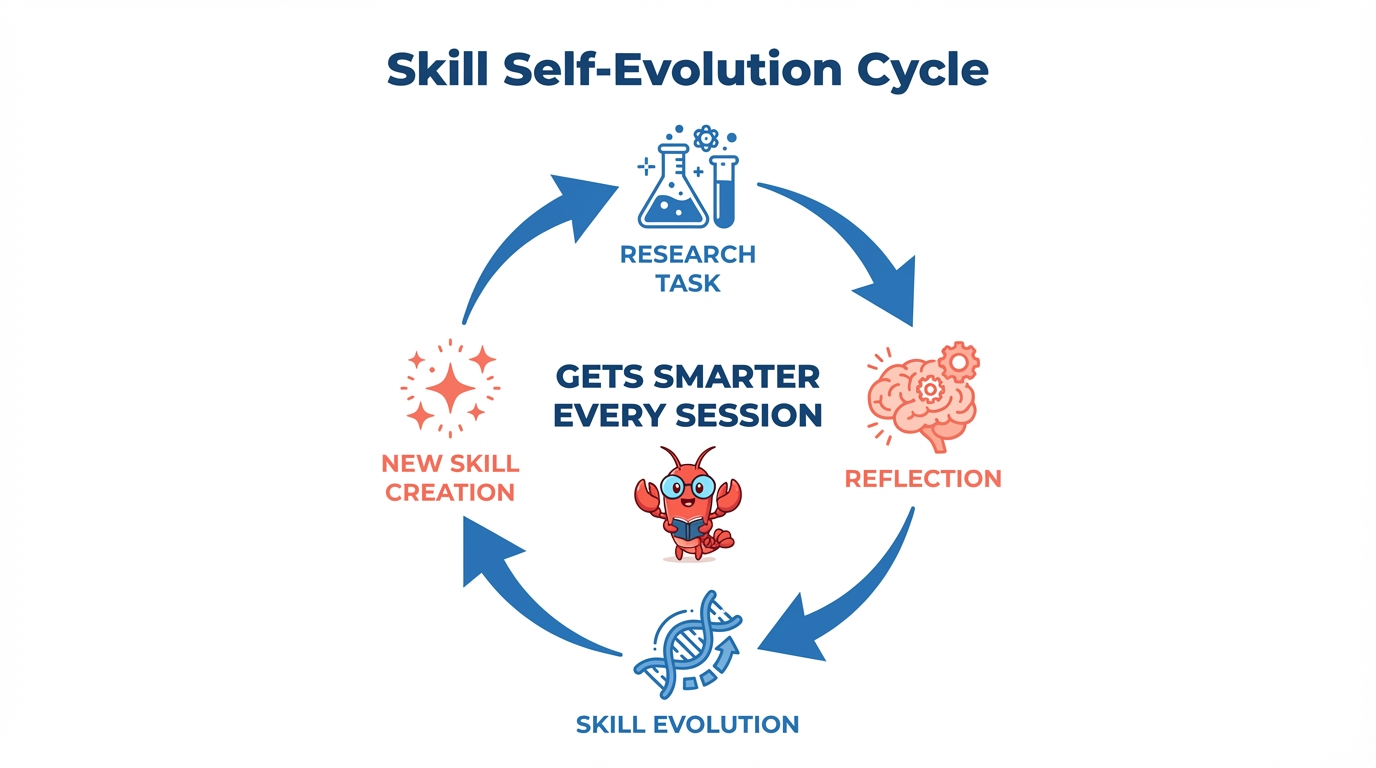
What this means in practice:
- Week 1: You study immunology. ScienceClaw learns that PubMed + Semantic Scholar works best for your queries, that you prefer forest plots over tables, and that you always need PMID + DOI in citations.
- Week 4: The system has created specialized skills for your subfield — optimized search templates, preferred statistical methods, database priority chains tuned to immunology literature.
- Month 3: ScienceClaw handles your domain like a trained research assistant. It knows which databases to hit first, which journals matter, and how you like your output formatted.
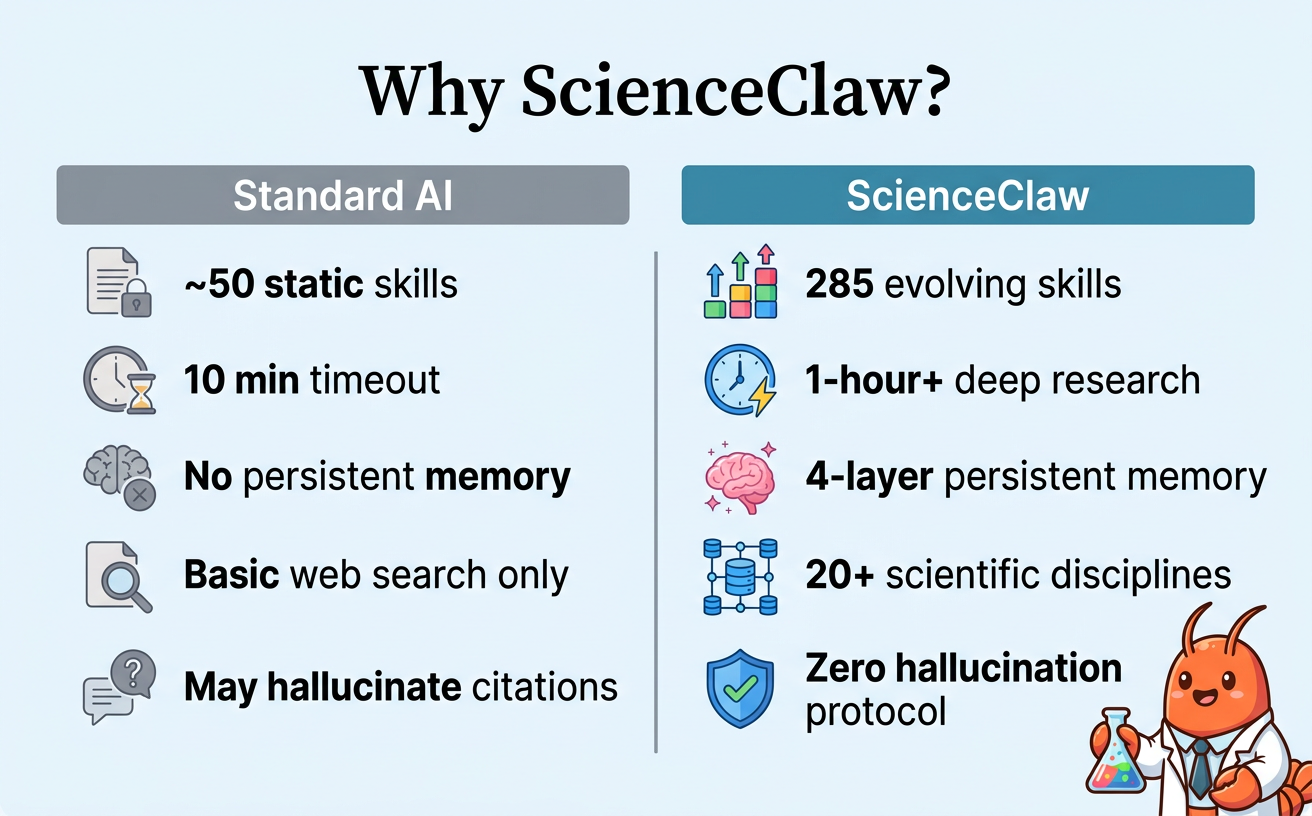
Compared to standard OpenClaw: OpenClaw ships with ~54 general-purpose skills that don't change. ScienceClaw starts with 285 skills and grows from there — the agent writes new
SKILL.mdfiles at runtime without any redeployment.
🧠 Core 2: Research Memory That Persists
Standard AI assistants forget everything when the conversation ends. ScienceClaw doesn't.
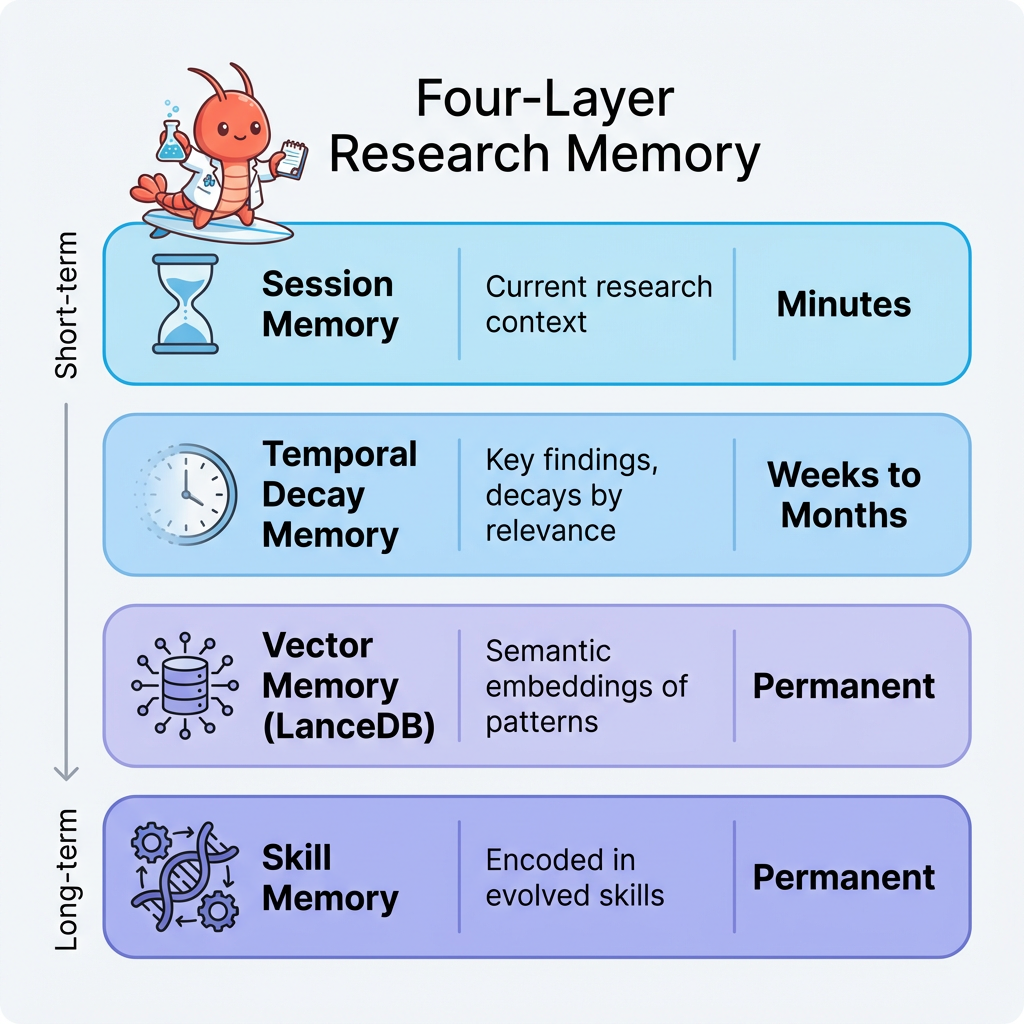
What this enables:
- "Continue the literature review we started last Tuesday" — it remembers where you left off
- "Use the same search strategy that worked for the BRCA2 project" — it retrieves past patterns
- Cross-session knowledge accumulation — findings from project A can inform project B
- Smart context pruning — when the context window fills up, it preserves statistical results, effect sizes, and key citations while compacting intermediate steps
Compared to standard OpenClaw: OpenClaw has a basic memory plugin. ScienceClaw adds temporal decay weighting, LanceDB vector storage, and cross-session research pattern retrieval — specifically designed for long-running academic work.
⏱️ Core 3: Built for Long-Duration Research
A real literature review takes hours, not seconds. Most AI tools time out after a few minutes. ScienceClaw is engineered for extended research sessions:
| Capability | Standard OpenClaw | ScienceClaw |
|---|---|---|
| Agent timeout | 600s (10 min) | 3600s (1 hour+) |
| Session persistence | Ends with conversation | Heartbeat keeps sessions alive across interruptions |
| Research depth | Single-pass response | Multi-phase protocol with mandatory depth thresholds |
| Minimum effort | No guarantee | Quick=5, Survey=30, Review=60, Systematic=100+ tool calls |
| Early stopping | Common | Anti-premature-conclusion checklist blocks shallow answers |
| Context management | Basic truncation | Smart compaction preserves key findings when context fills up |
The persistence protocol enforces real research depth. Before ScienceClaw concludes any task, it must verify:
- ✅ Searched at least 3 different databases/sources
- ✅ Retrieved full metadata (not just titles)
- ✅ Cross-referenced findings across sources
- ✅ Checked for contradictory evidence
- ✅ Verified key statistics against primary sources
- ✅ Organized results into a structured output file
- ✅ Met the minimum tool-call threshold for the task type
If any box is unchecked, it keeps working instead of giving you a half-baked answer.
Compared to standard OpenClaw: OpenClaw's default 10-minute timeout is fine for sending messages and setting reminders. ScienceClaw's 1-hour sessions with heartbeat monitoring and mandatory depth enforcement are built for real academic research.
🚫 Core 4: Zero Hallucination
This is the highest-priority rule in the entire system. It's non-negotiable.
The problem: General AI assistants routinely fabricate citations — inventing DOIs, making up author names, citing papers that don't exist. In scientific work, this is catastrophic.
ScienceClaw's approach:
EVERY citation must come from a tool result in the CURRENT conversation.

If a database didn't return it → you can't cite it.
If you're not sure → say "not verified" explicitly.
If you can't find evidence → say so. Don't guess.

No "I think." No "probably." No hallucinated PMIDs.
This is enforced at the protocol level in SCIENCE.md — the 629-line research protocol that governs all agent behavior. It's not a suggestion. It's a hard rule that applies before any other instruction.
Compared to standard OpenClaw: OpenClaw has no special hallucination controls. ScienceClaw's SCIENCE.md protocol treats every factual claim as requiring evidence — the same standard you'd apply to a manuscript under peer review.
🌍 Core 5: All of Science, Not Just Biomedicine
ScienceClaw covers natural sciences AND social sciences across dozens of disciplines:
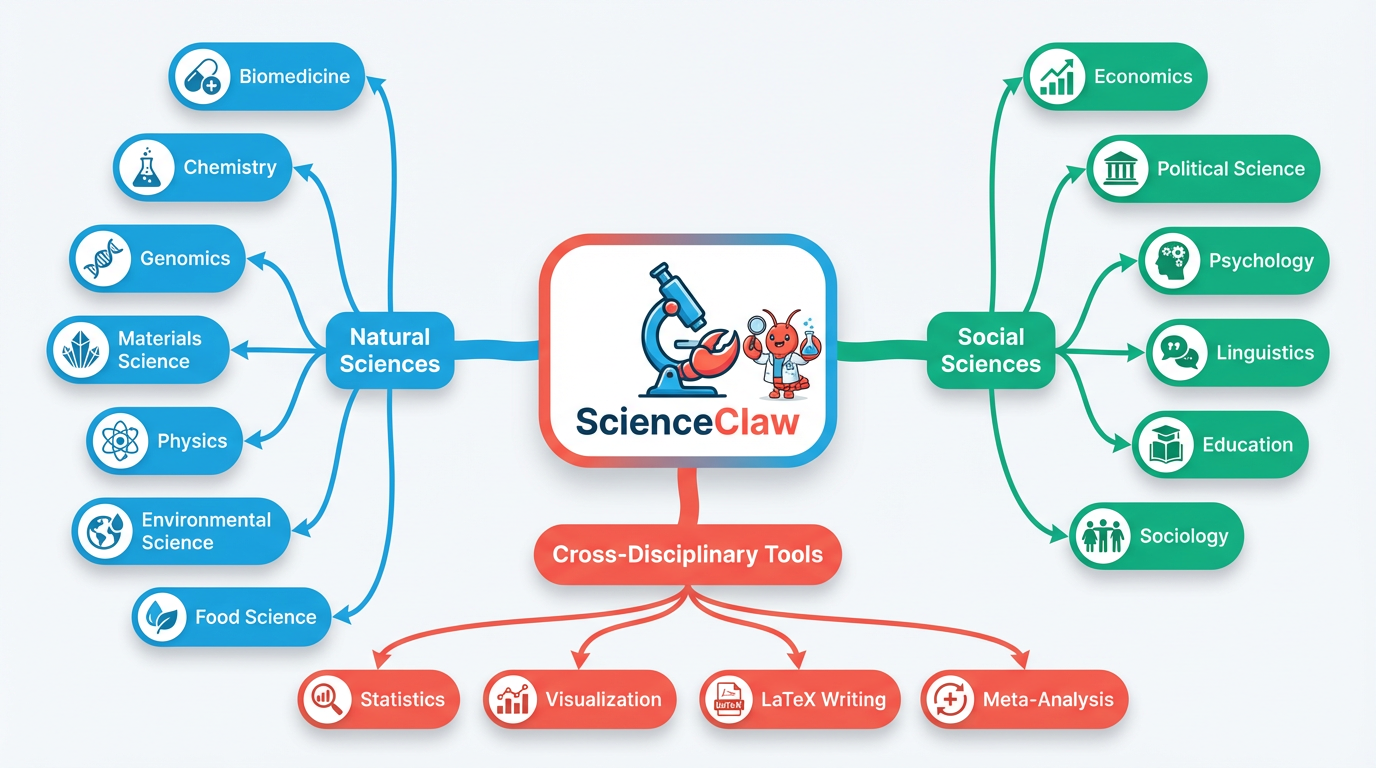
📋 Full discipline & database list
Natural Sciences
| Domain | Key Skills & Databases |
|---|---|
| Biomedicine | PubMed, UniProt, KEGG, PDB, ClinicalTrials, gnomAD, scanpy, biopython |
| Chemistry | PubChem, ChEMBL, RDKit, drug-discovery, molecular-dynamics |
| Genomics | NCBI Entrez, Ensembl, ClinVar, GEO, phylogenetics |
| Materials Science | Materials Project, pymatgen, materials-screening |
| Physics | astropy, quantum-computing, physics-solver, simulation |
| Environmental Science | Copernicus climate data, geospatial analysis, GIS tools |
| Food Science | Specialized analysis pipelines |
Social Sciences
| Domain | Key Skills & Databases |
|---|---|
| Economics | World Bank, SSRN, census data, econometrics |
| Political Science | Policy analysis, legislative data |
| Psychology | Experimental design, statistical testing, meta-analysis |
| Linguistics | spaCy, NLTK, NLP analysis |
| Education | Research methodology, assessment analysis |
| Sociology | Network analysis, survey methods |
Cross-Disciplinary Tools
| Category | Capabilities |
|---|---|
| Statistics | SciPy, statsmodels, scikit-learn, effect sizes, confidence intervals, multiple comparison corrections |
| Visualization | matplotlib, plotly, seaborn, publication-quality figures |
| Writing | LaTeX papers, systematic reviews (PRISMA), grant proposals, patent drafting |
| Mathematics | SymPy symbolic computation, numerical methods, optimization |
285 skills total — and growing, because the self-evolution system creates new ones as you work.
Compared to standard OpenClaw: OpenClaw has no scientific database integrations. No PubMed, no UniProt, no arXiv, no World Bank. ScienceClaw connects to 25+ academic databases with structured API query skills across all major scientific disciplines.
Quick Start
# Clone
git clone https://github.com/beita6969/ScienceClaw.git
cd ScienceClaw

# One-click setup (installs everything: Node, Python, MCP servers, skills)
chmod +x setup.sh && ./setup.sh

# Or manual install
pnpm install && npx openclaw onboard
Enable Research Features
The setup.sh script automatically configures everything. For manual setup, edit ~/.openclaw/openclaw.json:
{
  "gateway": { "mode": "local" },
  "plugins": {
    "slots": { "memory": "memory-core" },
    "entries": {
      "memory-core": { "enabled": true },
      "memory-lancedb": { "enabled": true }
    }
  },
  "agents": {
    "defaults": {
      "heartbeat": { "interval": 1800 }
    }
  }
}
Project Structure
ScienceClaw/
├── setup.sh                # 🦞 One-click setup (run this first!)
├── SCIENCE.md              # 629-line research protocol (the brain)
├── skills/                 # 285 skill definitions (and growing)
│   ├── skill-evolution/    # Self-improving skill system
│   ├── research-reflection/# Post-task learning & evaluation
│   ├── skill-creator/      # Runtime skill generation
│   └── ...
├── src/                    # Core engine
│   ├── memory/             # 4-layer memory (temporal decay, LanceDB)
│   ├── agents/             # Agent orchestration & persistence
│   └── skills/             # Skill loading & execution
├── ui/                     # Web-based research gateway UI
├── extensions/             # Plugin system
├── deploy/                 # Docker, Fly.io, Podman configs
├── config/                 # Vitest, build, lint configs
└── docs/                   # Documentation
Contact Us
License
MIT — see LICENSE.