Samyama Graph
A Rust-native graph-vector database for GraphRAG, knowledge graphs, and billion-edge analytics.
The graph database that queried 1 billion edges for $2.50





💬 Join the Samyama OSS community on WhatsApp — questions, help, and updates.
What is Samyama Graph?
Samyama Graph is a Rust-native graph-vector database that lets developers store, query, search, and analyze connected data in one system.
It brings together graph traversal, OpenCypher-style querying, vector search, graph algorithms, and Redis-compatible access, making it useful for GraphRAG, knowledge graphs, AI agent memory, and large-scale relationship analytics.
Quickstart
Option 1 — Run with Docker Compose
Step 1 — Prerequisites
- ✅ Docker Desktop installed and running — Watch setup video →
- ✅ No AWS account or credentials needed — the image is publicly available
Step 2 — Pull the Docker image
docker pull public.ecr.aws/f9f6l5u4/samyama-graph:1.1.0
Step 3 — Docker Compose setup
Create a clean folder, then create docker-compose.yml inside it.
Linux & Mac:
mkdir -p samyama-graph
cd samyama-graph
touch docker-compose.yml
Windows (PowerShell):
mkdir C:\samyama-graph
cd C:\samyama-graph
notepad docker-compose.yml
ℹ️ Replace
<your-openai-api-key>with your actual key. Generate one at platform.openai.com/api-keys.
version: "3.9"
services:
  samyama-graph:
    image: public.ecr.aws/f9f6l5u4/samyama-graph:1.1.0
    container_name: samyama-graph
    restart: unless-stopped
    ports:
      - "6379:6379"
      - "8080:8080"
    environment:
      EMBED_ENABLED: "true"
      EMBED_PROVIDER: openai
      EMBED_MODEL: text-embedding-3-small
      EMBED_API_KEY: <your-openai-api-key>
      EMBED_DIMENSION: 1024
    volumes:
      - samyama-data:/app/samyama_data
    networks:
      - samyama-network
networks:
  samyama-network:
    driver: bridge
volumes:
  samyama-data:
Step 4 — Start the server
docker compose up -d
Server will be available at http://localhost:8080
Step 5 — Verify it's running
docker ps
docker logs -f samyama-graph
You should see samyama-graph with status Up.
Step 6 — Samyama Visualizer
Visualize your imported graph data using the Samyama cloud visualizer at https://graph.samyama.cloud/
- Open https://graph.samyama.cloud/ in your browser.
- Sign up for a new account, or sign in if you already have one.
- From the left sidebar, click Home.
- In the connection field, enter your local graph server URL:
http://localhost:8080. - Click Connect — the status will change to Connected.
Step 7 — Optional: Load sample dataset Optional
7a — Download snapshot
| Dataset | Description | File |
|---|---|---|
| DBMS Research | Database management systems research knowledge graph | dbms-research.sgsnap |
Tip: Save the file in the same folder as docker-compose.yml to avoid path errors.
- Windows:
C:\samyama-graph\dbms-research.sgsnap - Linux / Mac:
./samyama-graph/dbms-research.sgsnap
7b — Create tenant
Linux & Mac:
curl -X POST http://localhost:8080/api/tenants \
  -H "Content-Type: application/json" \
  -d '{"id": "dbms-research", "name": "dbms-research"}'
Windows (PowerShell):
curl.exe -X POST http://localhost:8080/api/tenants `
  -H "Content-Type: application/json" `
  -d '{"id": "dbms-research", "name": "dbms-research"}'
7c — Import snapshot
Linux & Mac:
curl -X POST http://localhost:8080/api/snapshot/import \
  -F "file=@./samyama-graph/dbms-research.sgsnap" \
  -F "tenant_id=dbms-research"
Windows (PowerShell):
curl.exe -X POST http://localhost:8080/api/snapshot/import `
  -F "file=@C:\samyama-graph\dbms-research.sgsnap" `
  -F "tenant_id=dbms-research"
Note: On Windows always use curl.exe — PowerShell's curl alias does not support -F.
Step 8 — Stop / reset
Stop the server:
docker compose down
Reset all data (⚠️ deletes volume):
docker compose down -v
⚠️ This deletes all graph data stored in the Docker volume.
Option 2 — Build from source
System packages. zstd-sys generates its bindings with bindgen, which needs libclang.
Without it the build fails part-way through with a misleading 'stddef.h' file not found.
# Debian / Ubuntu
sudo apt-get install -y build-essential cmake pkg-config libssl-dev clang libclang-dev

# Fedora / RHEL
sudo dnf install -y gcc gcc-c++ cmake pkgconf-pkg-config openssl-devel clang clang-devel

# macOS — the Xcode Command Line Tools already provide clang
xcode-select --install
Then, with a stable Rust toolchain from rustup:
# Build from source
git clone https://github.com/samyama-ai/samyama-graph && cd samyama-graph
cargo build --release
./target/release/samyama    # RESP on :6379, HTTP on :8080
# Connect with any Redis client
redis-cli -p 6379
GRAPH.QUERY mydb "CREATE (a:Person {name: 'Alice'})-[:KNOWS]->(b:Person {name: 'Bob'})"
GRAPH.QUERY mydb "MATCH (a)-[:KNOWS]->(b) RETURN a.name, b.name"
What can you build with Samyama Graph?
Samyama Graph is useful when your application needs both connected-data reasoning and semantic retrieval.
You can use it to build:
- GraphRAG systems that combine vector search with graph traversal
- Knowledge graph applications for enterprise, research, healthcare, and operations data
- AI agent memory where entities, tools, actions, and context are stored as a graph
- Biomedical and clinical graphs across papers, trials, pathways, drugs, and conditions
- Fraud and investigation graphs for relationship discovery and pattern analysis
- Infrastructure and dependency graphs for impact analysis and root-cause exploration
- Large-scale graph analytics using built-in graph algorithms
We loaded the entire PubMed corpus — every article published since 1966 — plus ClinicalTrials.gov, Reactome pathways, and DrugBank into one graph. Then we asked:
"What drugs are most tested in cancer clinical trials?"
MATCH (m:MeSHTerm)<-[:ANNOTATED_WITH]-(a:Article)
      -[:REFERENCED_IN]->(t:ClinicalTrial)-[:TESTS]->(i:Intervention)
WHERE m.name = 'Neoplasms'
RETURN i.name, count(DISTINCT t) AS trials
ORDER BY trials DESC LIMIT 5
| Drug | Trials |
|---|---|
| Placebo | 521 |
| Pembrolizumab | 137 |
| Carboplatin | 106 |
| Paclitaxel | 106 |
| Cyclophosphamide | 98 |
5.2 seconds. One query. Four databases. 74 million nodes. 1 billion edges. A single machine.
See all 100 benchmark queries →
⭐ Find this useful? A GitHub star helps more developers discover Samyama Graph.
Demo
Cricket KG — 36K nodes, 1.4M edges, live graph simulation

Click for full demo (1:56)
Infrastructure failure-propagation
One query family — reachability, criticality, N-1 contingency — runs identically across infrastructure domains. Both demos use real CC BY 4.0 data.
Power Grid — IEEE 14-bus system (pglib-opf): degree centrality → connectivity → N-1 line contingency.

Telecom — GÉANT 2012 pan-European backbone (Internet Topology Zoo): 40 PoPs across 37 countries; N-1 link contingency exposes 8 single points of failure.

Case Studies — prove it yourself
case_studies/ lets anyone who clones this repo download a real
public knowledge graph, import it, run showcase Cypher (and vector search), and
render the session as a narrated GIF — one command, no database to install.
Every showcase query is gated to return real rows before any GIF is recorded
(see the Definition of Done).
cargo build --release && pip install rich requests
cd case_studies/cricket && ./run.sh          # fetch snapshot → import → validate → demo
RECORD=1 ./run.sh                            # also (re)generate demo.gif
Each snapshot is small enough to run on a laptop; every query returns real rows.
GIFs can't pause in a browser, so each domain also ships its demo.cast — replay
it pausably (space) with asciinema play case_studies/<domain>/demo.cast.
| Domain | Scale | Highlight | Snapshot | Demo |
|---|---|---|---|---|
| cricket | 37K / 1.4M | dismissal-rivalry networks, venues, awards | cricket.sgsnap | gif |
| drug-interactions | 245K / 388K | polypharmacy shared-target risk, CYP hubs | druginteractions.sgsnap | gif |
| surveillance | 217K / 241K | WHO disease burden + immunization gaps | surveillance.sgsnap | gif |
| health-determinants | 240K / 240K | air, water, poverty — the upstream "why" | health-determinants.sgsnap | gif |
| health-systems | 8.7K / 8.4K | WHO emergency-preparedness (SPAR) scores | health-systems.sgsnap | gif |
| pathways | 119K / 835K | protein hubs (TP53), pathway crosstalk | pathways.sgsnap | gif |
| dbms-research | 19K · 2 HNSW | vector search — semantic "nearest topics" | dbms-research.sgsnap | gif |
| imdb-movies | 1.94M / 2.63M | top-rated films, director–actor power pairs, genre trends, decade arcs | imdb.sgsnap | gif |
| football | 16K / 12K | top scorers, winning nations, busiest stadiums, multi-tournament veterans | football.sgsnap | gif |
surveillance + health-determinants + health-systems federate by Country.iso_code
into a public-health trifecta. Browse the catalogue →
Why Samyama Graph?
If your data has relationships, you need a graph database. If your graph database can't handle a billion edges on a single machine, you need Samyama.
| What | How |
|---|---|
| 74M nodes, 1B edges | Loaded PubMed + ClinicalTrials.gov + Reactome + DrugBank on one r6a.8xlarge ($2.50 spot) |
| 96/100 queries pass | Point lookups, multi-hop traversals, cross-KG aggregations — all verified |
| Parallel everything | Rayon: PageRank 3.1x, LCC 9.1x, Triangle Count 6x. Parallel scan, filter, compaction |
| 975 QPS concurrent | 16-client read workload, p99 < 25ms, zero errors across 67K queries |
| LDBC certified | SNB Interactive 21/21, FinBench 40/40, Graphalytics 12/12 |
The 30-Second Tour
Cypher queries — MATCH, CREATE, MERGE, aggregations, path finding, 30+ functions. Coverage against the openCypher TCK is not yet measured; see docs/CYPHER_COMPATIBILITY.md for a per-feature matrix verified by an executable probe.
MATCH (a:Person)-[:KNOWS*1..3]->(b:Person)
WHERE a.name = 'Alice'
RETURN b.name, length(shortestPath(a, b))
Graph algorithms — PageRank, WCC, SCC, BFS, Dijkstra, LCC, CDLP, Triangle Count. All rayon-parallelized.
CALL pagerank('social') YIELD nodeId, score
RETURN nodeId, score ORDER BY score DESC LIMIT 10
Vector search — HNSW indexing for semantic search and Graph RAG.
CREATE VECTOR INDEX paper_idx FOR (p:Paper) ON (p.embedding) OPTIONS {dimensions: 384, similarity: 'cosine'}

CALL vector.search('Paper', 'embedding', [0.1, 0.2, 0.3], 10) YIELD node, score
Natural language — Ask questions in English. The LLM translates to Cypher.
NLQ "Who are Alice's friends of friends that work at Google?"
→ MATCH (a:Person {name:'Alice'})-[:KNOWS]->()-[:KNOWS]->(fof)-[:WORKS_AT]->(c:Company {name:'Google'}) RETURN fof.name
AI agents — Auto-generated MCP servers from your graph schema.
pip install samyama[mcp]
samyama-mcp-serve --demo cricket    # Instant AI agent tools for any graph
Benchmarks
Run them: cargo bench --bench <name> (benches/). The vector,
optimization, and micro/MVCC suites are self-contained; LDBC needs a data download.
| Benchmark | Command | Measures | Data |
|---|---|---|---|
| Vector (HNSW) | cargo bench --bench vector_benchmark | build time, recall@k, search QPS (64–768 dim) | self-contained |
| Rao family | cargo bench --bench rao_family_benchmark | Jaya/Rao/BMR/NSGA-II on ZDT/DTLZ | self-contained |
| Graph optimization | cargo bench --bench graph_optimization_benchmark | 10+ metaheuristic solvers on allocation | self-contained |
| Graphalytics | cargo bench --bench graphalytics_benchmark | BFS, PageRank, WCC, CDLP, LCC, SSSP | synthetic / LDBC |
| Micro | cargo bench --bench graph_benchmarks | insertion, label scan, k-hop, filter, aggregate | self-contained |
| MVCC & arena | cargo bench --bench mvcc_benchmark | 1M-node alloc, version access, time-travel | self-contained |
| Late materialization | cargo bench --bench late_materialization_bench | raw vs lazy traversal vs Cypher | self-contained |
| LDBC SNB Interactive | cargo bench --bench ldbc_benchmark | 21 IS/IC queries + 8 updates | needs SF1 download |
| LDBC SNB BI | cargo bench --bench ldbc_bi_benchmark | 20 analytical (BI-1…20) | needs SF1 download |
| LDBC FinBench | cargo bench --bench finbench_benchmark | 40+ CR/SR/RW/W on financial networks | synthetic / download |
| Hierarchy (OEH) | cargo bench --bench hierarchy_benchmark | build, order test, roll-up vs subtree size | self-contained |
| HIER corpus | cargo run --release --example hier_benchmark | 112 hierarchy-heavy queries, index on vs off | self-contained |
HIER (benchmarks/hier/) is a category for subsumption and
hierarchical roll-up over time, geography and ontology — the workload the LDBC and FinBench
suites do not contain. Every query is checked against an unindexed run of the same
question, so a speedup is only reported alongside an identical answer. Latest: 108/108
agree; roll-up is flat at 15–20 ns from a 1-node subtree to a 137,257-node one. Against
Neo4j on an identical graph it is 94× faster across the 58 queries expressible on both,
with no class losing — though without the index Samyama is 1.6× slower than Neo4j, so the
index is the differentiator rather than the engine.
Scale: 74M Nodes, 1 Billion Edges
| KG | Source | Nodes | Edges |
|---|---|---|---|
| PubMed/MEDLINE | NLM | 66.2M | 1.04B |
| Clinical Trials | ClinicalTrials.gov | 7.8M | 27M |
| Pathways | Reactome | 119K | 835K |
| Drug Interactions | DrugBank + ChEMBL + SIDER | 245K | 388K |
Loaded in 31 minutes from snapshots. 96 of 100 queries return real data across all four KGs. Full results →
Cross-KG Query Highlights
| Query | Time | Result |
|---|---|---|
| Cancer → Trial interventions | 5.2s | Pembrolizumab #1 (137 trials) |
| Diabetes → Trial interventions | 2.4s | Metformin #1 (70 trials) |
| Metformin → Trial adverse events | 2.1s | Diarrhoea (185 trials) — known side effect confirmed |
| Cancer trial sites by country | 3.8s | US 4,062 · China 1,170 · France 827 |
| NCI-funded → Trial drugs | 19.4s | Cyclophosphamide (517) · Radiation (362) |
| Aspirin articles → Trials | 1.5s | NCT00000491 "Aspirin MI study" |
LDBC Compliance
| Benchmark | Pass Rate | Dataset |
|---|---|---|
| SNB Interactive | 21/21 (100%) | SF1: 3.18M nodes, 17.26M edges |
| SNB BI | 16/16 (100%) | SF1 |
| Graphalytics | 12/12 (100%) | XS reference graphs |
| FinBench | 40/40 (100%) | 7.7K nodes, 42.2K edges |
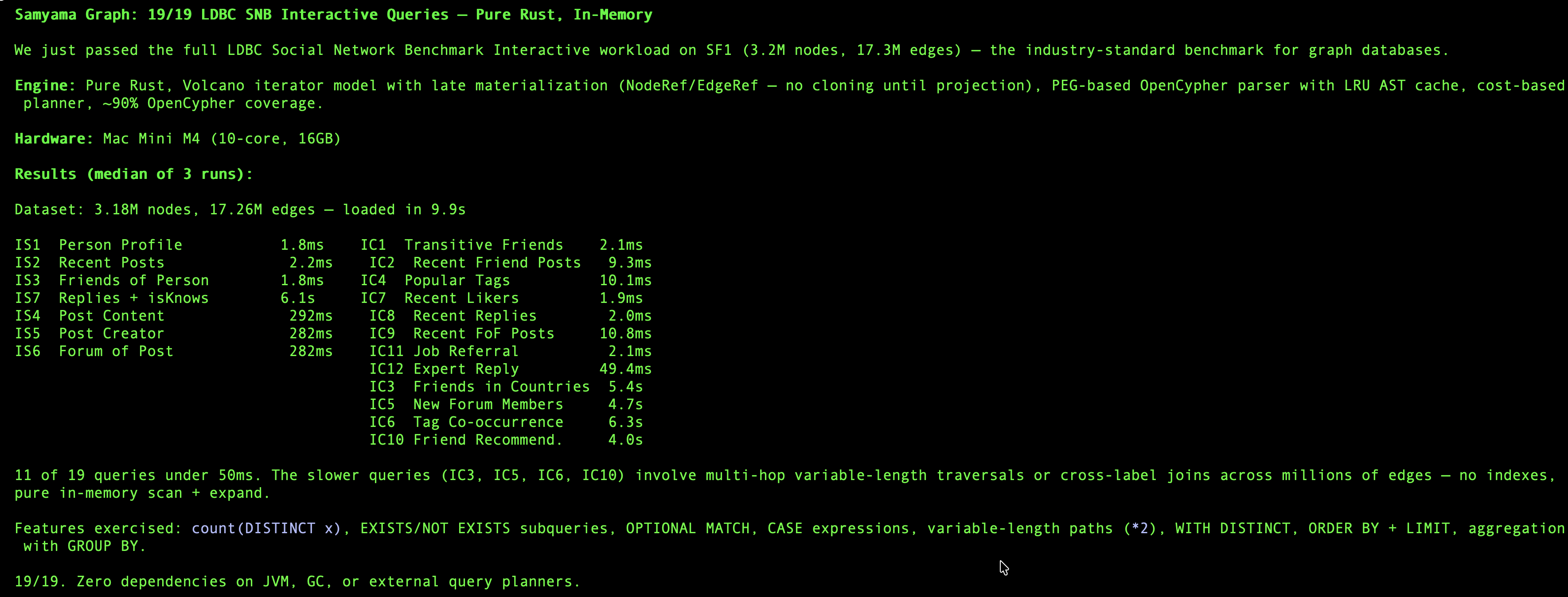
Concurrent Performance
| Workload | 1 client | 16 clients | Scaling |
|---|---|---|---|
| Pure read | 145 QPS | 975 QPS | 6.7x |
| Mixed 80/20 | 181 QPS | 722 QPS | 4.0x |
| Write-heavy | 279 QPS | 482 QPS | 1.7x |
Examples
Run them all in one command: ./scripts/run_all_examples.sh --batch builds
every example, starts a server, and runs each in turn with a pass/fail summary
(the orchestrator for the examples/ directory).
Domain Knowledge Graphs
| Domain | Command | What it shows |
|---|---|---|
| Banking & Fraud | cargo run --example banking_demo | Fraud patterns, money laundering, OFAC, NLQ |
| Clinical Trials | cargo run --example clinical_trials_demo | Patient-trial matching, drug interactions, vector search |
| Supply Chain | cargo run --example supply_chain_demo | Disruption analysis, port optimization (Jaya) |
| Manufacturing | cargo run --example smart_manufacturing_demo | Digital twin, failure cascades, scheduling |
| Social Network | cargo run --example social_network_demo | Influence, communities, recommendations |
| Enterprise SOC | cargo run --example enterprise_soc_demo | MITRE ATT&CK, attack paths, threat intel |
| Knowledge Graph | cargo run --example knowledge_graph_demo | Enterprise RAG + semantic search |
| Agentic (GAK) | cargo run --example agentic_enrichment_demo | Generation-augmented enrichment (needs claude CLI) |
| Raft Cluster | cargo run --example cluster_demo | 3-node HA consensus |
19 demo examples + 11 data loaders in examples/; optimization/use-case
demos: grid_dispatch_demo, amr_stewardship_demo, healthcare_allocation_demo,
wildfire_evac_demo, pca_demo, sdk_demo, …
Data Loaders
| Dataset | Command | Scale |
|---|---|---|
| LDBC SNB SF1 | cargo run --example ldbc_loader | 3.2M nodes, 17.3M edges |
| Clinical Trials | cargo run --release --example aact_loader | 7.8M nodes, 27M edges |
| Drug Interactions | cargo run --release --example druginteractions_loader | 245K nodes, 388K edges |
| Cricket | cargo run --release --example cricket_loader | 36K nodes, 1.4M edges |
| FinBench | cargo run --example finbench_loader | 7.7K nodes, 42K edges |
| IMDB Movies | cargo run --release --example imdb_loader -- --data-dir <path> | 1.94M nodes, 2.63M edges |
| Football | cargo run --release --example football_loader -- --data-dir <path> | 16K nodes, 12K edges |
Related Repositories
samyama-graph is the engine. Per-domain KGs and companion projects live separately and can be loaded into it:
- KGs: pubmed-kg (66M / 1B), clinicaltrials-kg (7.8M / 27M), druginteractions-kg (245K / 388K), pathways-kg (119K / 835K), cricket-kg (36K / 1.4M), imdb-kg (1.94M / 2.63M), football-kg (16K / 12K), assetops-kg (13K / 13K), powergrid-kg (pglib-opf — infrastructure), telecom-kg (Internet Topology Zoo — infrastructure)
- Benchmarks: biomedqa — 40-question pharmacology benchmark across three KGs
- Companions: graphrag-rs — doc-to-KG + MCP server; optimization_algorithms — PyPI
rao-algorithmspackage (PyO3 bindings overcrates/samyama-optimization/)
Architecture
samyama
├── graph/         Property graph model (Node, Edge, GraphStore, CSR adjacency)
├── query/         OpenCypher engine
│   ├── cypher.pest    PEG grammar
│   ├── executor/      Volcano iterator + WCO LeapFrog TrieJoin
│   └── planner.rs     Cost-based graph-native query planner
├── protocol/      RESP3 server (Redis-compatible, Tokio async)
├── persistence/   RocksDB + WAL + multi-tenancy
├── vector/        HNSW vector index
├── snapshot/      Portable .sgsnap v2 (CSR + ColumnStore)
├── raft/          Distributed consensus (openraft)
└── nlq/           Natural language → Cypher (OpenAI, Gemini, Ollama, Claude)
Companion crates:
- samyama-graph-algorithms — PageRank, BFS, Dijkstra, WCC, SCC, LCC, CDLP, Triangle Count (all rayon-parallelized)
- samyama-optimization — 15+ metaheuristic solvers (Jaya, Rao, GWO, NSGA-II, TLBO)
- samyama-sdk — Rust SDK with embedded and remote clients
Documentation
| Resource | Link |
|---|---|
| The Book | graph.samyama.cloud/book |
| Biomedical Benchmark | 100 queries, 96 pass |
| Cypher Compatibility | docs/CYPHER_COMPATIBILITY.md |
| LDBC Results | docs/BENCHMARKS.md |
| Architecture Decisions | docs/ADR/ |
| API Spec | api/openapi.yaml |
| Troubleshooting & Support | docs/TROUBLESHOOTING.md |
Enterprise Edition
Everything above is open source (Apache 2.0). Samyama Enterprise adds:
- GPU acceleration (wgpu + CUDA)
- OpenTelemetry OTLP metrics
- Prometheus + Grafana monitoring
- Backup & disaster recovery
- ADMIN commands + audit trail
- Ed25519 signed license tokens
Contributing
Contributions are welcome — bug reports, docs, tests, and code. See CONTRIBUTING.md for development setup, build/test commands, and the pull request workflow. Good first areas are listed there.
- 🐛 Found a bug or have an idea? Open an issue.
- 💬 Questions or general discussion? Join the community chat.
License
Apache License 2.0 — use it in production, contribute back if you'd like.
Samyama (Sanskrit: संयम) — the union of focused query, sustained analysis, and unified insight.