Chinese · English
🔬 Product Teardown Skill
Reverse-engineer any product as a system — and get a bilingual, print-ready HTML report. In one shot.








A Principal-PM-level product-teardown skill. Point it at any product (Linear, Notion, Cursor, Perplexity…) and it reverse-engineers the thing as a system — loops, strategy, moat, opportunities — then renders the analysis as a bilingual (EN + ZH), print-ready HTML report with an embedded product-screenshot gallery. Not a "5 things I like about this app" review. A structural read of why the product wins, where it leaks, and what the next move should be.
How it works — just 2 steps
Invoke the skill with anything like "teardown Linear" / "break down Notion" / "analyze Cursor" and it runs the same flow every time:
- Chat response — full teardown in 11 sections (Snapshot → Users & JTBD → Core Loop → Architecture → UX Quality → Business Model → Growth → AI Readiness → Friction → Opportunities → Final PM Verdict).
- HTML report auto-generates — two cross-linked files (EN + ZH, toggle in the bottom-right), saved to
~/Desktop/Claude skills/product-teardown-<slug>-{en,zh}-<yyyymm>.html. Print-optimized (Cmd+P → clean PDF).
Teardown Report · the 11-section spine
Every run ends with two single-file HTML reports at ~/Desktop/Claude skills/. Fixed 11-section spine, plus a product-tour gallery:
| # | Section | What it answers |
|---|---|---|
| — | Product Tour | 6 screenshots pulled from the product's own og:image marketing assets. |
| 1 | Snapshot | One-line pitch · category · stage · pricing · notable numbers. |
| 2 | Users & JTBD | Who hires this product, and for what job — including the replaced alternative. |
| 3 | Core Loop | The atomic user loop that makes the product habit-forming (or doesn't). |
| 4 | Architecture | Object model · surfaces · integrations · what's a primitive vs a feature. |
| 5 | UX Quality | Signature interactions, latency, information density, empty states. |
| 6 | Business Model | Monetization vector · unit economics · expansion path (PLG / sales / hybrid). |
| 7 | Growth | Acquisition loops · virality vector · retention hooks · notable moats. |
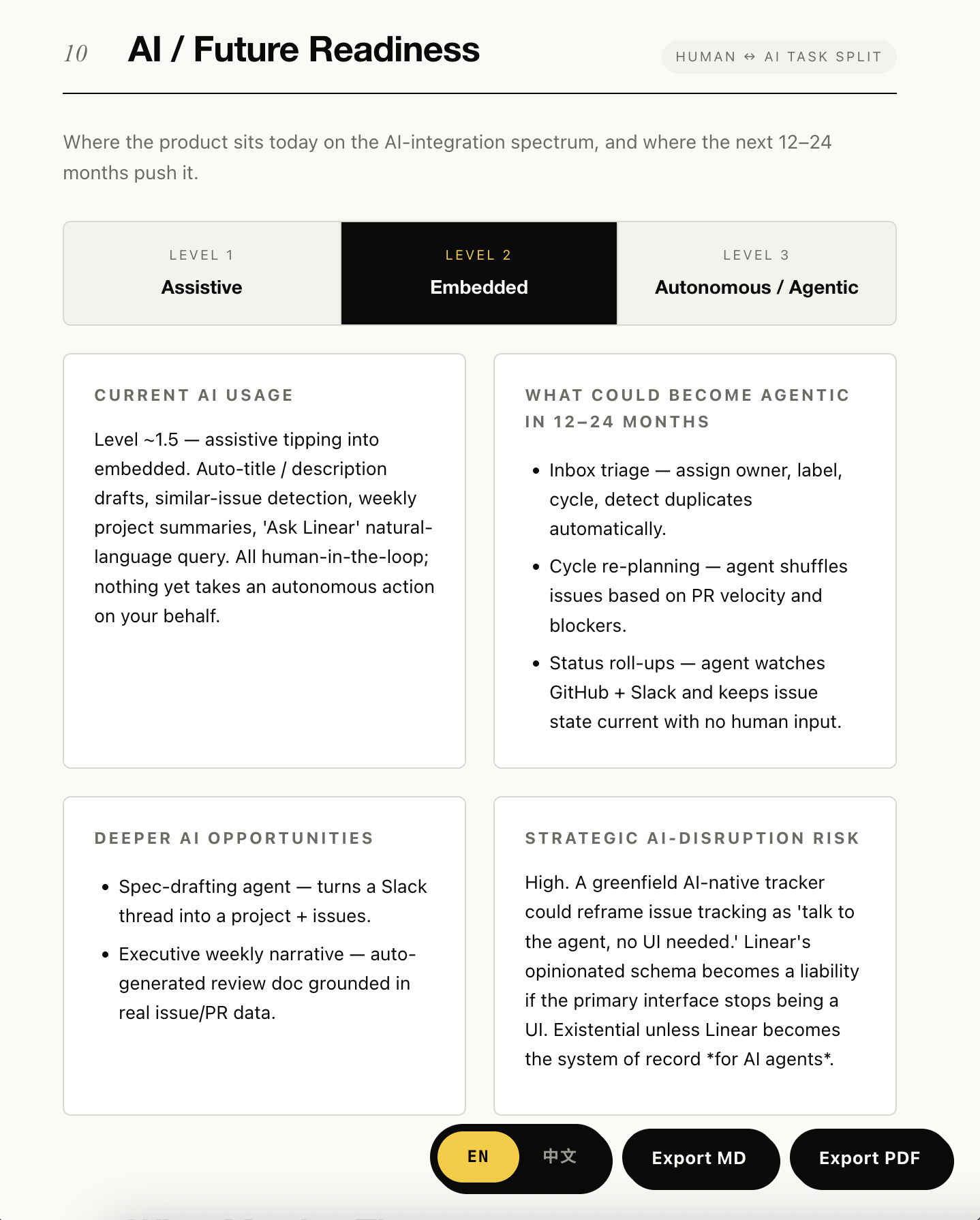
| 8 | AI Readiness | Assistive / Embedded / Autonomous — placed on the spectrum with evidence. |
| 9 | Friction | Where the product leaks — onboarding, mid-funnel, power-user ceiling. |
| 10 | Opportunities | 3–5 concrete next-move bets (features, wedges, adjacencies). |
| 11 | Final PM Verdict | The one sentence a Principal PM would write on the internal doc. |
Reports are print-optimized (Cmd+P → clean PDF) and cross-linked EN ↔ ZH via a bottom-right language switcher.
Example output · Linear teardown
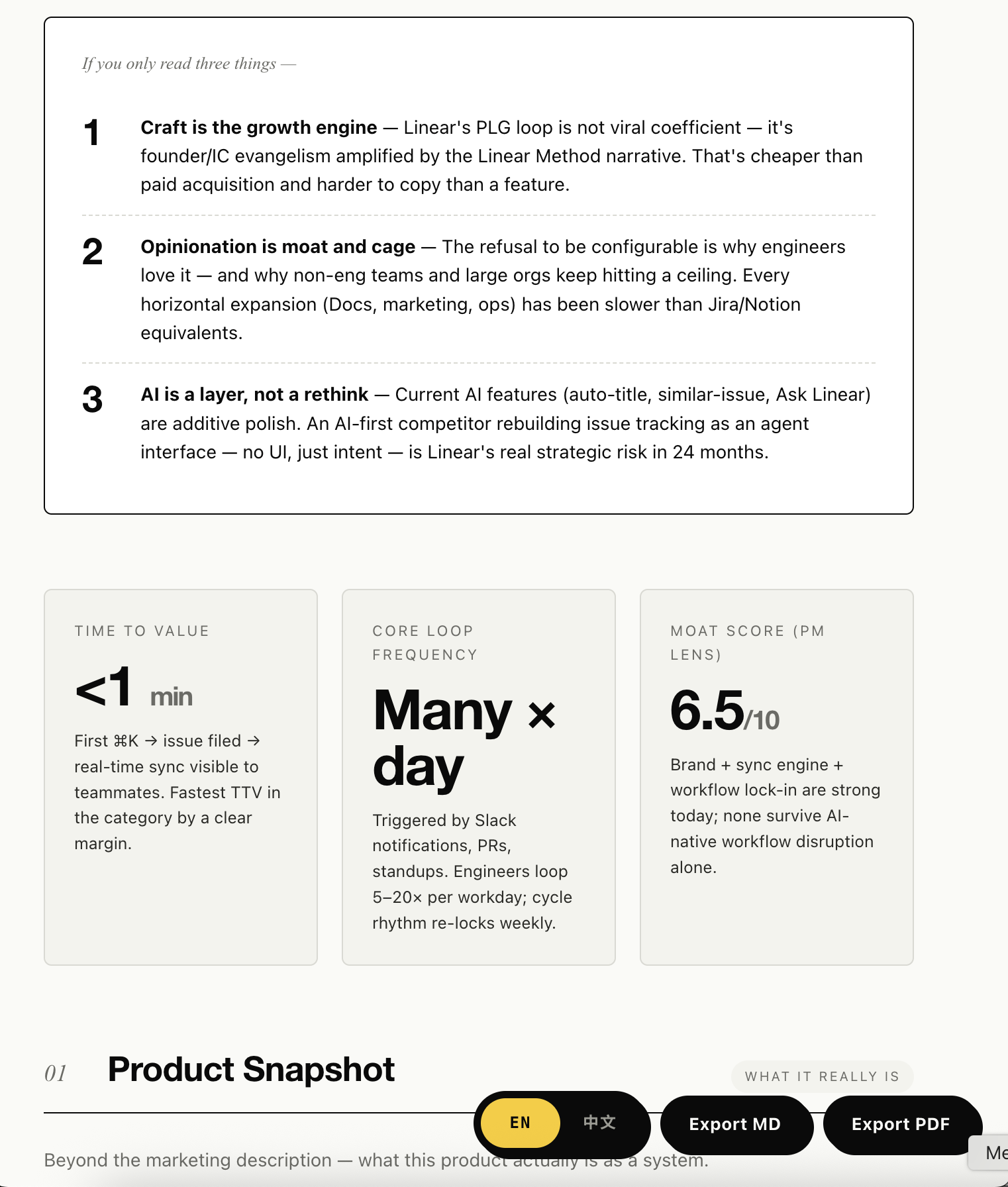
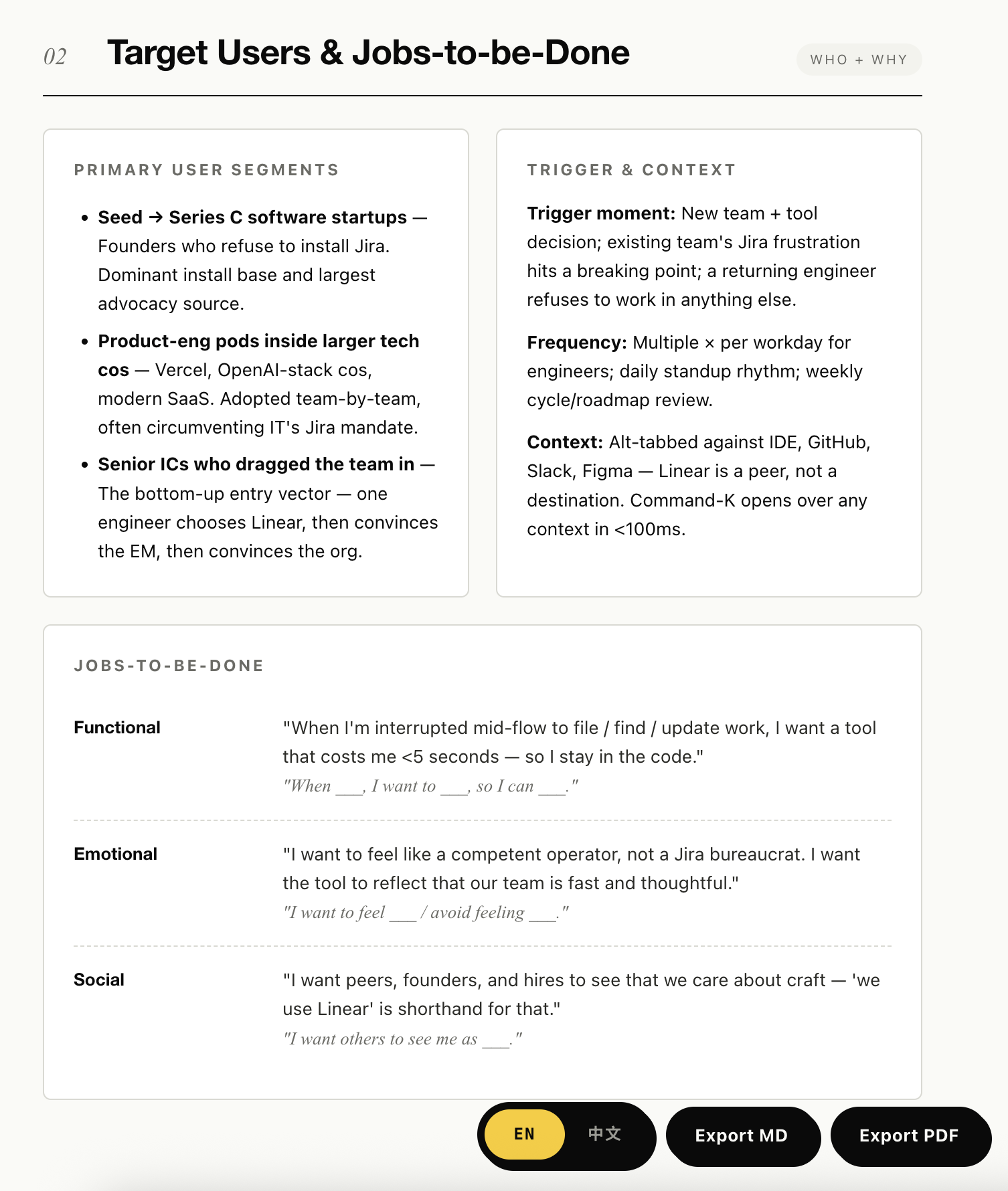
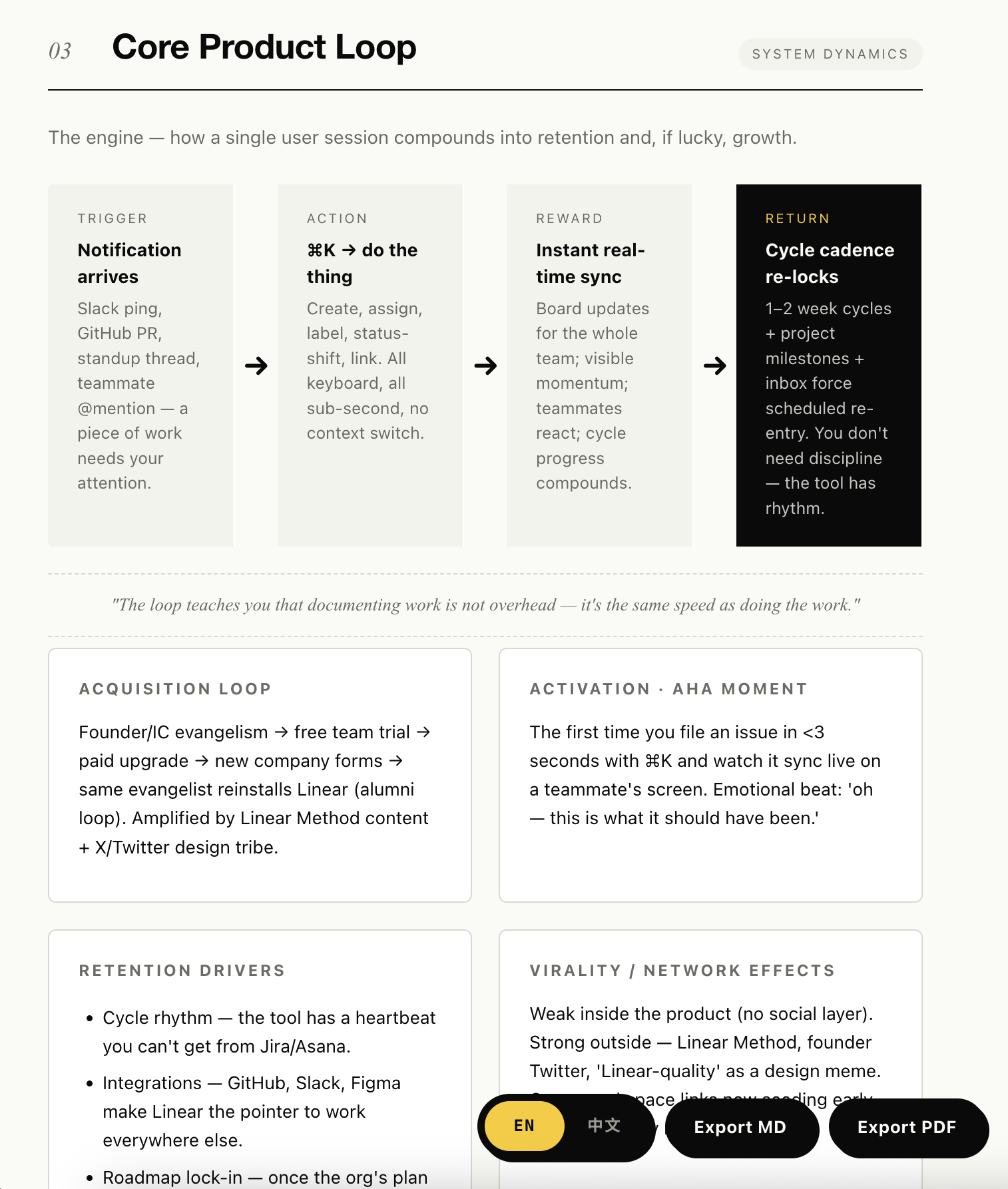
product-teardown-linear-en-202607.html + -zh- counterpart · cross-linked EN / ZH switcher · 6-image product tour · 11-section deep dive.
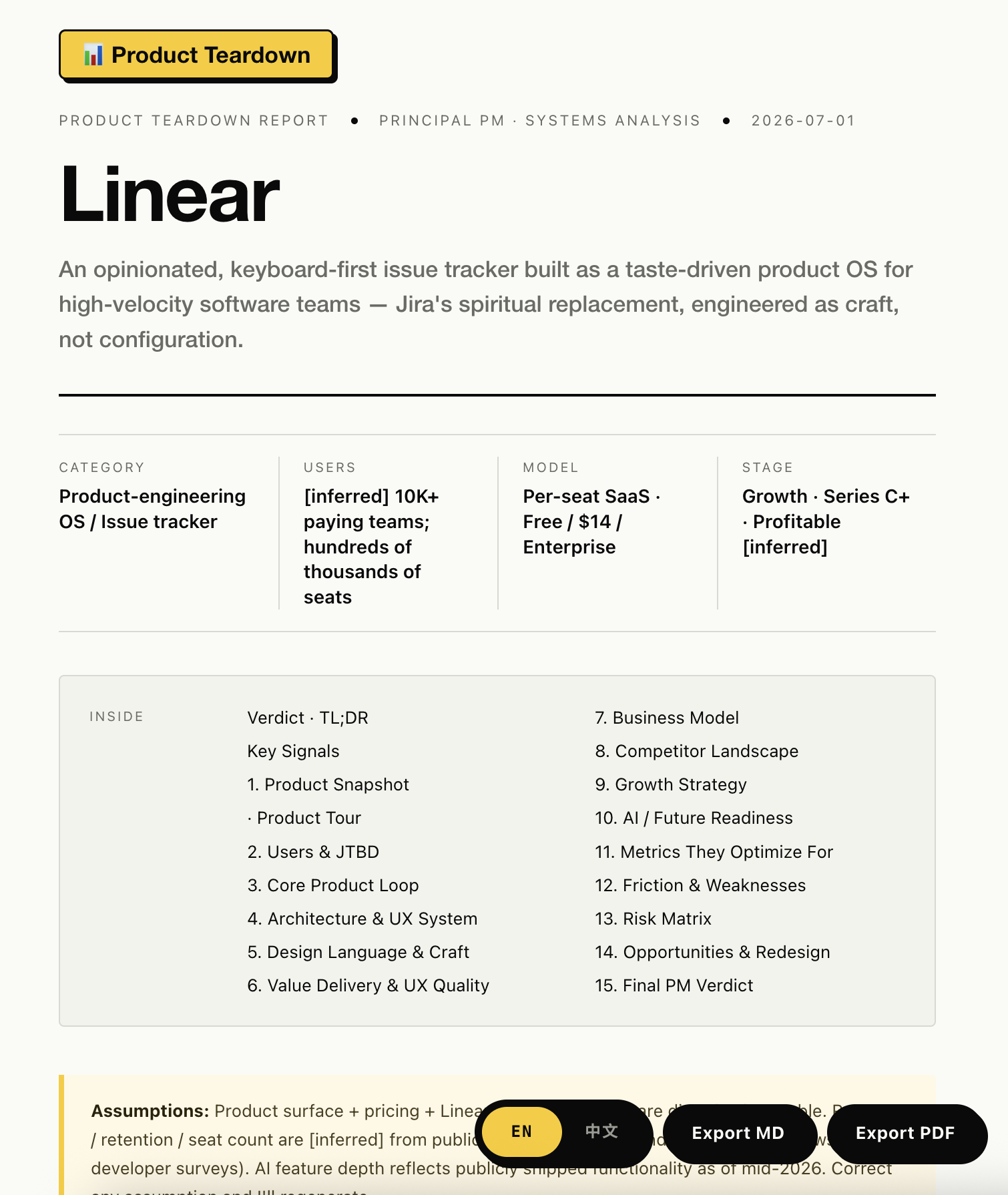
| TL;DR + key metrics | Users & JTBD | Core Product Loop |
|---|---|---|
 |  |  |
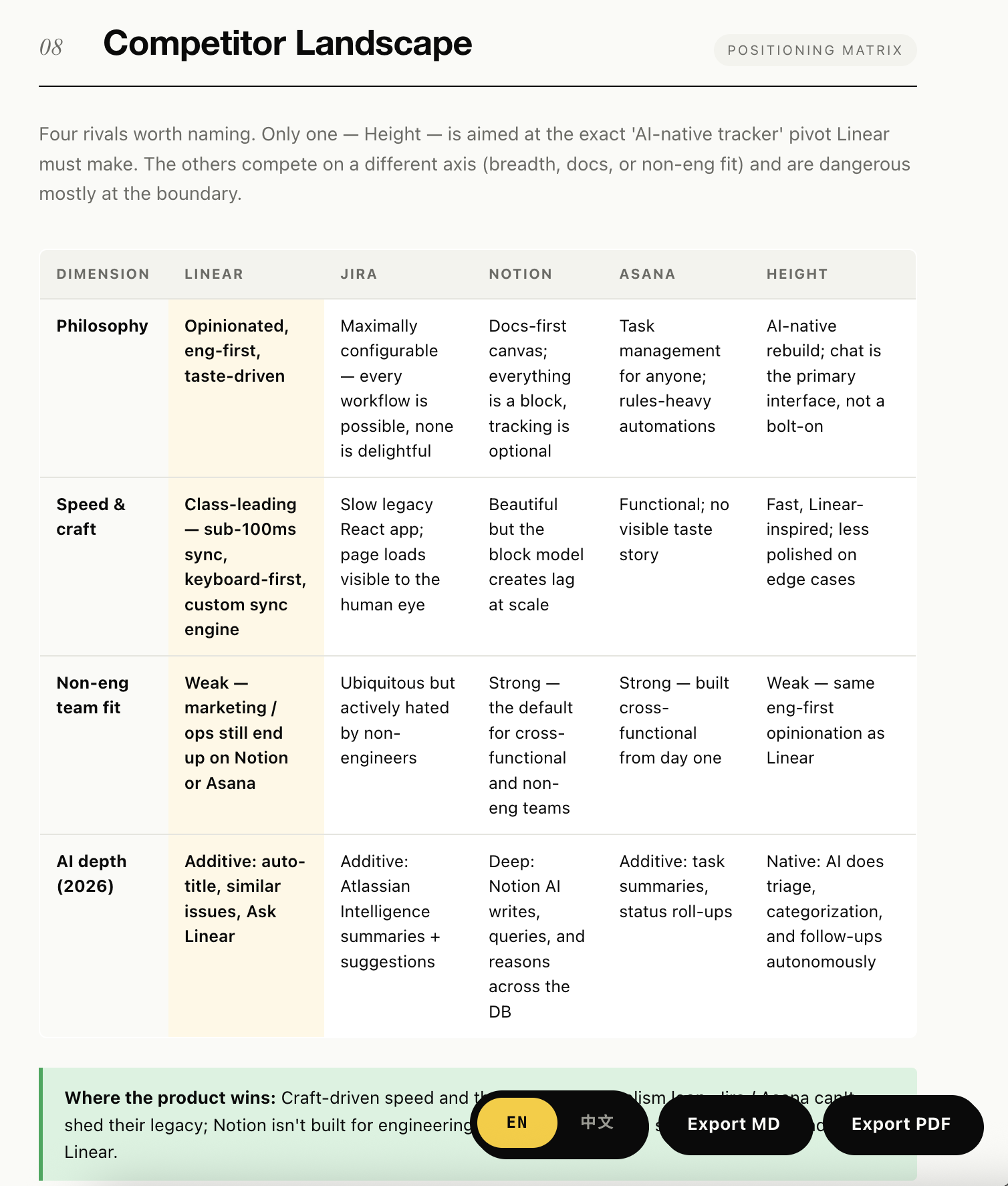
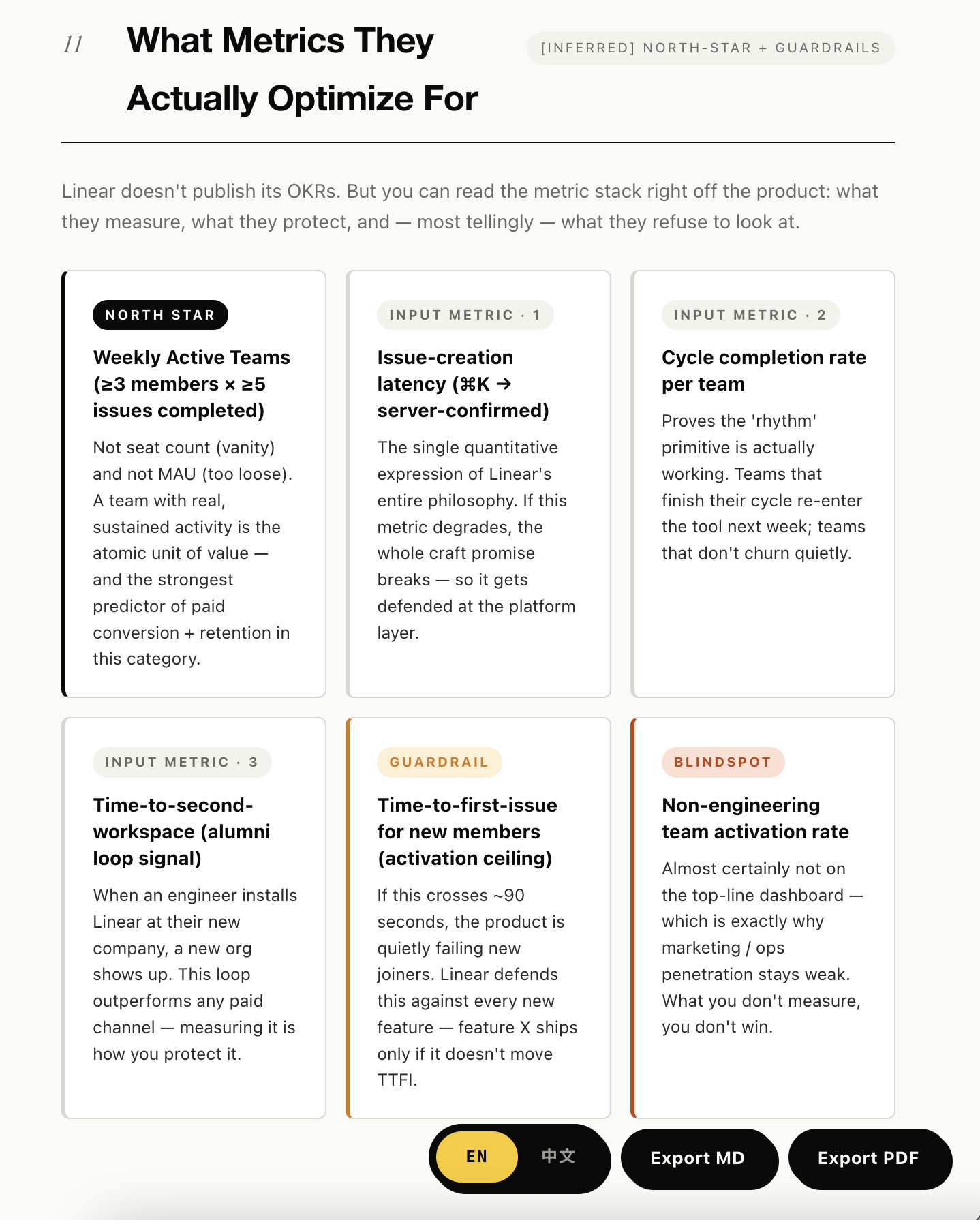
| Competitor Landscape | AI / Future Readiness | Metrics · North Star + Guardrails |
 |  |  |
Five design principles
- Structure over opinion. Every section answers a specific question. No "here's what I think about this app."
- Loops, not features. The Core Loop section is the spine of the teardown — features are downstream of the loop.
- AI placement is a spectrum, not a badge. Assistive / Embedded / Autonomous — pick one and defend it with evidence.
- Screenshots must come from the product itself. Pull from
og:imagemarketing assets (curl -s <url> | grep og:image), not random blog posts. - Bilingual by default. Every teardown ships EN + ZH in the same run, cross-linked. Not translated later.
Repo contents
product-teardown-skill/
├── product-teardown-prompt.md              # Portable skill prompt (paste into any tool)
├── templates/
│   ├── product-teardown-template-en.html   # English report template
│   └── product-teardown-template-zh.html   # Chinese report template (same placeholders)
└── scripts/
    ├── fill_linear.py                      # Reference implementation — renders both templates
    └── translate_template_zh.py            # One-shot: derives the ZH template from EN
- Aesthetic: cream paper + serif display + yellow accent. Print-optimized.
- Placeholders:
{{ALL_CAPS_KEYS}}. Fill viastr.replacewith keys sorted longest-first so prefixes don't collide. - AI meter: put
activeon exactly one of{{ACTIVE_IF_ASSISTIVE}}/{{ACTIVE_IF_EMBEDDED}}/{{ACTIVE_IF_AUTONOMOUS}}; empty on the other two. - Language switcher:
{{LANG_EN_HREF}}/{{LANG_ZH_HREF}}= target filenames;{{ACTIVE_IF_EN}}/{{ACTIVE_IF_ZH}}=activeon the file's own language. - Brand footer: contains
TEARDOWN.mark + LinkedIn / X / Xiaohongshu links. Do not remove.
Use as a VS Code slash command
Copy product-teardown-prompt.md into your VS Code prompts folder as product-teardown.prompt.md and invoke via /product-teardown <product name>.
macOS: ~/Library/Application Support/Code/User/prompts/
How it thinks
- A product is a system, not a screen. The screen is what you see; the loop is what makes it work. The teardown always finds the loop first, then works outward to surfaces, business model, and moat.
- JTBD beats persona. "Who uses it" is less useful than "what did they hire it to replace." The interesting answer is almost never the obvious one.
- AI readiness is a placement problem, not a checkbox. Every AI feature sits somewhere on Assistive → Embedded → Autonomous. Naming the point is the analysis.
- Opportunities must be actionable. No "they should add AI." Every opportunity in §10 is a concrete wedge you could ship next quarter.
License
MIT — fork it, remix it, ship your own version.
Created by Dreameryanyan · LinkedIn · X · Xiaohongshu