
mcptools

by posit-devVerified

Model Context Protocol For R

193
Stars
18
Forks
R
Language
8/23/2026
Added
View on GitHubDownload ZIP

⚠️ Third-Party Software Notice

This skill is third-party open-source software developed and hosted independently on GitHub. SkillTip is an informational directory and does not control or maintain the underlying repository. Any security checks displayed are automated and limited in scope. Review the source code before installing.

Read the Terms of Service

Installation

Add to your Claude Code skills directory:

# Add to your Claude Code skills
git clone https://github.com/posit-dev/mcptools

Getting Started

Guides for using skills like mcptools.

Security Report

Verified

Last scanned: —

{
  "status": "PASSED",
  "issues": []
}

README.md

mcptools A hexagonal logo showing a bridge connecting two portions of a forested meadow.

Lifecycle:
experimental CRAN
status R-CMD-check

mcptools implements the Model Context Protocol in R. There are two sides to mcptools:

R as an MCP server:
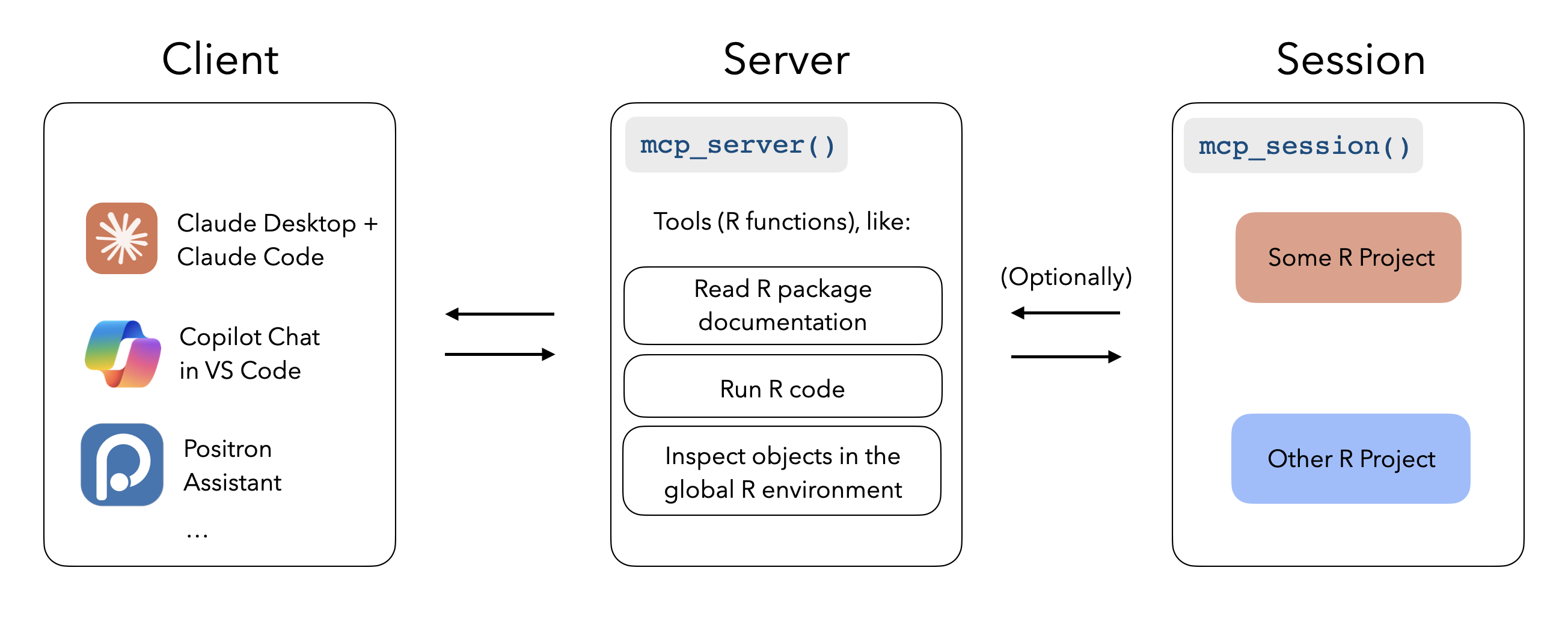
A system architecture diagram showing three main components: Client (left), Server (center), and Session (right). The Client box lists AI coding assistants including Claude Desktop, Claude Code, Copilot Chat in VS Code, and Positron Assistant. The Server is initiated with `mcp_server()` and contains tools for R functions like reading package documentation, running R code, and inspecting global environment objects. Sessions can be configured with `mcp_session()` and can optionally connect to interactive R sessions, with two example projects shown: 'Some R Project' and 'Other R Project'.

When configured with mcptools, MCP-enabled tools like Claude Desktop, Claude Code, and VS Code GitHub Copilot can run R code in the sessions you have running to answer your questions. While the package supports configuring arbitrary R functions, you may be interested in the btw package’s integrated support for mcptools, which provides a default set of tools to to peruse the documentation of packages you have installed, check out the objects in your global environment, and retrieve metadata about your session and platform.

R as an MCP client:
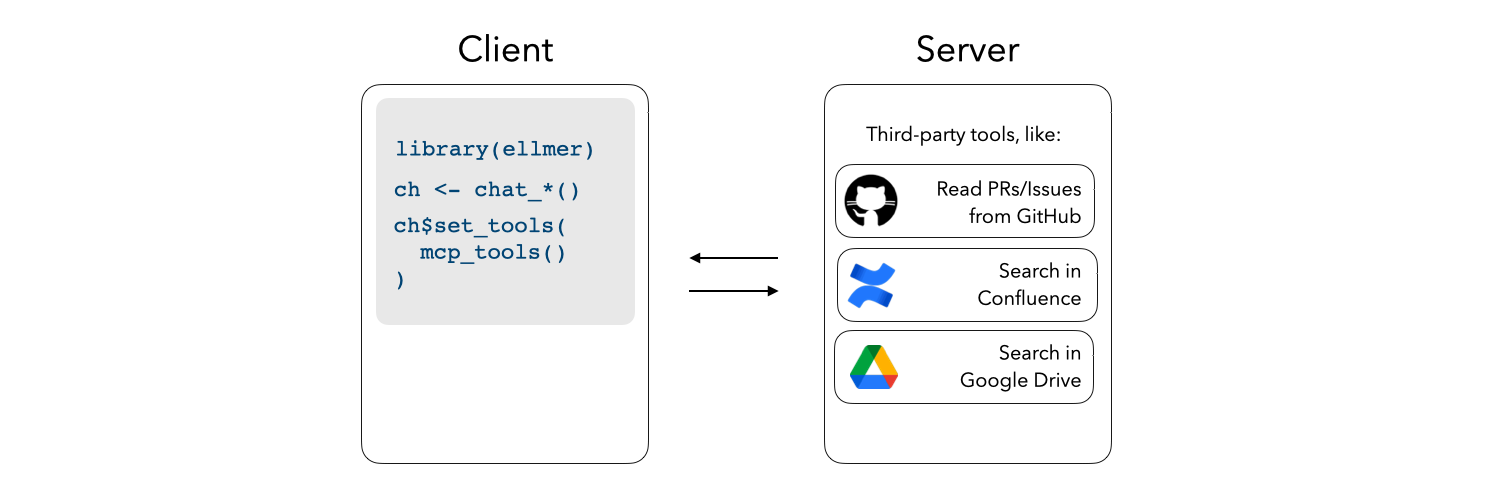
An architecture diagram showing the Client (left) with R code using the ellmer library to create a chat object and then setting tools from mcp with `mcp_tools()`, and the Server (right) containing third-party tools including GitHub (for reading PRs/Issues), Confluence (for searching), and Google Drive (for searching). Bidirectional arrows indicate communication between the client and server components.

Register third-party MCP servers with ellmer chats to integrate additional context into e.g. shinychat and querychat apps.

Installation

Install mcptools from CRAN with:

install.packages("mcptools")

You can install the development version of mcptools like so:

pak::pak("posit-dev/mcptools")

R as an MCP server

mcptools can be hooked up to any application that supports MCP. For example, to use with Claude Desktop, you might paste the following in your Claude Desktop configuration (on macOS, at ~/Library/Application Support/Claude/claude_desktop_config.json):

{
  "mcpServers": {
    "r-mcptools": {
      "command": "Rscript",
      "args": ["-e", "mcptools::mcp_server()"]
    }
  }
}

Or, to use with Claude Code, you might type in a terminal:

claude mcp add -s "user" r-mcptools -- Rscript -e "mcptools::mcp_server()"

Then, if you’d like models to access variables in specific R sessions, call mcptools::mcp_session() in those sessions. (You might include a call to this function in your .Rprofile, perhaps using usethis::edit_r_profile(), to automatically register every session you start up.)

To deploy an HTTP MCP server to Posit Connect, add a _server.yml file with engine: mcptools and a tools file:

engine: mcptools
tools: tools.R

Deploy the directory as an R API and mark it as MCP content:

rsconnect::deployAPI(".", contentCategory = "mcp")

If the content URL is https://connect.example.com/content/abc123/, use https://connect.example.com/content/abc123/mcp as the MCP endpoint.

If you cannot set contentCategory = "mcp" during deployment, set the MCP category in Connect after deploying and set minimum processes to at least 1.

R as an MCP client

mcptools uses the Claude Desktop configuration file format to register third-party MCP servers, as most MCP servers provide setup instructions for Claude Desktop in their documentation. For example, here’s what the official GitHub MCP server configuration would look like:

{
  "mcpServers": {
    "github": {
      "command": "docker",
      "args": [
        "run",
        "-i",
        "--rm",
        "-e",
        "GITHUB_PERSONAL_ACCESS_TOKEN",
        "ghcr.io/github/github-mcp-server"
      ],
      "env": {
        "GITHUB_PERSONAL_ACCESS_TOKEN": "<YOUR_TOKEN>"
      }
    }
  }
}

Once the configuration file has been created (by default, mcptools will look to file.path("~", ".config", "mcptools", "config.json")), mcp_tools() will return a list of ellmer tools which you can pass directly to the $set_tools() method from ellmer:

ch <- ellmer::chat_anthropic()
ch$set_tools(mcp_tools())

ch$chat("What issues are open on posit-dev/mcptools?")

Example

In Claude Desktop, I’ll write the following:

“From what year is the earliest recorded sample in the forested data in my Positron session?”

Without mcptools, Claude couldn’t get far here; by default, it can’t run R code and doesn’t have any way to “speak to” my interactive R sessions.

A screencast of a chat with Claude. After the question is asked, a tool called 'describe data frame' is called with the `data_frame` argument set to `forested`. The results are returned from mcptools as json, which the model then integrates into its response: 'Based on the data structure, I can see there's a `year` column with values ranfing from 1995 to 2024. The earliest recorded sample in the `forested` data is from 1995.'

Using the package, the model asks to describe the data frame using a structure that will show summary statistics from the data. mcptools will appropriately route the request to the open Positron session, forwarding the results back to the model for it to situate in a response.

Frequently Asked Questions

What is mcptools?

mcptools is an open-source mcp servers skill for AI coding assistants such as Claude Code, Codex CLI, and ChatGPT, built by posit-dev. Model Context Protocol For R. It has 193 GitHub stars.

Is mcptools safe to use?

Yes. mcptools passed SkillsLLM's automated security scan — a dependency vulnerability audit plus prompt-injection heuristics — with no high-severity issues. You can read the full report in the Security Report section on this page.

How do I install mcptools?

Clone the repository with "git clone https://github.com/posit-dev/mcptools" and add it to your Claude Code skills directory (see the Installation section above).

What programming language is mcptools written in?

mcptools is primarily written in R. It is open-source under posit-dev on GitHub, so you can review or fork the full source.

Are there alternatives to mcptools?

Yes. SkillsLLM lists many other MCP Servers skills you can browse and compare side by side. Open the MCP Servers category from the badge at the top of this page, or use the Related Skills and comparison links further down to weigh mcptools against similar tools.

Comments (0)

No comments yet. Be the first to share your thoughts!

n8n

by n8n-io

12

Fair-code workflow automation platform with native AI capabilities. Combine visual building with custom code, self-host or cloud, 400+ integrations.

201,88160,308TypeScript
MCP Serversapisai-tools
View details

Scrapling

by D4Vinci

🕷️ An adaptive Web Scraping framework that handles everything from a single request to a full-scale crawl!

75,9137,581Python
MCP Servers
View details

TrendRadar

by sansan0

⭐AI-driven public opinion & trend monitor with multi-platform aggregation, RSS, and smart alerts.🎯 告别信息过载,你的 AI 舆情监控助手与热点筛选工具!聚合多平台热点 + RSS 订阅,支持关键词精准筛选。AI 智能筛选新闻 + AI 翻译 + AI 分析简报直推手机,也支持接入 MCP 架构,赋能 AI 自然语言对话分析、情感洞察与趋势预测等。支持 Docker ,数据本地/云端自持。集成微信/飞书/钉钉/Telegram/邮件/ntfy/bark/slack 等渠道智能推送。

61,65224,883Python
MCP Servers
View details

context7

by upstash

Context7 Platform -- Up-to-date code documentation for LLMs and AI code editors

61,0602,938TypeScript
MCP Servers
View details

High-performance code intelligence MCP server. Indexes codebases into a persistent knowledge graph — average repo in milliseconds. 158 languages, sub-ms queries, 99% fewer tokens. Single static binary, zero dependencies.

39,9393,219C
MCP Servers
View details

Developers Also Liked

Based on votes and bookmarks from developers who liked this skill

ECC

by affaan-m

10

The agent harness performance optimization system. Skills, instincts, memory, security, and research-first development for Claude Code, Codex, Opencode, Cursor and beyond.

242,21936,702JavaScript
AI Agentsai-agentsanthropicclaude-code
View details
15

An agentic skills framework & software development methodology that works.

234,96620,863Shell
AI Agentsai-agentsbrainstorming
View details

n8n

by n8n-io

12

Fair-code workflow automation platform with native AI capabilities. Combine visual building with custom code, self-host or cloud, 400+ integrations.

201,88160,308TypeScript
MCP Serversapisai-tools
View details

The agent harness performance optimization system. Skills, instincts, memory, security, and research-first development for Claude Code, Codex, Opencode, Cursor and beyond.

185,94028,768JavaScript
AI Agentsai-agentsanthropicclaude-code
View details

cc-switch

by farion1231

3

A cross-platform desktop All-in-One assistant for Claude Code, Codex, OpenCode, OpenClaw, Grok Build & Hermes Agent. Only official website: ccswitch.io

128,8688,826Rust
AI Agentsclaude-codeai-tools
View details