Pi Agent
English | 简体中文
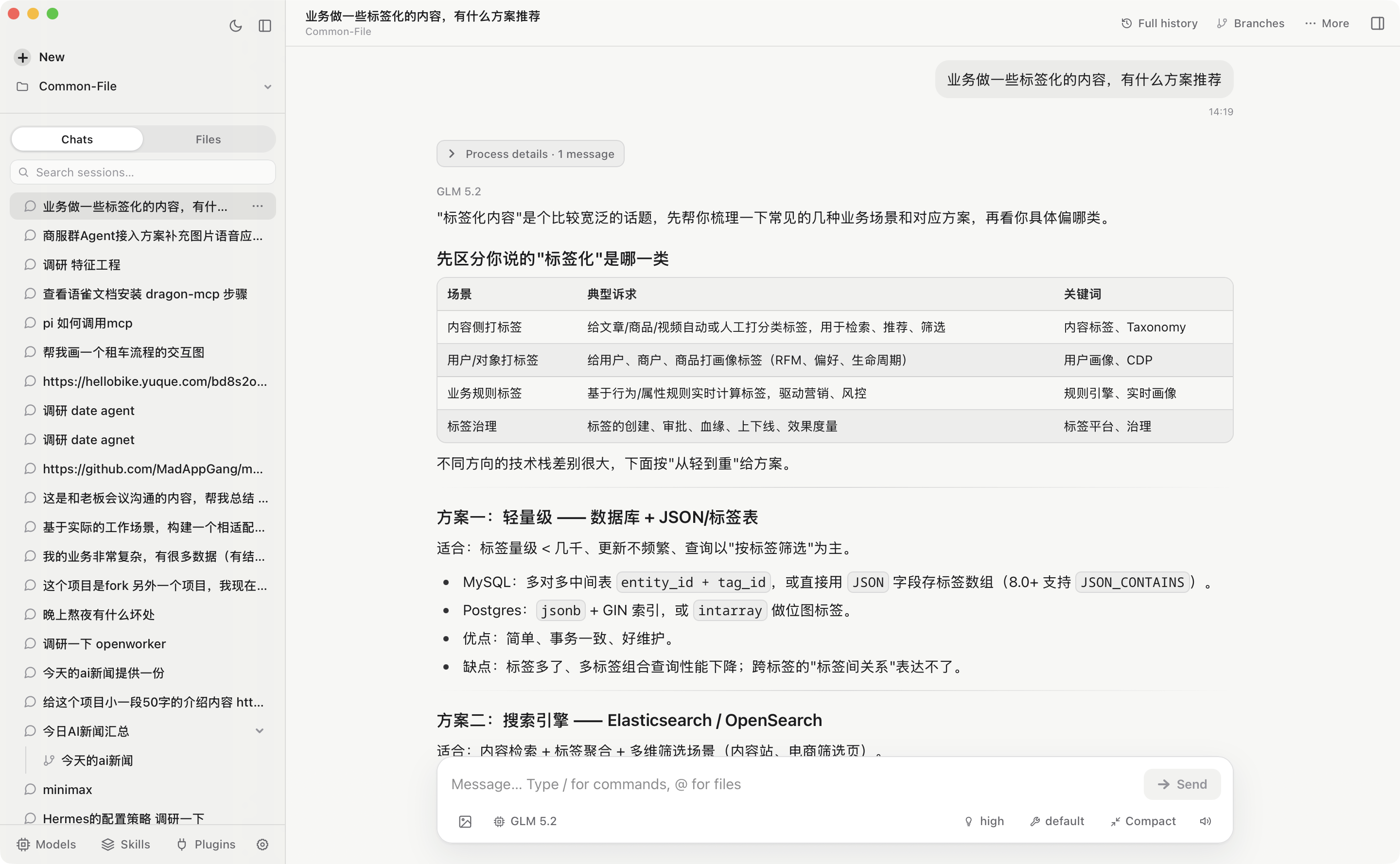
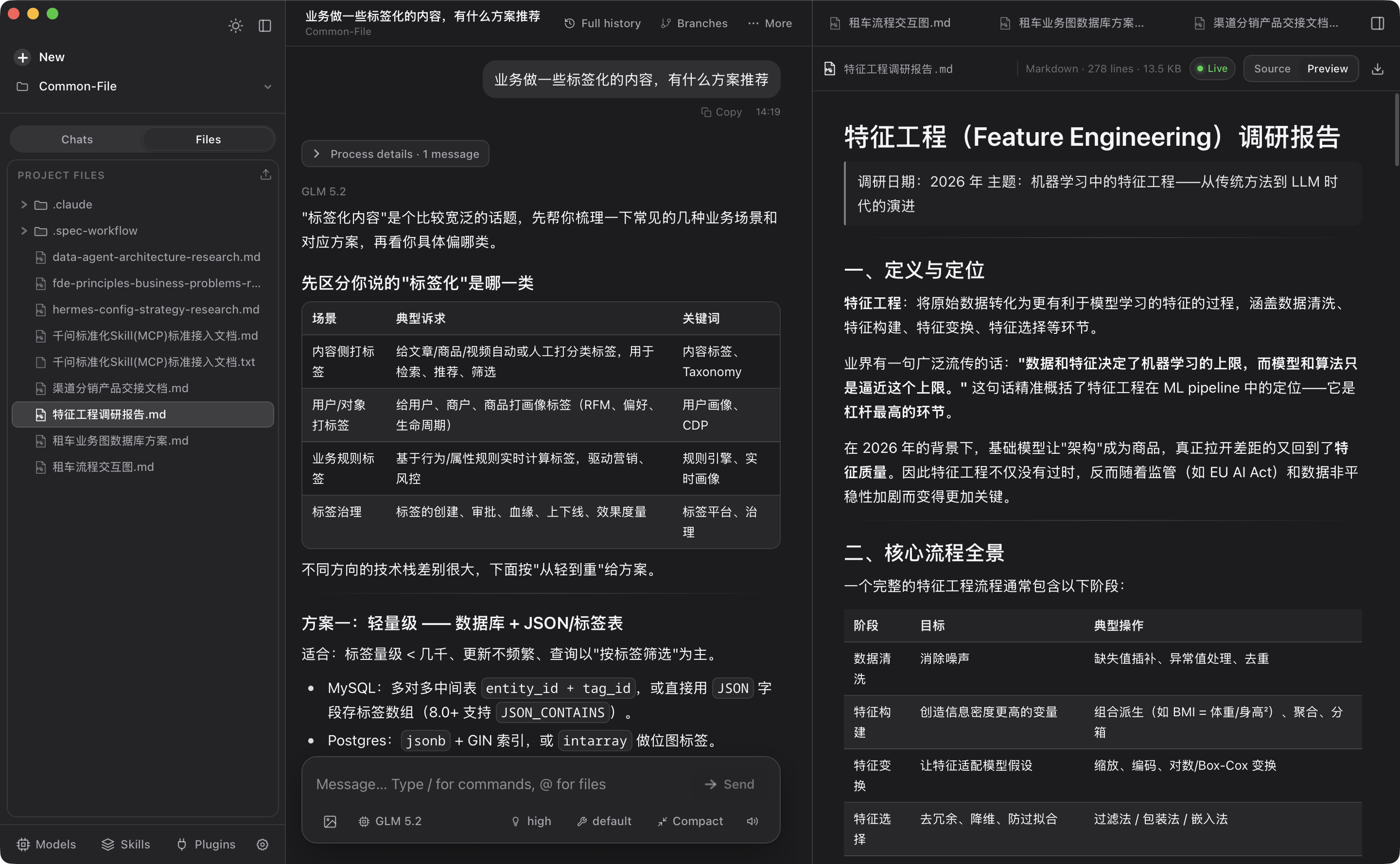
pi-agent-desktop is a local AI agent desktop app for macOS and Windows. It packages the agent capabilities of pi into a standalone, installable application.
Features
- Browse and resume past Pi sessions by project, without digging through terminal history or
.jsonlfiles. - Talk to the agent in real time inside a desktop window, with thinking, tool calls, context usage, cost, and compaction state all visible.
- Continue from any earlier message as a branch, or fork the conversation into an independent session.
- Manage models, OAuth/API keys, custom model configuration, skills, and plugins.
- Switch Git worktrees from the sidebar and browse project files.
- Preview source code, diffs, Markdown, images, audio, PDF, and DOCX files.
- Dark mode, automatic session naming, a completion sound, and restored run state.
- A weekly check of the latest stable
pi-agent-desktopGitHub Release, with an in-app notice only when the installed app is older. - One upgrade button installs a complete, signed new build of Pi Agent and restarts automatically.
⬇️ Download Pi Agent (macOS / Windows)
Repository: abcwyc/pi-agent-desktop
Installation And Usage
Install The Desktop App
Builds are available from GitHub Releases:
-
Apple Silicon Mac: download the
aarch64.dmg, open it, and drag the app intoApplications. Official releases do not build for Intel Macs. -
Linux x64: download the
.debpackage and install it with your distribution's package manager. A community-maintained Flatpak is also available at flatpark.org — not an official release, but Flatpak works across most distributions and handles updates for you. -
Windows x64: download the installer whose name ends in
x64-setup.exeand run it. The installer pulls in Microsoft WebView2 when it is missing.
Official releases support Apple Silicon Macs running macOS 11 or later, Windows 10/11 x64, and Linux x64 distributions with WebKitGTK 4.1 and GTK 3. The desktop package bundles the Next.js server, the Node.js runtime, and the current Pi SDK, so the local server starts with the app — no separate terminal, Node.js installation, or manually started web server is required.
Installing Pi Agent gives you the agent inside the app, but it does not install a global
picommand. If you also want the Pi CLI in your terminal, install it separately by following the pi project instructions.
Before signed auto-updates can be used for the first time, an older build without the updater has to be replaced by manually installing a signed one. Upgrades then happen from Settings.
Use Existing Pi Data
Pi Agent reads Pi's local data directory by default:
~/.pi/agent/
Sessions normally live under:
~/.pi/agent/sessions/<encoded-cwd>/<timestamp>_<uuid>.jsonl
If you have used Pi on this machine before, the app picks up your existing sessions, models, and authentication after installation. Set PI_CODING_AGENT_DIR to point at a different Pi agent data directory.
Model keys and session data stay on your machine. The file-browsing API only allows access to the current session, the selected project, and explicitly authorized working directories.
Update Checks And Upgrades
Pi Agent checks the latest stable release of abcwyc/pi-agent-desktop at most once every seven days:
abcwyc/pi-agent-desktopearendil-works/piagegr/pi-web
The versioning and upgrade rules are:
- The latest stable
pi-agent-desktoprelease is the only source used for update reminders. - The upgrade button in Settings becomes enabled only when the installed desktop app version is older.
- When several components need updating, the release automation syncs and verifies them in the order
pi → pi-web → pi-agent-desktop. - Nothing patches an individual JavaScript package inside an installed app. The app downloads one complete signed build containing all three components at their latest versions.
- The app restarts after installation, so all three components land in the same verified release state at once.
This keeps the components in a desktop install consistent, and avoids the runtime incompatibilities that come from swapping pi or pi-web on their own.
If a new upstream version has been detected but the signed pi-agent-desktop release containing it is not published yet, Settings says that no signed complete build is installable for now. The app never falls back to downloading unsigned files or partially overwriting dependencies.
The full sync, signing, and release configuration is described in Desktop updates and releases.
HTTP Proxy
Server-side model and API requests honor the standard HTTP_PROXY, HTTPS_PROXY, and NO_PROXY environment variables. For example, when starting the dev server from a terminal:
HTTP_PROXY=http://127.0.0.1:7890 \
HTTPS_PROXY=http://127.0.0.1:7890 \
NO_PROXY=localhost,127.0.0.1 \
npm run dev
Local Development
Requirements
- macOS 11+ (Apple Silicon), Windows 10/11 x64, or Linux x64 with WebKitGTK 4.1 and GTK 3
- Node.js 22 (recommended)
- npm
- Rust 1.85+
- macOS: Xcode Command Line Tools
- Windows: Microsoft C++ Build Tools and WebView2
- Linux: GTK/WebKitGTK development packages
Start The Web Dev Server
npm install
npm run dev
The dev server runs at http://localhost:30141.
Do not run next build or npm run build during normal development. They write into .next/ and can disrupt a running dev server; production builds are done by the desktop preparation script or by CI.
Start Desktop Dev Mode
npm run desktop:dev
This starts the existing Next.js dev server and opens it in a native Tauri window, without producing an installer.
Common Checks
# Node tests (identical to the CI sync gate, including components/ tests)
npm test

# TypeScript
node_modules/.bin/tsc --noEmit

# ESLint and the branding protection test
npm run lint

# Divergence from pi-web upstream, split into "styling" and "structural" changes
npm run drift

# Rust/Tauri
cargo fmt --check --manifest-path src-tauri/Cargo.toml
cargo clippy --manifest-path src-tauri/Cargo.toml -- -D warnings

# Verify the bundled components match the latest stable releases
npm run release:verify
release:verify reaches GitHub and requires the bundled pi and pi-web to match their latest stable releases exactly, while also checking the component manifest against the actual dependencies.
Desktop Packaging
npm run desktop:build
The desktop build:
- Generates the Next.js standalone server in an isolated directory.
- Bundles the Node.js runtime for the current architecture.
- Places the server and runtime into the app as Tauri resources.
- Produces
.app,.dmg, and updater artifacts on Apple Silicon Macs; an NSIS-setup.exeplus updater artifacts on Windows x64; and a.debpackage on Linux x64.
On Linux, the package requires a WebKitGTK 4.1 runtime and GTK 3. It includes the Node.js runtime, so users do not need to install Node.js separately.
Local builds do not register the production updater and cannot accept official updates. Official releases must inject the updater public key through GitHub Actions and sign with the matching private key.
Upstream Sync And Releases
The repository contains two chained automation workflows:
component-updates.yml: checks the stable releases ofpiandpi-webdaily. When a new version appears, it first intersects the incoming upstream changeset with the "upstream files this fork has modified" recorded inscripts/fork-ownership.json, then merges the tag, updates dependencies and the component manifest, and runs the full gate (npm test,tsc,lint, a real standalone build).- Empty intersection → commits to
mainand triggers a release. - High or medium risk files hit → pushes a
sync/pi-web-<tag>branch and opens a PR with the boundary report, and does not trigger a release. Merging that PR is what ships a version.
- Empty intersection → commits to
release.yml: after an explicit trigger from the component sync workflow, serially builds the Apple Silicon (aarch64) DMG, the Linux x64.deb, and the Windows x64 NSIS-setup.exe. No Intel Mac build is produced. The release stays a draft until the updater signature files,latest.json, and the component manifest for all platforms are uploaded — themanifestjob depends on the entire build matrix, so a failure on any platform keeps it from being published. Build failures create or update arelease-failureissue.
Upstream sync uses a Git merge, so this fork's Pi Agent branding, settings entry points, and upgrade logic survive as local modifications. Merge conflicts stop the workflow, which is the safe failure mode. The genuinely dangerous case is a conflict-free but semantically wrong merge: upstream changed a region this fork also changed, Git merged it cleanly, and the tests still pass. The boundary intersection above exists for exactly that case; the rules are in Ownership boundaries.
A failed sync creates or updates a component-sync-failure issue, so nothing piles up silently.
An official release additionally requires:
- Tauri updater key pair.
- Apple Developer ID signing and notarization for distribution to external users.
- Authenticode code signing is recommended for Windows distribution to external users; an unsigned
.execan trigger SmartScreen warnings.
Project Structure
app/
  api/                  Next.js APIs: agent, sessions, models, files, update checks
components/             Pages, chat, sidebar, settings, and version notices
hooks/                  Client state: session streams, audio, drag and drop, theme
lib/                    AgentSession, HTTP proxy, session reading, file security, upgrade logic
scripts/                Desktop packaging, component version sync, release verification
src-tauri/
  capabilities/         Tauri permission configuration
  resources/            Desktop resources and the component version manifest
  src/                  Desktop window, local server, and updater registration
.github/workflows/      Daily component sync and desktop release automation
instrumentation.ts     Next.js server-side HTTP proxy initialization
Related Documents
- Ownership boundaries — the split with
pi-webupstream, the rules for editing shared files, and how the automated sync decides - Desktop updates and releases
- Git worktrees
- Pi session and project architecture
Credits And License
The desktop integration of Pi Agent is provided by pi-agent-desktop; the core capabilities and the web interface come from earendil-works/pi and agegr/pi-web respectively. Thanks to those projects and their contributors.
Code in the root of this repository is under the MIT License in LICENSE. The code and dependencies of the three component projects remain subject to the licenses of their own repositories; keep the corresponding copyright and license notices when copying, modifying, or redistributing.