
Parallel agent sessions in one panel, with permission-aware tools, preflight conflict checks.
Remembers context across turns. Asks before risky actions. Runs parallel sessions with conflict-safe execution.
TUI-first workflow, extensible tools, and explicit policy gates.
Inspired by 4 other agent repos: claude-code, mercury-agent, hermes-agent, nanobot.


Demo
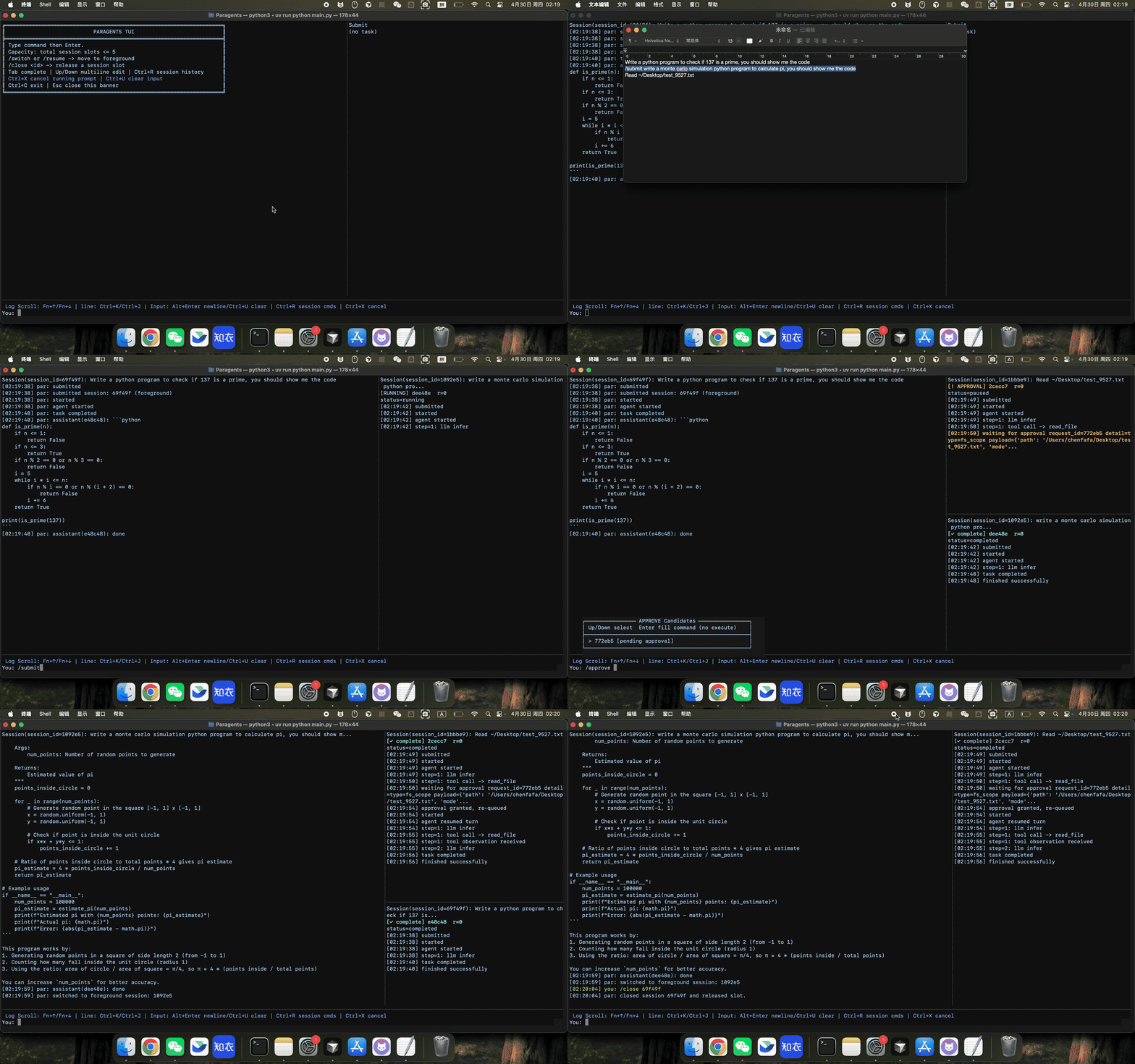
Quick Start (TUI Only)
- Install dependencies
uv sync
- Start TUI
uv run python main.py
- First run setup
- If
runtime_config.jsonis missing, startup enters interactive setup. - You can reconfigure in TUI with:
/setup/show-config
- Command reference
| Command | Purpose |
|---|---|
/new <text> | Create a new foreground session with the initial prompt |
/prompt <text> | Continue current foreground session with a new prompt |
/submit <text> | Submit a new background session |
/list | List current sessions and their status |
/switch <session_ref> | Switch foreground focus to a target session |
/close <session_ref> | Close a session and release its slot |
/approvals | Show pending approval requests |
/approve <request_ref> [always] | Approve a pending request (optional persistent allow) |
/deny <request_ref> | Deny a pending request |
/pause <prompt_ref> | Pause a running prompt |
/resume <session_ref> | Resume paused prompt in target session |
/cancel <prompt_ref> | Cancel target prompt |
/permissions | Print current effective permission config |
/setup | Re-run runtime/provider setup |
/show-config | Show runtime config file path and provider info |
/quit | Exit TUI |
Why Parallel-Agent
The current design focuses on multi-session parallelism with per-session continuity:
- Session-based scheduler and worker model
- Single active agent instance per session (reused across turns)
- Session-level context + memory persistence
- Preflight conflict checks (especially output conflicts) and approval flow
- TUI-first operations for observing multiple sessions
flowchart LR
  UserInput[UserInput] --> Scheduler[Scheduler]
  Scheduler --> SessionQueue[SessionPromptQueue]
  SessionQueue --> SessionWorker[SessionWorker]
  SessionWorker --> AgentInstance[AgentInstance]
  AgentInstance --> Tools[ToolsAndPermissions]
  AgentInstance --> ContextState[SessionRuntimeState]
  ContextState --> Scheduler
Key implementation files:
main.pyscheduler.pyagent_instance.pysession_runtime.pytui_app.py
Cross-Repo Learning Notes (inlined)
Legend:
- Code verified: implementation or interface is directly confirmed in code.
- Docs/changelog signal: mainly inferred from README/changelog/config examples; full core implementation may not be fully open.
1) Permission and Capability Governance
| Dimension | Paragents | claude-code | mercury-agent | hermes-agent | nanobot |
|---|---|---|---|---|---|
| Capability switches | PermissionsConfig.capabilities (Code verified) | Tool-level permission governance in settings (Docs/changelog signal) | permissions.yaml + capability registry (Code verified) | Governance via toolset/gateway composition (Code verified) | ToolsConfig level toggles (Code verified) |
| ask/deny semantics | needs_approval / blocked / auto_approved (Code verified) | Explicit ask/deny (Code verified) | Command pattern-based approvals (Code verified) | Approval is more runtime-pipeline oriented (Code verified) | Primarily enable/sandbox/restrict style (Code verified) |
| File scope control | fs_scopes (Code verified) | Combined through tool permissions + policy layering (Docs/changelog signal) | File scopes (Code verified) | Mostly enforced in tool runtime (Code verified) | restrict_to_workspace (Code verified) |
| Sandbox/network policy | Relatively lightweight currently (Code verified) | sandbox.network.* (Code verified) | Basic shell constraints (e.g., cwd) (Code verified) | More gateway/runtime governance oriented (Code verified) | exec.sandbox + SSRF allowlist (Code verified) |
2) Context, Compaction, and Recovery
| Dimension | Paragents | claude-code | mercury-agent | hermes-agent | nanobot |
|---|---|---|---|---|---|
| Session continuity | Session worker + one reused agent per session (Code verified) | Strong --resume/--continue semantics (Docs/changelog signal) | conversationId-scoped short-term memory (Code verified) | Session + contextvars isolation (Code verified) | SessionManager persistence (Code verified) |
| Prompt construction | PromptAssembler abstraction (Code verified) | Core internals not fully public (Docs/changelog signal) | system + relevantFacts + recentMemory + user (Code verified) | Unified through ContextEngine (Code verified) | Layered assembly via ContextBuilder (Code verified) |
| Compaction strategy | should_compact()/compact() (Code verified) | auto-compact + pre-compact hook (Docs/changelog signal) | Mainly recent-N control (Code verified) | ContextEngine + Compressor (Code verified) | online consolidate + idle auto-compact (Code verified) |
| Interruption/recovery | CheckpointRecovery + SessionStateStore (Code verified) | Ongoing long-session recovery hardening (Docs/changelog signal) | Persistent memory resume (Code verified) | checkpoint manager (Code verified) | runtime checkpoint + keep-context on stop (Code verified) |
3) Current Paragents Conclusions
- The "policy config + ask/deny semantics" model is partially in place with
permissions.json+blocked/needs_approval/auto_approved. - Compared with
claude-code, current gaps are mainly:- ask/deny logic is still fragmented across capability/policy domains instead of one unified rule layer;
- missing a stronger hierarchical policy model (managed/user/project) and tool-level unified rule interpretation.
Requirements
From pyproject.toml:
- Python
>=3.11 - Runtime dependencies:
httpxprompt-toolkit
- Dev dependency group:
pytest
System/runtime prerequisites:
uvinstalled- An OpenAI-compatible endpoint configured in
runtime_config.json(interactive setup on first run)
TODO Roadmap
The detailed roadmap is in a dedicated file for readability:
At a glance:
P0: IM integration, multi-session usability, and recovery hardeningP1: context quality, policy unification, conflict UX, session invariantsP2: observability, regression suites, and UI state-machine consistency
Non-Goals / Caveats
- Not production-ready
- No stability guarantees on internal APIs
- Behavior may prioritize experimentation over strict backward compatibility
Testing
Run core TUI regressions:
uv run pytest -q tests/test_tui_layout.py tests/test_tui_commands.py tests/test_run_approval_flow.py
License
MIT.
Note: this README declares MIT intent. If a top-level LICENSE file is missing, add one before public distribution.
Contributing
Small, focused PRs are preferred.
- Keep changes easy to review and easy to hack on.
- Add or update tests for behavioral changes.
- Prefer readability over cleverness.