



Past Claude Code, Codex, Kimi Code, and Pi sessions -- queryable by your agent, browsable by you.
Two sides of the same index
Obelisk has two sides that share one SQLite index:
Agent side — the obelisk CLI owns the local runtime, while a separate
agent skill teaches coding agents how to search and query their session history.
The agent writes JS queries, runs them locally, and answers in plain language.
App side — an Electron desktop app for humans to browse sessions, manage memories, view usage stats, and see weekly recap cards.
Both read from the same ~/.obelisk/obelisk.sqlite database. The indexer reads Claude Code transcripts from ~/.claude/projects, Codex transcripts from ~/.codex/sessions and ~/.codex/archived_sessions, Kimi Code sessions from ~/.kimi-code/sessions (or $KIMI_CODE_HOME/sessions), and Pi sessions from ~/.pi/agent/sessions.
Multi-provider support
Obelisk indexes every provider into the same SQLite schema instead of keeping separate databases. Rows carry a source value, and non-Claude IDs are provider-prefixed so they cannot collide.
Codex root threads become normal Obelisk sessions. Codex child threads are attached through the same subagents table when parent-thread metadata is available. Codex does not emit Claude-style workflow metadata, so workflow tables may be empty for Codex-only history.
Kimi session directories become one Obelisk session each. Main and child-agent
wire.jsonl streams are projected into the same messages, tools, summaries and
subagents tables. Undo/clear is handled as a full session replay, so retracted
wire records do not remain in the index.
Pi JSONL v1-v3 sessions are projected through the same provider contract. Pi's tree, branch summaries, compactions, durable leaf, retained checkpoint tail, custom messages, bash records, tool calls, token usage, and raw JSONL evidence stay inside the adapter; no Pi-specific database or renderer branch is needed. Active visibility follows Pi's own context rules: a retained tail replaces pre-compaction ancestors even when those physical entries still exist and bounds any later legacy compaction, while a legacy-only chain retains ancestors beginning at firstKeptEntryId. Missing parents form orphan branch roots, matching Pi's recovery behavior. Pi entries that the source explicitly superseded are stored as inactive: the app and normal agent queries omit them, while supported query helpers can include them with includeInactive: true. Display-suppressed or transport-only records remain hidden and are never returned by those helpers.
| Provider | Superseded-history support |
|---|---|
| Pi | Branch, leaf, and compaction state attests inactive history |
| Kimi Code | Undo/clear can attest supersession; preservation is a follow-up |
| Claude Code | The source does not attest rewind or current-leaf state |
| Codex | Sessions have no branching semantics |
Because Pi's explicit --session-id is project-local, Obelisk combines the header ID with a deterministic hash of the normalized header cwd; this keeps the identity stable across file moves and v1-v3 migration while allowing two projects to use the same custom ID. Replacement and deletion replay is provenance-aware, so stale session snapshots are retracted atomically; compaction and branch-summary model usage is included in usage totals.
For live app refresh, Obelisk watches the roots declared by every registered provider, including ~/.claude/projects, ~/.codex/sessions, ~/.codex/archived_sessions, ~/.kimi-code/sessions, and ~/.pi/agent/sessions. Codex's session_index.jsonl is used as lightweight title/update metadata during indexing, not as the message transcript source.
Pi chooses its session directory in this order: --session-dir, PI_CODING_AGENT_SESSION_DIR, sessionDir in settings, then the default under ~/.pi/agent/sessions. Obelisk automatically follows absolute or ~-prefixed environment/global settings and the project setting for Obelisk's launch cwd; a relative project setting is resolved against that cwd. CLI-only roots, relative environment/global settings, and project settings from another launch cwd cannot be inferred safely, so select the resolved directory in Obelisk Settings instead of letting Obelisk guess.
Skill: agent-first retrieval
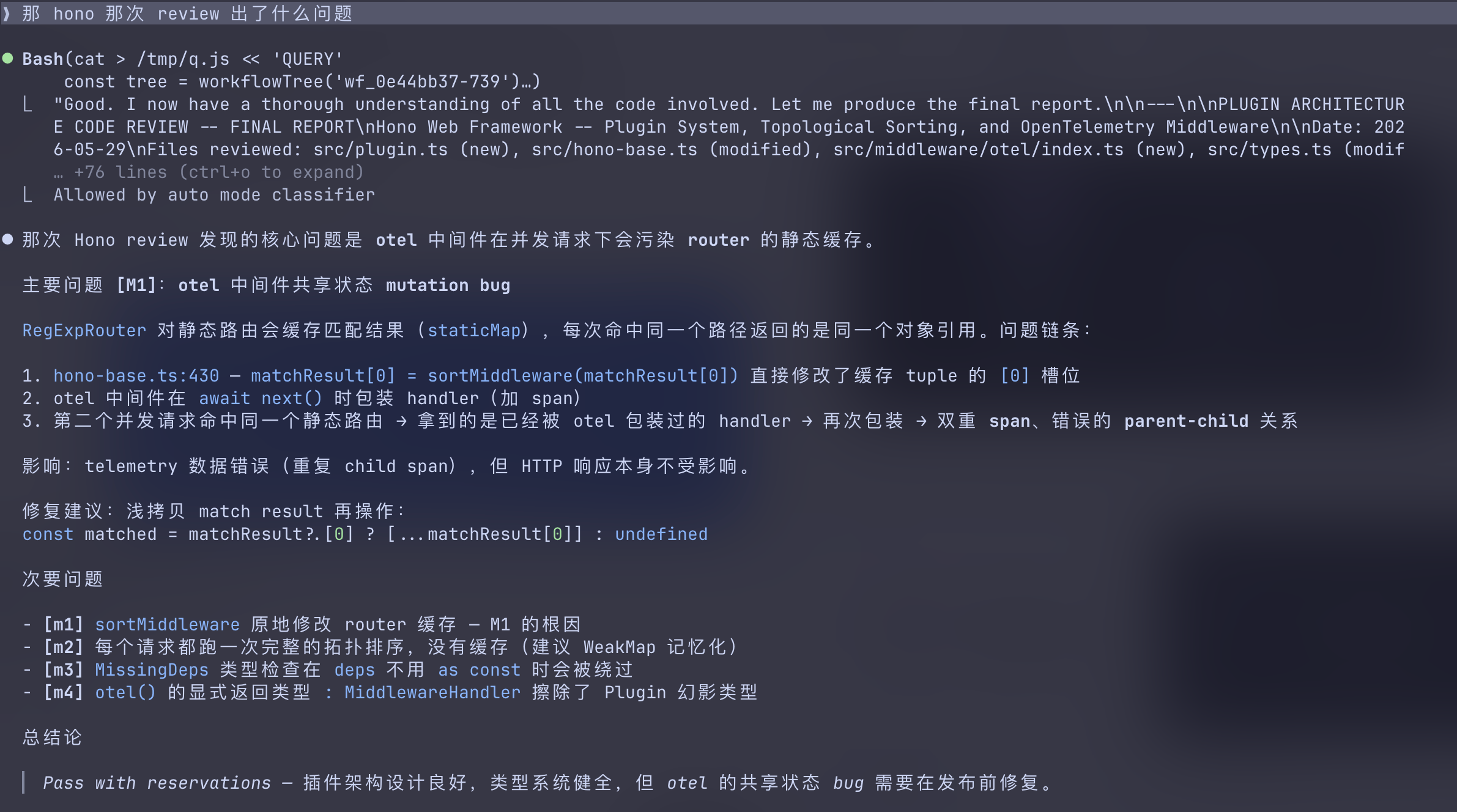
You can use obelisk like:
/obelisk 上次 auth bug 最后到底改了哪些文件,为什么这么改
/obelisk 这个文件最近在哪些 sessions 里被反复修改
/obelisk 找出最近失败的 tool calls,它们分别发生在哪些任务里
/obelisk 那个 review workflow 的 subagents 各自结论是什么
/obelisk recap this week
Install
Let your agent install it (recommended)
The shortest path is to give the bootstrap guide directly to a coding agent with shell access. Paste this as a prompt into Claude Code, Codex, or another agent — not into your terminal:
Install Obelisk by fetching and following this guide:
curl -fsSL https://raw.githubusercontent.com/tommy0103/obelisk/main/SKILL.md
The agent will ask before changing your machine, install and verify the CLI,
then ask whether the formal /obelisk skill should be installed for the current
project or globally. The bootstrap guide is only for one-time setup; it is not
the query skill itself.
Install manually
Obelisk requires Node.js 22.13 or newer. Install the platform-neutral CLI:
npm install --global @obelisk-apps/cli
obelisk --version
On macOS, Linux, or WSL, the CLI-only installer is equivalent:
curl -fsSL https://raw.githubusercontent.com/tommy0103/obelisk/main/install.sh | sh
Then install the agent skill:
obelisk install
obelisk install delegates to the standard skills installer for
tommy0103/obelisk-skill.
Then in any Claude Code session:
/obelisk <your question>
First run builds the index (~5 seconds for 100 sessions). After that it rebuilds incrementally.
How it works
You ask a question
  ↓
Agent writes a JS query against the SQLite index
  ↓
Runs it via obelisk --query <script>
  ↓
Reads the JSON result, answers in natural language
Core API: search(), context(), sql(), plus structured helpers (sessions, memories, summaries, workflows, failures, fileHistory, etc).
Memory layer
When a retrieval produces a conclusion worth keeping, the agent proposes a markdown memory file. After user approval, it registers the file with obelisk --attune <script>. Memories are recalled via memories() in future sessions — a synthesis cache, not a replacement for raw evidence.
App: A surface for humans
A companion desktop app for browsing the same index maintained by the CLI or the app daemon.
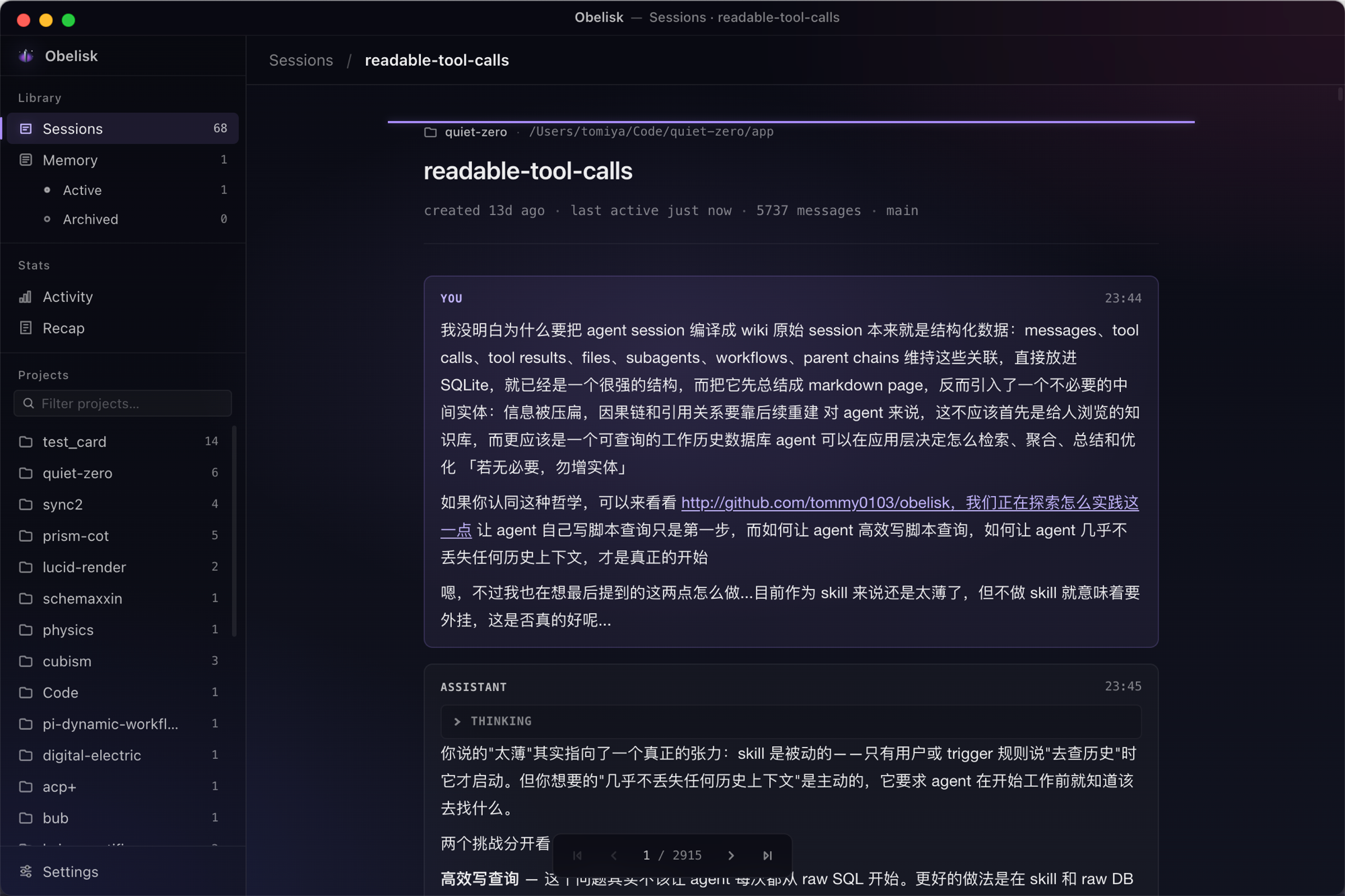
- Sessions — browse all sessions with search, project filtering, readable tool calls (diffs, terminal output, file viewers)
- Memory — list and detail views for registered memory files
- Activity — GitHub-style heatmap, weekly/cumulative token charts
- Recap — shareable weekly/monthly recap cards with archetype theming
- Settings — data source configuration, auto-refresh, rebuild index
Prebuilt releases are currently available for macOS from Releases. The source app can be run locally on macOS, Windows, and Linux.
Run locally
Install Node.js 22 and npm, then run the app from its own package directory:
git clone https://github.com/tommy0103/obelisk.git
cd obelisk/app
npm ci
npm run dev
electron-vite starts the renderer dev server and launches Electron. On first run, Obelisk creates ~/.obelisk/obelisk.sqlite, indexes the available registered-provider transcripts, and then watches them for changes. The default sources include ~/.claude/projects, ~/.codex/sessions, ~/.codex/archived_sessions, ~/.kimi-code/sessions, and ~/.pi/agent/sessions; use Settings to point the app at different directories. On Windows, Obelisk also checks common WSL distributions for the Claude Code directory.
Debug the app
- Renderer changes use Vite hot module replacement. Open Electron DevTools with
Cmd+Option+Ion macOS orCtrl+Shift+Ion Windows/Linux. - Main-process and preload logs appear in the terminal running
npm run dev; their source changes are rebuilt by electron-vite. - To attach a Node debugger to the Electron main process, start it with
npm run dev -- --inspect=5858, then attach your debugger to port5858. - The development app reads and updates the real
~/.obeliskindex. Back it up before testing destructive rebuilds. For an isolated run, launch with a disposable home directory (HOME=/tmp/obelisk-dev npm run devon macOS/Linux, or set a temporaryUSERPROFILEfirst on Windows), then select fixture source directories in Settings.
better-sqlite3 provides prebuilt binaries for common platforms. If npm ci
falls back to compiling it locally, install the platform's C/C++ build tools and
run npm ci again.
What gets indexed
| Layer | Source | What's captured |
|---|---|---|
| Sessions | Claude <project>/<sessionId>.jsonl; Codex sessions/YYYY/MM/DD/*.jsonl and archived_sessions/*.jsonl; Kimi session directories; Pi recursive *.jsonl | Title, project, timestamps, git branch, source |
| Messages | user + assistant turns | Full text, model, token usage, parent chain |
| Tool calls | every tool invocation | Tool name, input, file paths |
| Subagents | Claude subagents/agent-<id>.jsonl; Codex child threads | Agent type, description, full conversation |
| Workflows | Claude workflows/wf_<runId>.json | Script, result, agent count |
| Workflow agents | Claude subagents/workflows/wf_<runId>/ | Per-agent transcripts |
| Memories | registered markdown files | Conclusions linked to source sessions |
Full-text search via FTS5 covers all layers.
Structure
packages/core/                # @obelisk/core npm workspace (TypeScript + ESM)
├── src/
│   ├── providers/
│   │   ├── types.ts          # Provider + TranscriptRecord contract
│   │   ├── claude.ts         # Claude Code adapter (line-incremental)
│   │   ├── codex.ts          # Codex adapter (full-reparse)
│   │   ├── kimi.ts           # Kimi Code adapter (session projection)
│   │   └── pi.ts             # Pi adapter (tree-aware full-reparse)
│   ├── session-detail.ts     # Provider-independent transcript projection
│   ├── persist.ts            # Binding-agnostic record writer (upsert/merge)
│   ├── tx.ts                 # Write transaction + connection config
│   ├── write-coordinator.ts  # Bounded retry policy
│   ├── writer-lease.ts       # Cross-process single-writer lease (SQLite lock DB)
│   ├── core.ts               # buildIndex / searchText / executeQuery / executeAttune
│   ├── indexer.ts            # Skill orchestration (discover → persist → finalize)
│   ├── parsing.ts            # Pure helpers (node:sqlite-free, app-consumable)
│   ├── db.ts                 # node:sqlite lifecycle + migrations
│   ├── query.ts              # Query/attune sandbox API (helpers)
│   └── schema.sql            # SQLite schema (single source of truth)
├── package.json
└── dist/                     # Generated package JS, declarations, and schema

packages/cli/                 # @obelisk-apps/cli npm workspace
├── src/obelisk.ts            # CLI shell + skill installer delegation
├── scripts/build.mjs         # Compiles CLI + readable Core into one package
├── package.json
└── dist/                     # Generated platform-neutral npm payload

skill-doc/                    # Source for the docs-only obelisk agent skill
├── SKILL.md                  # Query and memory workflow
└── references/               # Progressive-disclosure API/schema/pattern docs
    └── recap/                # Per-card recap retrieval + writing references

app/                          # Electron desktop app (electron-vite + Vue)
├── src/main/                 # TypeScript main process (consumes shared core)
├── src/preload/              # CJS preload (sandbox)
├── src/renderer/             # Vue renderer
└── electron.vite.config.ts

packaging/                    # Skill publish infrastructure
├── build-skill.mjs           # Builds the docs-only skill artifact
├── skill-package.json
├── skill-README.md
├── skill-LICENSE             # MIT (relicensed for the skill artifact)
└── publish-skill.sh

SKILL.md                      # Remote one-time CLI + skill bootstrap guide
install.sh                    # POSIX CLI-only installer
CONTEXT.md                    # Project glossary
docs/adr/                     # Architecture decision records (0001–0006)
The optional /obelisk recap flow is loaded only for explicit /obelisk recap intent.
It starts at skill-doc/references/recap/overview.md and proceeds card-by-card:
skill-doc/references/recap/pattern1-cover.md+skill-doc/references/recap/writing1-cover.mdskill-doc/references/recap/pattern2-thinking.md+skill-doc/references/recap/writing2-thinking.mdskill-doc/references/recap/pattern3-vibe.md+skill-doc/references/recap/writing3-vibe.mdskill-doc/references/recap/pattern4-workflow.md+skill-doc/references/recap/writing4-workflow.mdskill-doc/references/recap/pattern5-closing.md+skill-doc/references/recap/writing5-closing.md
Generated build outputs
packages/core/dist/is produced bynpm run build:core. It is the compiled internal@obelisk/coreworkspace: JavaScript, type declarations, andschema.sql.packages/cli/dist/is produced bynpm run build:cli. It is the publishable@obelisk-apps/clipayload: the thin command shell, readable compiled Core, andschema.sql.dist/obelisk-skill/is produced bynpm run build:skill. It is the docs-only skill artifact:SKILL.md, references, and skill package metadata.- Skill publishing stages that artifact at
skills/obelisk/in theobelisk-skillrepository; onlyREADME.mdandLICENSEremain at the repository root fornpx skillsdiscovery.
Both directories are generated and should not be edited by hand. The Electron
app imports packages/core/src/ directly so electron-vite can bundle Core.
Implementation Notes
The index rebuilds incrementally — only new or modified JSONL files are re-parsed.
When the optional app is running, it is the active indexer: it watches Claude
project files and builds in a worker thread. A fresh __app_heartbeat__ alone
means the daemon owns writes, so CLI invocations remain read-only; a separate SQLite
writer lease prevents cross-process writes from overlapping. The
__app_last_successful_build__ marker records index freshness, not ownership.
The CLI has zero runtime npm dependencies and uses Node 22's built-in
node:sqlite with FTS5. The formal skill contains instructions and references,
not a second executable runtime.
20K lines of scattered JSONL → something the agent can search() and sql() against in milliseconds.
Contributing
Contributions are welcome. Read CONTRIBUTING.md before opening a PR — it is short, and it is written from what actually blocked past PRs rather than from generic style rules.
The parts worth knowing up front:
- Run every claim in your PR description end to end. The most common reason a PR stalls here is a capability that is advertised but unreachable — including inputs shown in screenshots.
- Assert the requirement, not the implementation. Copy the sentence from the issue into your test name.
- Transcript content is attacker-controlled. Obelisk indexes third-party
agent logs; anything reaching
shell.*,fs.*,innerHTML, or DDL is deny-by-default. - Re-run verification after merging main. A merge voids every result above it, including your own noted limitations.
CONTRIBUTING.md also carries hard constraints per area — renderer/Electron,
provider adapters, schema migrations, main process, and indexing/daemon
ownership. The PR template mirrors them as per-area checklists.
Star History
License
Copyright (C) 2026 tommy0103 and contributors.
Obelisk is licensed under the GNU Affero General Public License v3.0 (AGPL-3.0-only); see LICENSE. Derivative works are welcome: if you distribute a modified version, please keep the per-file copyright notices intact and mark your modifications prominently with a date, as AGPL-3.0 §5 requires.