memex
Fast local history search for Claude, Codex CLI, Cursor, OpenCode, Pi, Oh My Pi, OpenClaw, GitHub Copilot CLI, and Hermes usage records. Uses BM-25 and optionally embeds your transcripts locally for hybrid search.
Mostly intended for agents to use via skill. The intended workflow is to ask agent about a previous session & then the agent can narrow things down & retrieve history as needed.
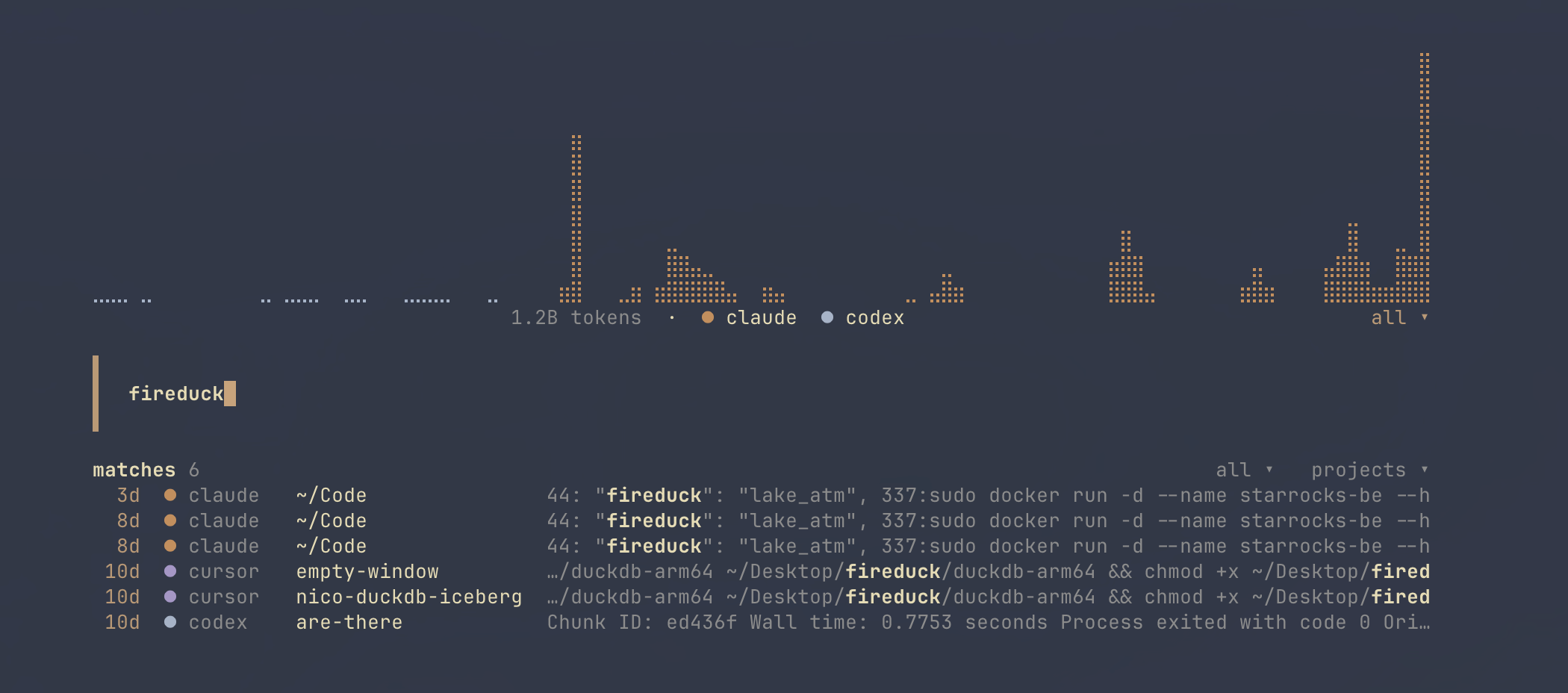
Includes a TUI for browsing, finding and resuming agent CLI sessions, with optional token usage tracking.
Install
brew install nicosuave/tap/memex
Or
curl -fsSL https://raw.githubusercontent.com/nicosuave/memex/main/scripts/setup.sh | sh
Or (from the AUR on Arch Linux):
paru -S memex
Or (with Nix):
nix run github:nicosuave/memex
Nix development and advanced configuration
Development shell:
nix develop
Note: No binary cache is configured, so first builds compile from source.
NixOS service:
Enable background indexing with the provided module:
{
  inputs.memex.url = "github:nicosuave/memex";

  outputs = { nixpkgs, memex, ... }: {
    nixosConfigurations.default = nixpkgs.lib.nixosSystem {
      modules = [
        memex.nixosModules.default
        {
          services.memex = {
            enable = true;
            continuous = true; # Run as a daemon (optional)
          };
        }
      ];
    };
  };
}
Home Manager:
Configure memex declaratively (generates ~/.memex/config.toml):
{
  inputs.memex.url = "github:nicosuave/memex";

  outputs = { memex, ... }: {
    # Inside your Home Manager configuration
    modules = [
      memex.homeManagerModules.default
      {
        programs.memex = {
          enable = true;
          settings = {
            embeddings = true;
            include_reasoning = false;
            model = "minilm";
            execution_provider = "auto"; # coreml on macOS, cpu elsewhere
            cuda_device_id = 0; # optional when execution_provider = "cuda"
            cuda_library_paths = ["/usr/local/cuda/lib64"]; # optional override
            cudnn_library_paths = ["/usr/lib/x86_64-linux-gnu"]; # optional override
            compute_units = "ane"; # CoreML only: ane, gpu, cpu, all
            auto_index_on_search = true;
            token_usage = false; # opt in to local token and cost tracking
            index_service_interval = 3600;
          };
        };
      }
    ];
  };
}
Then install the shared skill used by Codex, OpenCode, Pi, and Oh My Pi:
memex skill install --target shared
The shared memex-search skill is installed once at
~/.agents/skills/memex-search/SKILL.md for Codex, OpenCode, Pi, and Oh My Pi.
For Claude Code, use memex skill install --target claude; its copy lives at
~/.claude/skills/memex-search/SKILL.md.
Use memex skill status to compare installed copies with the current Memex binary,
memex skill update after upgrading Memex, and memex skill cleanup to explicitly
remove obsolete paths left by older releases. Install never overwrites a differing file;
update only replaces copies that are already installed.
Restart Claude, Codex, OpenCode, Pi, or Oh My Pi after installing or updating the skill.
Quickstart
Index (incremental):
memex index
The default scan indexes Pi sessions from ~/.pi/agent/sessions and Oh My Pi sessions
separately from ~/.omp/agent/sessions plus named profile session directories.
Plaintext reasoning is excluded by default because it is usually low-value search noise. Opt
in with memex index --include-reasoning; reasoning records remain BM25-only. Encrypted and
redacted payloads, along with reasoning signature fields, are always excluded.
Search (JSONL default):
memex search "your query" --limit 20
TUI:
memex tui
Notes:
- Embeddings are disabled by default. Pass
--embeddingsto generate them during indexing. - Searches run an incremental reindex by default (configurable).
- Index updates are copy-on-write generations. A writer builds a private generation and atomically publishes it when complete; searches keep using the previous immutable generation until then.
- Concurrent searches coalesce stale auto-index work: one process refreshes while other lexical
searches query the last committed index. Semantic and hybrid searches wait for vector writes to
finish. Explicit
index,reindex,embed, and analytics backfill commands wait up to 30 seconds for another index mutation to finish and report its holder on timeout.
Full transcript:
memex session <session_id>
Single record:
memex show <doc_id>
Human output:
memex search "your query" -v
Multiple machines over SSH
Each machine keeps and updates its own index. The coordinating memex queries configured machines concurrently over SSH, merges their rankings, and keeps the originating machine attached to every result. The TUI uses the same backend for search, history previews, sharing, token charts, and interactive resume.
Install a protocol-compatible memex binary on each machine and configure SSH normally in
~/.ssh/config. Then add machines to ~/.memex/config.toml:
[multi_machine]
default = ["local", "mini"]
timeout_seconds = 10

[[machines]]
id = "mini"
label = "Mac mini"

[machines.control]
type = "ssh"
host = "mini" # SSH config alias

[machines.index]
type = "remote"
The ssh = "mini" field is a shorthand for the machines.control table. Set
command = "/path/to/memex" when memex is not on the non-interactive SSH PATH.
SSH keys, users, ports, jump hosts, and host-key policy remain in ~/.ssh/config.
memex search "tantivy corruption"             # configured defaults
memex search "tantivy corruption" --machine mini
memex usage --machine local --machine mini
Unavailable machines produce partial results with a warning. Remote token usage requires
token_usage = true in that machine's memex config. The index backend is intentionally
separate from the control transport so an immutable S3 split backend can replace
type = "remote" later while SSH continues to handle indexing and resume.
In the TUI, use the machines dropdown (or press m while the session list is focused)
to select the configured default set, local, or one remote machine. The machine, source,
project, and query filters are shared by the session results and token chart; the range
dropdown bounds the chart.
Opening federated results
Search results include the originating machine. Use it when opening a document or session from another machine:
memex show 123 --machine mini
memex session SESSION_ID --machine mini --source-path /path/on/mini/session.jsonl
memex session SESSION_ID --machine mini --offset 500 --limit 500
Session pages are limited to 500 records. To fetch several sessions in one bounded request, provide JSONL on stdin or as a file:
{"machine":"mini","session_id":"SESSION_ID","source_path":"/path/on/mini/session.jsonl","offset":0,"limit":500}
memex hydrate requests.jsonl
cat requests.jsonl | memex hydrate
The batch input accepts at most 32 requests and returns one JSONL response per request, including machine provenance, pagination metadata, and stable record_id values where available.
Token usage
Token tracking is disabled by default because it scans and caches local agent logs. Enable it in ~/.memex/config.toml:
token_usage = true
Then reconstruct historical token usage from local Claude Code, Codex, Cursor, OpenCode, Pi, Oh My Pi, OpenClaw, Copilot, and Hermes records:
memex usage
memex usage --source codex --since 2026-07-01
memex usage --source hermes --since 2026-07-01
memex usage --json --events
--cost auto prefers a provider-stored request cost and otherwise applies the versioned built-in API price catalog. --cost source uses only stored costs; --cost reprice always applies the catalog. Calculated costs are API-equivalent estimates, not subscription charges. Events with unknown models or prices remain in token totals and are reported as unpriced.
Each source also reports prompt-cache efficiency: the cache hit rate, plus an estimate of cache waste — prompt tokens that were in the previous request's prompt but were re-billed at input rates instead of read from cache, priced at catalog rates and attributed to idle gaps past the cache TTL or model switches where those apply. Waste is estimated per transcript file chain and errs toward undercounting: subagent sidechains, ambiguous dedupe deltas, and prompts that shrink past compaction are not counted.
Local token history is reconstructed usage. It is deliberately kept separate from authoritative subscription quota percentages and reset windows. Hermes usage is read from state.db in the Hermes root and immediate profile directories (HERMES_PROFILE_ROOTS, HERMES_HOME, or HERMES_STATE_DIR, with safe local defaults), opened read-only and WAL-compatible. The sessions aggregate is used for legacy databases; newer session_model_usage delta rows are emitted by model/task and reconciled against the session aggregate so historical seeded rows count once and positive residuals are retained. Snapshots, backups, arbitrary nested databases, JSON/JSONL transcripts, and auth, config, memory, skills, plugins, and cron paths are excluded. Hermes queries never read message, system-prompt, tool, reasoning-text, or credential tables. Usage output contains counters and metadata only. Any API-equivalent cost estimate is analytical and is not a Hermes subscription quota measurement; source-stored API costs are not quota percentages. Hermes parser-version changes invalidate only Hermes usage cache rows.
When token tracking is enabled, press Ctrl+T on the TUI home screen to toggle the 30-day activity chart between session count and token volume. Token activity is loaded lazily and cached when first shown.
Build from source
cargo build --release
Linux with NVIDIA CUDA support:
cargo build --release --features cuda
Binary:
./target/release/memex
Setup (manual)
If you built from source, install the skill embedded in that build:
memex skill install --target shared
Omit --target for an interactive menu of detected Claude/Codex/OpenCode/Pi/Oh My Pi installations.
Search modes
| Need | Command |
|---|---|
| Exact terms | search "exact term" |
| Fuzzy concepts | search "concept" --semantic |
| Mixed | search "term concept" --hybrid |
Common filters
--project <name>--role <user|assistant|tool_use|tool_result>--tool <tool_name>--session <session_id>--source claude|codex|cursor|opencode|pi|omp|openclaw|copilot|hermes--since <iso|unix>/--until <iso|unix>--limit <n>--min-score <float>--sort score|ts--top-n-per-session <n>--unique-session--fields score,ts,doc_id,session_id,snippet--json-array
JSON output also includes source and, when available, tree/linkage metadata:
event_id, parent_event_id, logical_parent_event_id,
parent_session_id, thread_source, conversation_kind,
parent_tool_use_id, source_tool_use_id, and
source_tool_assistant_uuid.
Background index service
Works on macOS (launchd) and Linux (systemd).
Enable:
memex index-service enable
memex index-service enable --continuous
memex index-service enable --web-ui
Regenerate the service from current config and restart it:
memex index-service restart
Inspect the registered service and whether it is serving the Web UI:
memex index-service status
Open an authenticated browser session:
memex index-service open
Disable:
memex index-service disable
index-service reads config defaults (mode, interval, log paths). Flags override.
Reclaiming obsolete index generations
After an upgrade, normal indexing automatically migrates a legacy index and removes obsolete pre-lease generations. It preserves the committed Tantivy segments without rebuilding or reparsing conversation history. No user action is required.
For diagnostics or to reclaim space immediately without waiting for the next index run, stop the background service and close TUI/Web readers, then preview and run GC:
memex index-service disable
memex index-gc --dry-run
memex index-gc --offline
memex index-service enable --web-ui # or restore the mode you previously used
index-gc validates the committed index, hard-links only its live Tantivy segments into a clean
generation, atomically switches CURRENT, validates the document count again, and then removes
unreachable generations. It does not rebuild the index and does not rewrite live segment data.
The explicit command retains an --offline acknowledgement because it performs cleanup without a
normal index publication.
On Linux, creates systemd user units in ~/.config/systemd/user/. On macOS, creates a launchd plist in ~/.memex/.
On successful enable, memex writes auto_index_on_search = false to config when that setting is absent, so searches do not duplicate daemon work. Explicit user config is preserved.
--web-ui implies continuous mode and serves a local search and transcript browser at
http://127.0.0.1:6363. It mirrors the TUI's core workflow with search-as-you-type,
source and project filters, a persistent session list, and Matches/History transcript
previews. The server binds to loopback by default because the index
contains private conversation history. Memex refuses non-loopback HTTP listeners. If
remote access is required, use an authenticated TLS reverse proxy to 127.0.0.1 that
injects the installation bearer token into upstream requests. To use a different local port:
memex index-service enable --web-listen 127.0.0.1:8080
memex index-service open --listen 127.0.0.1:8080
The first Web UI start creates ~/.memex/web-auth-token with mode 0600. Private API
routes require that token as Authorization: Bearer ... or a browser session established
by index-service open. Browser links carry a signed, one-time credential in the URL
fragment, remove it before navigation continues, and exchange it for an ephemeral bearer
token held only in page memory. The browser token is never stored in a cookie,
localStorage, or session storage. Browser sessions expire after 12 hours, disappear when
the page closes, and are invalidated whenever the daemon restarts.
To run the same UI in the foreground without changing the background service:
memex web
Then run memex index-service open from another terminal.
The browser frontend lives in web/, uses React and shadcn components, and is
built with cd web && bun install && bun run build. The generated static assets
are embedded in the memex binary, so serving the UI does not add a JavaScript
runtime to the daemon.
Embeddings
Enable during indexing:
memex index --embeddings
Recommended when embeddings are on (especially non-potion models): run the background
index service or index --watch, and consider setting auto_index_on_search = false
to keep searches fast.
Embedding model
Select via --model flag or MEMEX_MODEL env var:
| Model | Dims | Speed | Quality |
|---|---|---|---|
| minilm | 384 | Fastest | Good |
| bge | 384 | Fast | Better |
| nomic | 768 | Moderate | Good |
| gemma | 768 | Slowest | Best |
| potion | 256 | Fastest (tiny) | Lowest |
memex index --model minilm
# or
MEMEX_MODEL=minilm memex index
Execution provider
Select via execution_provider in config or MEMEX_EXECUTION_PROVIDER:
| Provider | Platforms | Notes |
|---|---|---|
| auto | all | Default. Uses CoreML on macOS, CPU elsewhere |
| cpu | all | Force CPU execution |
| coreml | macOS | Uses CoreML; compute_units controls ane/gpu/cpu/all |
| cuda | Linux/NVIDIA | Requires a binary built with --features cuda and CUDA 12/cuDNN runtime libraries |
When execution_provider = "cuda", you can optionally select a GPU with
cuda_device_id or MEMEX_CUDA_DEVICE_ID.
When loading CUDA, memex first tries the system loader paths, then any
configured cuda_library_paths / cudnn_library_paths, then common CUDA install
locations and active venv / conda site-packages/nvidia/*/lib directories.
If your system keeps CUDA or cuDNN in a nonstandard location, set
MEMEX_CUDA_LIBRARY_PATHS and MEMEX_CUDNN_LIBRARY_PATHS or the matching config
keys.
Config (optional)
Create ~/.memex/config.toml (or <root>/config.toml if you use --root):
embeddings = true
auto_index_on_search = true
include_reasoning = false  # opt in to plaintext reasoning; encrypted/redacted payloads stay excluded
token_usage = false  # opt in to local token and cost tracking
model = "minilm"  # minilm, bge, nomic, gemma, potion
execution_provider = "auto"  # auto, cpu, coreml, cuda
cuda_device_id = 0  # optional, when execution_provider = "cuda"
cuda_library_paths = ["/usr/local/cuda/lib64"]  # optional list of CUDA library dirs
cudnn_library_paths = ["/usr/lib/x86_64-linux-gnu"]  # optional list of cuDNN library dirs
compute_units = "ane"  # CoreML only: ane, gpu, cpu, all
scan_cache_ttl = 3600  # seconds (default 1 hour)
max_indexed_tool_input_bytes = 65536  # 64 KiB default
max_indexed_tool_output_bytes = 262144  # 256 KiB default
exclude_paths = ["~/.claude/projects/*-client-*", "~/work/**"]  # never index matched transcripts
index_service_mode = "interval"  # interval or continuous
index_service_interval = 3600  # seconds (ignored when mode = "continuous")
index_service_poll_interval = 30  # seconds
index_service_web_ui = false  # serve local browser; forces continuous mode when true
index_service_web_listen = "127.0.0.1:6363"
index_service_label = "memex-index"  # service name (default: com.memex.index on macOS)
index_service_systemd_dir = "~/.config/systemd/user"  # Linux only
claude_resume_cmd = "claude --resume {session_id}"
codex_resume_cmd = "codex resume {session_id}"
cursor_resume_cmd = "cursor-agent --resume {session_id}"
opencode_resume_cmd = "opencode resume {session_id}"
pi_resume_cmd = "pi --session {source_path_shell}"
# copilot_resume_cmd = "your-copilot-resume-command {session_id}"
herdr_resume = "tab"  # inside a herdr pane: "tab" (default), "split", or "off"
Service logs and the plist live under ~/.memex by default (macOS). On Linux, systemd units are created in ~/.config/systemd/user/.
scan_cache_ttl controls how long auto-indexing considers scans fresh.
include_reasoning defaults to false. Set it to true (or pass memex index --include-reasoning) to add plaintext reasoning as BM25-only records. Encrypted
and redacted reasoning payloads are always excluded.
max_indexed_tool_*_bytes limits oversized tool payloads while leaving user and assistant text
unchanged. memex keeps roughly the first three quarters and final quarter, with a marker reporting
the omitted middle. Each value must be at least 1024 bytes. Run memex index --reindex to apply
new limits to records that are already indexed.
exclude_paths takes glob patterns matched against transcript source paths at index time, so
matched transcripts never enter the index (a leading ~/ is expanded to your home directory).
Adding a pattern also removes records previously indexed from matched paths — no --reindex
required. For one-off runs, pass --exclude GLOB (repeatable) to memex index.
execution_provider applies to ONNX-backed models; potion uses the model2vec backend.
cuda_library_paths and cudnn_library_paths accept path lists and are only used
when execution_provider = "cuda".
Resume command templates accept {session_id}, {project}, {source}, {source_path}, {source_dir}, {cwd}, plus shell-quoted {source_path_shell}, {source_dir_shell}, and {cwd_shell}.
The skill definitions are bundled in skills/.
herdr plugin
This repo is also a herdr plugin: it turns the memex TUI into a herdr-native session desk. Browse and search every past agent session from a herdr pane, then resume one into a new herdr tab.
herdr plugin install nicosuave/memex
Or from a checkout:
cargo build --release
herdr plugin link .
install reuses a memex already on your PATH when it is current, otherwise it downloads the
release build matching the plugin version. link uses target/release/memex from the checkout.
| Action | What it does |
|---|---|
memex: session palette | Recent sessions as an overlay: Enter resumes into a new tab, quitting returns focus where it was |
memex: recent sessions here | The palette pre-filtered to the focused workspace's repo |
memex: session desk | Opens the TUI zoomed over the focused pane |
memex: toggle sidebar | Opens the TUI as a split beside your work, or closes it |
memex: resume last session | Resumes the most recent session for the focused pane's directory, without opening the TUI |
memex: refresh index | Runs an incremental memex index now |
memex: open web UI | Starts memex web if nothing is listening, then opens it in the browser |
Resuming inside herdr opens the session in a new herdr tab rather than taking over the current
pane, so the desk stays where it is and you can resume several sessions in a row. Set
herdr_resume = "split" (or "off") in memex's own config.toml to change that. Each herdr
session start also kicks off a background incremental index.
The plugin is backed by two new CLI surfaces that work anywhere:
memex sessions --cwd . --limit 5     # JSONL: session_id, cwd, git_root, resume_cmd, ...
memex herdr resume-last --cwd .      # resume the newest session for this repo into a herdr tab
Plugin config lives at config.toml in the plugin's herdr config directory and is re-read on
every action:
toggle_placement = "split"     # split, overlay, zoomed, tab
toggle_direction = "right"     # right, down
index_on_startup = true        # background index at herdr session start
web_listen = "127.0.0.1:6363"
Bind the desk to a key in your herdr config:
[[keys.command]]
key = "cmd+m"
type = "plugin_action"
command = "nicosuave.memex.palette"
description = "memex session palette"
The plugin is listed in the herdr marketplace through the herdr-plugin GitHub topic on this
repo.