EN · RU




Iva is a self-hosted Telegram AI assistant with layered memory that turns your messages into an Obsidian-compatible vault. You talk, it files: voice notes, photos, forwarded posts and decisions become plain-markdown cards it actually remembers. Everything runs on your own server, with your keys and your data.
One command installs it:
curl -fsSL https://raw.githubusercontent.com/smixs/iva-agent/main/install.sh | bash
Why people run Iva
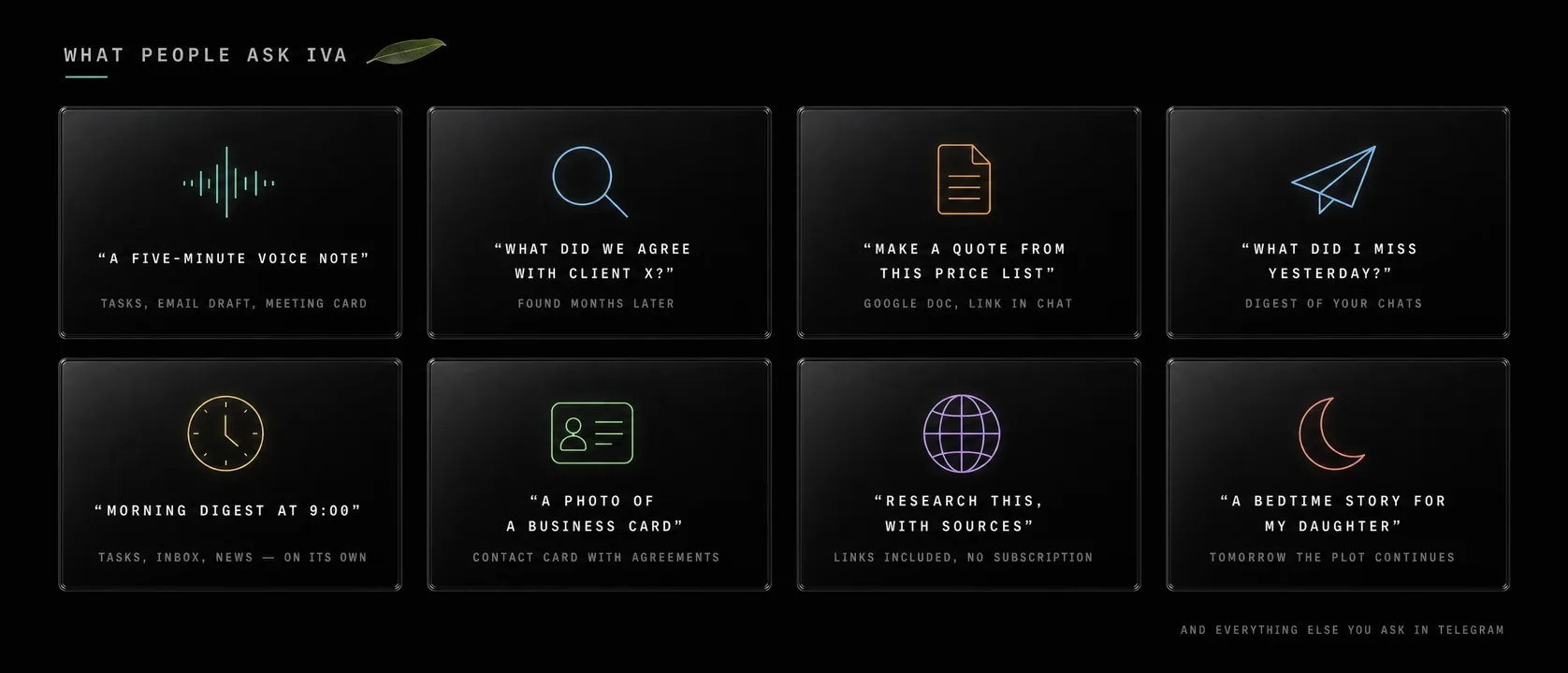
- "What did we agree with client X about the last shipment?" — found in seconds, months later.
- A five-minute voice note from the car → a task list, a draft email, a meeting card.
- "Make a quote from this price list, cut the discount by 2.5%, send it to the client" — a finished Google Doc, link in the chat.
The rest — for business owners, specialists, executives and everyday life: Use cases.
How it works
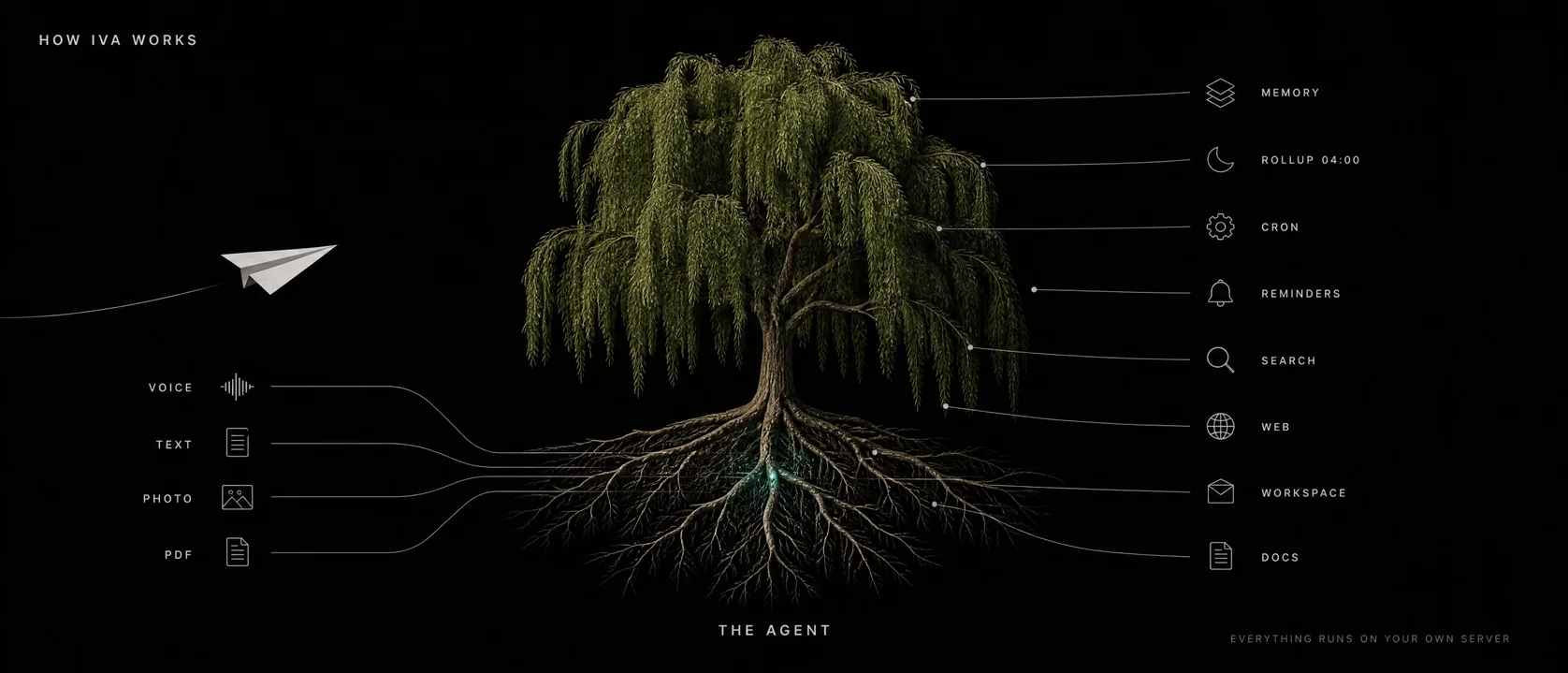
The bridge long-polls Telegram, so no public HTTPS, domain or webhook is needed. Iva runs as two systemd user services, two systemd watchdog timers and five in-process eve schedules — operations live in docs/deploy.md.
Wondering what you'd actually use an agent for? → 25+ real scenarios — business, work, everyday life.
Features
Voice, vision, memory, personal CRM, Google Workspace, skills — expand the full list
- Voice — voice, audio and video notes transcribed with Deepgram nova-3; auto-detects ru/uz/en.
- Vision — photos described by your provider's own vision model; no extra key, no extra bill.
- Rich replies — tables, checklists, collapsible blocks and formulas render natively in Telegram via Bot API 10.1 rich messages; plain formatting keeps its proven path, with a graceful fallback.
- Quiet update checks — once a day Iva checks for a newer stable release without spending model tokens. If one exists, Telegram offers Update or Later once; otherwise it says nothing.
- Layered memory — remembers across months, long after the chat window has scrolled away.
- Personal CRM — who your people are, what you agreed, when to follow up.
- Search by meaning — BM25 plus link-graph rerank, any language; optional vector mode with one key.
- Decision cards — what you chose, when and why; old versions stay in a dated History.
- Tasks & reminders — priorities, due dates and a morning digest.
- Web search — four pluggable providers: Tavily, Exa, Parallel or Brave.
- Google Workspace — Gmail, Calendar, Drive, Sheets, Docs and Tasks from chat via the
gwsCLI; installed for you, with a guided key setup right in the conversation. - Skills & MCP — drop one file to add a procedure or connect an MCP server; keys stay in
.env. - Personal Telegram — userbot (beta) — read and send from your own account, not just the bot; connect by chat (QR, no terminal). Rough and buggy — opt-in, at your own risk. A server-side anti-ban guardrail (FloodWait compliance + randomized pacing + circuit-breaker) is enforced, not just advised. Details.
- Safe to forward — forwarded text, captions and voice transcripts pass an injection screen before the model reads them. A flagged message or transcript reaches the model tagged as data rather than as an instruction; for media captions the screen runs but the tag does not travel with it yet.
- Token accounting — every model step is logged;
/usagereports it for free.
The Memory Tree
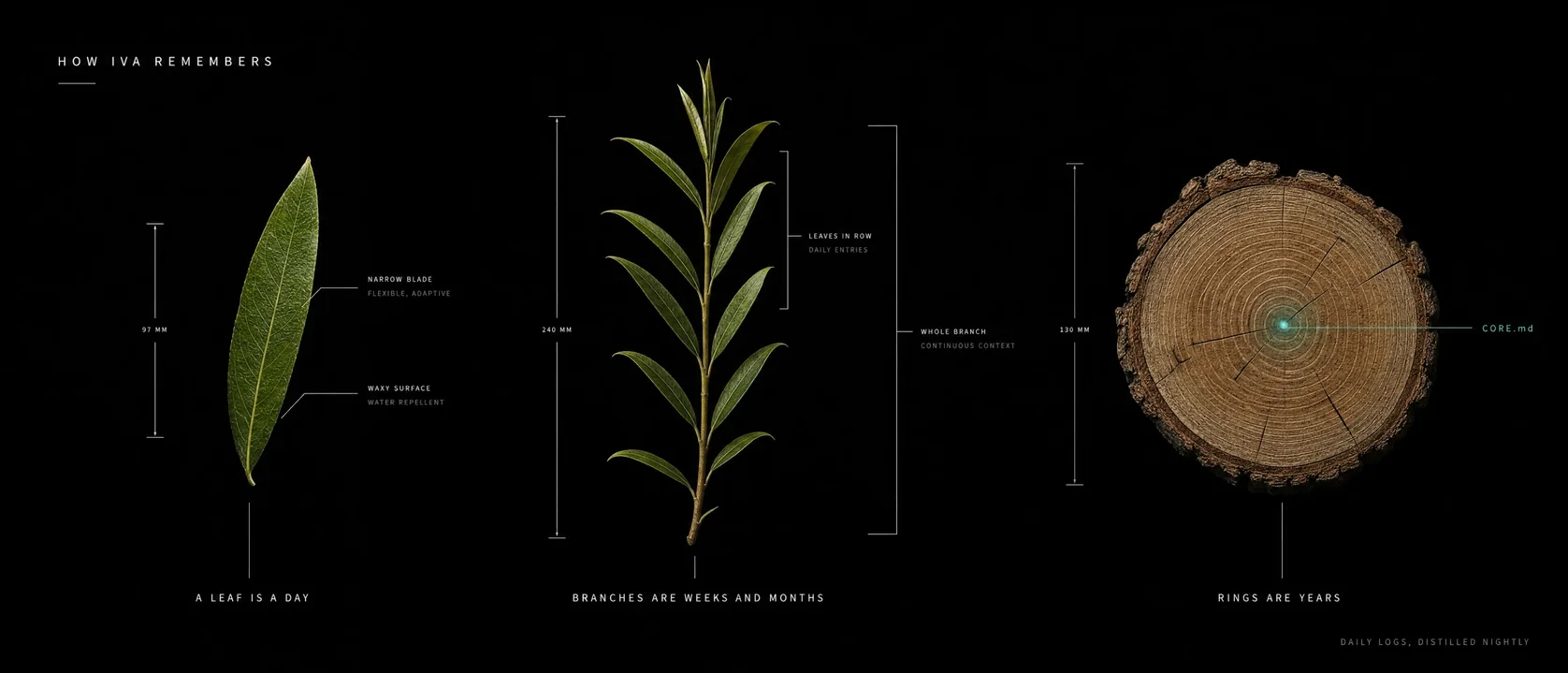
| Layer | What lives there | Path |
|---|---|---|
| 🍃 Leaves | the word-for-word transcript of each day, Iva's replies included | daily/YYYY-MM-DD.md |
| 🌿 Branches | summaries folded upward: day → week → month → year | summaries/daily/, weekly/, monthly/, yearly/ |
| 🪵 Trunk | CORE.md (≤1200 chars, in every prompt) + typed cards: contacts, projects, decisions, ideas, notes | CORE.md, cards/ |
- Every message lands verbatim in a daily markdown log — nothing is paraphrased on arrival.
- A nightly rollup at 04:00 distills day → week → month → year into schema-validated cards; facts that change get rewritten, not piled up.
- One core file,
CORE.md(≤1,200 chars), rides in every prompt — Iva knows you before it searches anything.
Full architecture and search internals: docs/memory.md.
A secretary inside Telegram
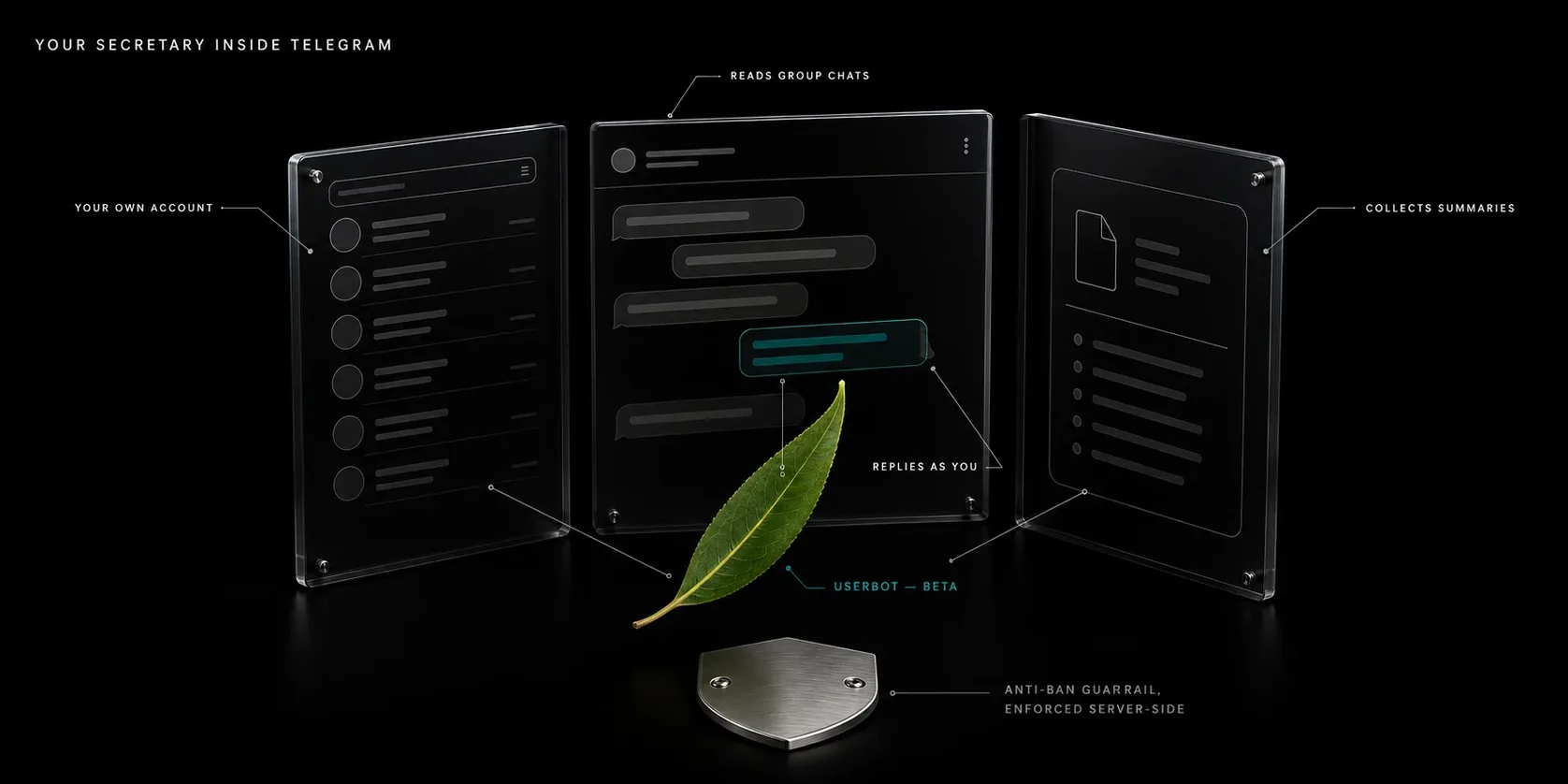
The bot is half of Telegram. The other half is your personal account: connect the userbot (beta, opt-in) and Iva works from it like a secretary — reads the group chats you never keep up with, folds them into summaries, catches the messages that actually need you, and replies as you.
- All of Telegram — groups, channels, unreads, search and the full history of your personal account.
- Onboarding in chat — tell the bot to connect your Telegram, scan a QR. No terminal.
- Anti-ban guardrail on the server — FloodWait compliance, a randomized delay after every send, and a circuit-breaker that pauses sending after three FloodWaits in 24 hours. It is enforced in the proxy rather than asked for in a prompt, and it wraps the three outbound calls that actually get accounts flagged: messages, files, forwards. Joins, invites, contact imports and reactions are not wrapped — those limits live in the skill file, which is a prompt.
- Read-only mode — one
.envswitch and Iva can read and search but physically cannot send.
[!WARNING] Automating a personal account is against Telegram's ToS and can get the account limited or banned. The userbot is opt-in, beta, and used at your own risk — reading is far safer than sending. Details: docs/userbot.md.
Security & privacy
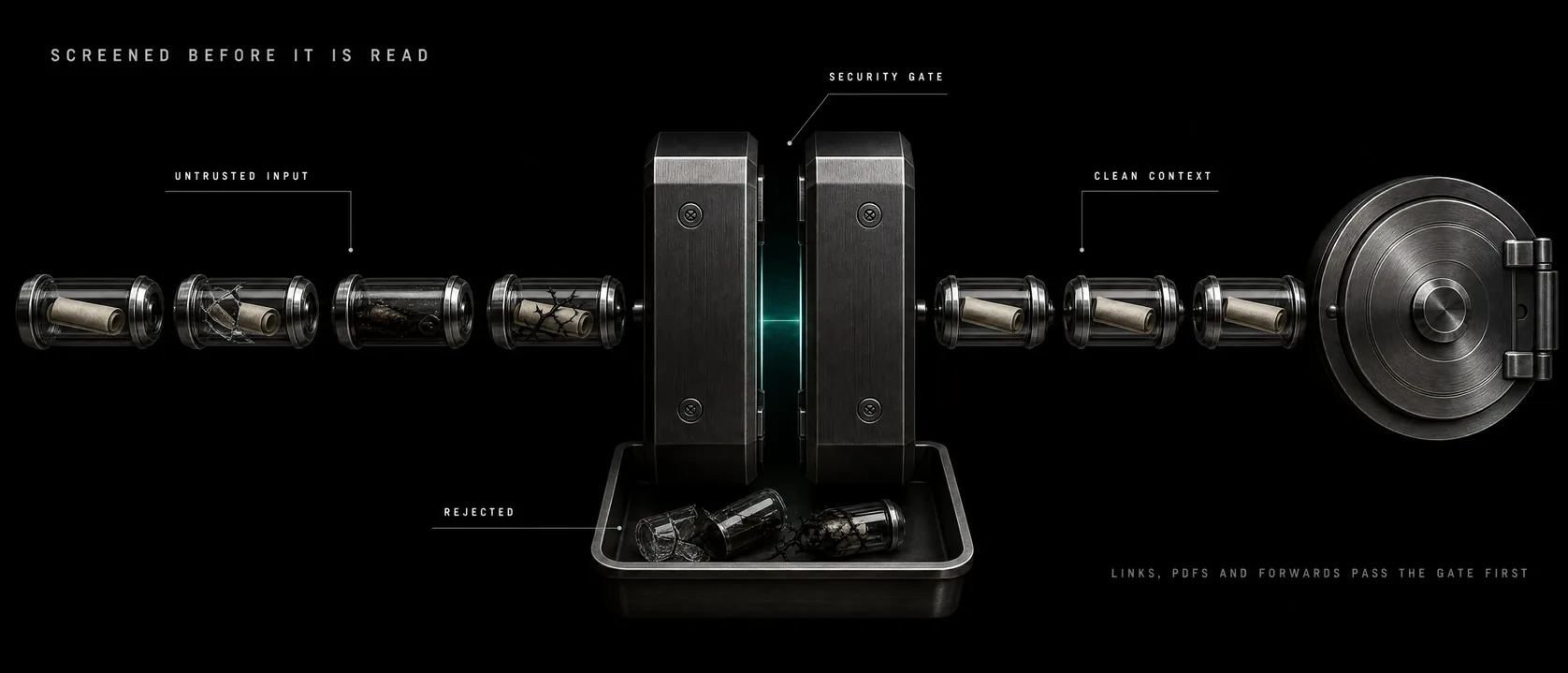
Web pages, search results, voice transcripts, captions and the vision model's description of a picture reach the model only through a prompt-injection sanitizer. On a forwarded text message the same gate annotates the turn with a warning instead of filtering the text, and document bodies, userbot-read chats and agent-browser output are not screened at all. Everything that leaves through the Outbox passes a secret-redaction gate, and the user allowlist fails closed — an empty list answers nobody. Your memory is a private git repo you own; the honest boundary is that the model and transcription are cloud APIs you choose and pay for. Gate internals and the full boundary: docs/security.md.
Install
One command on any Ubuntu/Debian box — a fresh VPS or your own machine:
curl -fsSL https://raw.githubusercontent.com/smixs/iva-agent/main/install.sh | bash
- Get a bot token from @BotFather.
- Run the installer and answer its questions.
- Message your bot. The wizard picks your Telegram ID out of that message, finishes setup, and Iva confirms right in the chat that it's live.
Brand-new VPS, still logged in as root? Run bash <(curl -fsSL https://raw.githubusercontent.com/smixs/iva-agent/main/bootstrap.sh) first: it creates your sudo user (with lingering enabled), updates the box, and turns on a firewall, fail2ban and SSH hardening. It asks three things — a login, its password, and the timezone — and no SSH key. Then log in as that user with that password and run the installer above. Details: docs/install.md.
Install as a normal user, not as root — Iva's shell tool runs as whoever installed it. Headless installs take --skip-setup or --non-interactive. Prefer to read before you run? Fetch it with curl -fsSL https://raw.githubusercontent.com/smixs/iva-agent/main/install.sh -o install.sh, read it, then bash install.sh. Wizard walkthrough and an SSH primer for first-time VPS owners: docs/install.md.
The first minute
Three messages, and you can watch the memory work:
- Send a voice note about your day — anything, out loud. Then look in
daily/inside your vault on the server: your words are sitting there in plain markdown, dated, yours. No other assistant hands you the file. - Tell it something a colleague would remember:
Marina at Acme wants the revised quote by Friday — she never picks up the phone. - Ask for it back the way a person would:
how should I follow up with Marina?— the answer comes from the card Iva just wrote, not from the last few messages.
Then send a photo of a business card, or forward a long post and ask for the gist. /menu has the rest; the full list is in 25+ scenarios.
Install from a clone — build it yourself
git clone https://github.com/smixs/iva-agent.git ~/iva
cd ~/iva && bash install.sh
The installer reuses the existing checkout instead of re-cloning, keeps .env and the vault untouched, and installs the same dependencies. A fork or a branch works through variables read at startup: REPO_URL=…, BRANCH=…, INSTALL_DIR=… (defaults: this repo, main, ~/iva). Details: docs/install.md.
Providers & cost
Four model providers. Pick one and fill its block in .env:
| Provider | How you pay |
|---|---|
| OpenCode Go | API key, ~$10/mo ($5 first month) |
| Ollama Cloud | API key, ~$20/mo |
| OpenRouter | API key, pay-as-you-go, 300+ models |
| OpenAI (ChatGPT) | your Plus/Pro subscription, no API key |
Default model is deepseek-v4-pro, 131k context. On Go it runs about $14–15/mo all-in ($10 model + $4–5 VPS; the model's first month is $5), no markup; voice rides Deepgram's free starter credit. Model lists, limits and the search matrix: docs/providers.md.
Documentation
Use cases · Install · Configuration · Memory · Providers · Security · Deploy · Commands & CLI · Menu · Extending · Plugins · FAQ · Troubleshooting
Документация на русском → docs/ru/
What's New
v0.3.28 · 19.08.2026 — expand the latest releases
19.08.2026
v0.3.28
- The update cleans up after itself: the disk keeps the running version and one rollback, everything else goes. Before a build only the running version stays — the build takes the rollback slot, so the peak is two versions (~400 MB each), not three. In the finish, removing old versions is the first step, ahead of
npm i -g @googleworkspace/cli@latest, which downloads onto the same disk; a failed cleanup chore no longer cancels it.iva doctorremoves leftovers of interrupted builds and surplus versions by itself, under the update lock, and printsversions on disk: N (current …, rollback …) — X GB free; with an update running it saysversion cleanup skipped, with a corruptactive.jsonit reports and deletes nothing. The cleanup before a build starts working from the update after this one —iva updateruns on the installed CLI. Prompted by a test droplet with 8.7 GB that stalled on three copies ofnode_modules(#194). New troubleshooting section «Disk full during update», an honest disk line in install. - The promoted runtime carries every source tree: the stable runtime snapshot copied
agent/andscripts/by hand,packages/never reached it, and on an install with a non-empty custom layer the agent died with[UNRESOLVED_IMPORT]onagent/lib/data-dir.tsin a restart loop. One list now —RUNTIME_SOURCE_TREES— feeds both the snapshot and the replica smoke, the layout digest moves to v3 so a runtime staged withoutpackages/rebuilds itself, and a guard test resolves every import of those trees and fails on a tree the snapshot would leave behind (#192, #191). - Timezones come back in canonical spelling: Intl accepted
europe/moscowin.env, systemd rejectedOnCalendar=*-*-* 05:00:00 europe/moscow, and the nightly timer never came up. The validator now returns what Intl resolves —Europe/Moscow; aliases canonicalize (US/Pacific→America/Los_Angeles); property tests pin idempotence and insensitivity to case and padding (#190). - A vision model per provider: instead of a constant in code, a variable in
.enveach, blank meaning the provider default —OLLAMA_VISION_MODEL(gemma4:31b),OPENCODE_VISION_MODEL(qwen3.7-plus),OPENROUTER_VISION_MODEL(google/gemini-2.5-flash); Codex has none, the subscription is multimodal.iva configasks for the vision model right after the text model and writes it next to*_MODEL. The OpenCode Go default comes from live runs on 18.08:gpt-5.6-lunaanswers 400 to any image,minimax-m3wraps its answer in<think>insidecontent,qwen3.7-plusreturns a clean description with OCR in 4–6 seconds. - Three Telegram fixes: the Stop button only in private chats — its callback has been rejected in groups since the last release, and the button hung there dead. Messages buffered during a rolling update pass the inbound gate with the same warning to the model and the same
[security] inbound flaggedline as fresh ones — the verdict used to be ignored. Prose that looks like a code placeholder (the price is 50 dollars, tables with padded numbers) is no longer cut out of an HTML reply: the placeholder moved to the Private Use Area, such code points from outside are stripped first, and a seeded property test walks digits, space runs and code spans mixed in prose.
18.08.2026
v0.3.27
- MCP servers of a plugin, both transports:
streamable-httpandsseinmcp.jsonbecome a generated eve connectionmcp-<name>--<server>, and${VAR}in a header is filled at run time fromdata/custom/plugins/<name>.env, so no token is baked into a build.stdioruns as the systemd unitiva-mcp-<name>-<server>.servicebehind Iva's own MCP proxy (services/mcp-proxy/,@modelcontextprotocol/sdk): the agent reaches it over127.0.0.1:<port>/mcpwith a bearer, and the token lives indata/plugin-data/<name>/mcp-<server>.tokenat mode 0600. The server sees onlyPATH,HOME,PLUGIN_ROOT,PLUGIN_DATA, its own env frommcp.jsonand<name>.env— nothing of the agent's environment reaches it. A second switch joins the first:trusted, throughiva plugin trust | untrust, andaddprints the processes and asksStart these processes on this machine? [y/N](--trustanswers yes; a shell without a terminal answers no). Ports are handed out from 8730, once, and stay until the plugin is removed. Proven end to end against a real stdio server and a real client from the SDK, not fakes. - Plugin services:
sh.iva/services/<svc>/service.jsonwith{command,args,port}becomes the unitiva-plugin-<name>-<svc>.service— envIVA_SERVICE_PORT,IVA_DATA_DIR,PLUGIN_ROOTandPLUGIN_DATA, the service's own folder as the working directory, started only while the plugin is enabled and trusted.iva plugin updaterestarts the units of a plugin whose content changed,iva updatebrings them back right after the flip, andiva doctorlists the units, printsis-activeand callsGET /healthon every MCP proxy.sh.iva/is now two kinds: an eve Extension (sh.iva/package.json, built into a version) and services, which never rebuild one. - The default Marketplace is live —
smixs/iva-plugins: the list sits at github.com/smixs/iva-plugins and carries two plugins.traceis the Trace viewer: the schema of Iva with the path of a turn lit across it, the feed of turns, replay at ×1, ×2 and ×4, tiles for today, 7 and 14 days; it listens on loopback only, andiva trace openprints the ready ssh tunnel command.hellois the demo code plugin authors copy: one skill, one tool. Three commands to get there:iva plugin add trace,iva plugin trust trace,iva trace open. Checked live from the public list:list --available,add tracepinned to a sha,update,remove. - Plugin docs:
docs/plugins.md(Russian:docs/ru/plugins.md) — what a plugin is, how to install one (a folder,owner/repo[/subdir][@ref], a git URL or a name from a Marketplace), how enabled differs from trusted, whativa updatedoes to plugins, how to write your own (skills, an Extension undersh.iva/,mcp.json, services) and what you risk;SECURITY.mdgains a Plugins section. Also: theiva pluginCLI is split into modules with no command changed, and on a development checkoutaddandremoveof a code plugin stop promising a build that never happened and say plainly that no version was built there.
17.08.2026
v0.3.26
- Plugins by name from a Marketplace:
iva plugin add tracefinds the plugin in an.agents/plugins/marketplace.jsonlist (the Codex convention — a path string orlocal | url | git-subdir;npmandpolicyentries are skipped aloud) and installs it through the same path as a folder or a git URL.iva plugin marketplace add | remove | listmanage your lists,iva plugin list --availableshows what is on offer; the default list issmixs/iva-plugins. Lists are cached underdata/marketplace-cache/; offline, the cache is used and marked as possibly stale. Onlyhttps://,ssh://andgit@host:are accepted —file://and local paths from a foreign list are refused, and plugin git never waits for a password in the terminal. A name offered by two lists is refused with anadd <name>@<list>hint. - Plugin code is built into the version: a plugin with an eve Extension under
sh.iva/now rides the update rails — a copy inside the version,npm ci,eve extension buildwith the very eve that runs Iva, a mount under its own namespace, then probe, flip and restart. The plugin's config is read fromdata/custom/plugins/<name>.config.jsonat start, never baked into the build. A failed build onadd | update | enablerolls the install back and leaves the running version alone; oniva updatethe version is built without that plugin, the plugin is switched off and one Alert says what to do.iva doctorreports whether each plugin's code is built into the current version. Verified against the real eve 0.30.8, not only fakes. iva tracereads the turn journal:iva trace tailstreams events live (--since Nprints the last N lines first),iva trace showlists the last 20 turns,iva trace show <turn_12 | tg:<chat>:<message> | session id | last>prints one turn with its steps, tools and subagent (--fullwithout the cap,--jsonraw lines),iva trace openprints the viewer address and a ready ssh tunnel command. Control characters in content never reach the terminal. The contract indocs/trace.mdnow says how night turns stitch: inside one session, turns are split byturn_N, and a line without a turn key belongs to the most recent open turn of its session.iva postreplaces the Python sender: a rich post to another allowlisted chat goes from the CLI through the Outbox and the outbound gate (ADR-0005) — the recipient is the digest chat or an explicit--chatfrom the allowlist, the token comes from.env, a local image reaches the public upload host only behind--allow-uploadand only as a real media file by magic bytes, 50 media at most. A post that cannot render rich is not downgraded to HTML without its images: it fails with one Bot API call and the error; a turn reply keeps its fallback. The Python copies of the security checks are gone from the skill — the gate lives inagent/lib/security-gate.ts, only data (the pattern list and the secret-key inventory) stays beside the skill. Missed in the 0.3.26 notes.
v0.3.25
- Iva reads rich Telegram posts: longreads from the new editor (
rich_message— headings, lists, tables, quotes, collages, media captions) used to arrive empty because theirtextfield is empty and the content lives in blocks. Now the text is read whole and in order, photos and videos from any block go through the usual media pipeline (10 per message, the rest announced in one line), truncation is visible. Works everywhere text is read: single message, album, forward, quoted message, media caption. Ordinary messages are untouched. The gap was shown by contributor PR #189. - Plugins install from the terminal:
iva plugin add <folder | owner/repo[/subdir][@ref] | git URL>puts an Agent Plugins 1.0.0 folder underdata/custom/plugins/, records it indata/custom/plugins.json, and its skills work from the next turn — no build, no restart.iva plugin list | remove | update | enable | disable | syncmanage them;iva doctorgains a Plugins section. Only the owner, only the terminal: no Telegram command and no model tool by design (ADR-0009). Plugin code and MCP servers are read and reported but not built yet — that lands in the next patch. - A turn journal:
data/trace/YYYY-MM-DD.jsonlrecords every turn from the Bridge to the Outbox — allowlist, Gate verdicts, context parts, model steps, tool calls, subagents, delivery — one JSON line per event, kept 14 days, content capped and switchable off withcaptureContentindata/settings.json. The format is documented indocs/trace.md(ADR-0010); a terminal reader (iva trace) and a viewer plugin follow in the next patch.
Full history — CHANGELOG.md.
Built on
eve 0.30.8, Vercel's agent framework, runs the agent; Node 24's built-in SQLite runs the search index — no separate database. Iva grew out of agent-second-brain and autograph — that story is in docs/memory.md.
Thanks
Iva gets better because people run it for real — contributors are welcome. Open an issue with what breaks, or send a PR. Everyone who already helped: docs/thanks.md.
License
MIT — take it, change it, run it on a hundred servers; just don't blame anyone if something breaks.