🔥 Hephaestus: A Semi-Structured Agentic Framework




What if AI workflows could write their own instructions as agents discover what needs to be done?
Quick Start • Documentation • Examples • Join our discord • Hephaestus Dev
🎥 See Hephaestus in Action
https://github.com/user-attachments/assets/7b021611-2c09-494b-9da1-2ce05176dc51
Watch how Hephaestus coordinates multiple AI agents, monitors their trajectories, and builds workflows dynamically
NEW: Hephaestus Dev
Ready to use Hephaestus as a development tool? We've built Hephaestus Dev - a pre-configured setup with 5 production-ready workflows for software development:
| Workflow | What it does |
|---|---|
| PRD to Software Builder | Build complete software from a Product Requirements Document |
| Bug Fix | Analyze, fix, and verify bugs systematically |
| Index Repository | Scan and index a codebase to build knowledge in memory |
| Feature Development | Add features to existing codebases following patterns |
| Documentation Generation | Generate comprehensive docs for existing codebases |
python run_hephaestus_dev.py --path /path/to/project
Get started with Hephaestus Dev →
The Problem I Kept Running Into
I was trying to build a system where AI agents could handle complex software projects. You know the kind: "Build me an authentication system with OAuth, JWT, rate limiting, and comprehensive tests."
Traditional agentic frameworks can branch and loop, but they have a limitation: every branch needs predefined instructions. You must write the task descriptions upfront for every scenario you anticipate.
But what about discoveries you didn't anticipate? When a testing agent finds an optimization opportunity, a security issue, or a better architectural pattern?
Here's what I tried instead: Define logical phase types that are needed to solve problems - like "Plan → Implement → Test" - and let agents create tasks in ANY phase based on what they discover.
What Actually Happened: A Branching Tree That Builds Itself
Instead of a rigid sequence, I set up phase types:
- Phase 1 (Analysis): Understanding, planning, investigation
- Phase 2 (Implementation): Building, fixing, optimizing
- Phase 3 (Validation): Testing, verification, quality checks
The key insight: Agents can spawn tasks in any phase they want.
A validation agent testing your auth system might discover an elegant caching pattern. Instead of being stuck (or following predefined branching logic you wrote), the agent:
- Creates a Phase 1 investigation task: "Analyze auth caching pattern - could apply to 12 other API routes for 40% speedup"
- Keeps working on their validation task
- Another agent picks up the investigation task and explores it
The workflow just branched itself. Not because you predicted "if optimization found, spawn investigation task" - but because the agent discovered something worth exploring and had the freedom to create work for it.
This creates a branching tree of tasks that grows based on actual discoveries, not anticipated scenarios.
Let me show you what this looks like in practice:
Example: Building from a PRD
I give Hephaestus a product requirements document: "Build a web application with authentication, REST API, and a React frontend."
Phase 1 agent reads the PRD and identifies 5 major components:
- Authentication system
- REST API layer
- React frontend
- Database schema
- Background workers
It spawns 5 Phase 2 tasks — one for each component. Now I have 5 agents building in parallel, each focused on one piece.
One of the Phase 2 agents finishes the REST API and spawns a Phase 3 validation task: "Test the REST API endpoints."
The Phase 3 agent starts testing. Everything passes. But then it notices something:
"The auth endpoints use a caching pattern that reduces database queries by 60%. This could speed up all API routes significantly."
Here's where it gets interesting.
The Phase 3 agent doesn't just log this observation and move on. It doesn't get stuck because there's no "investigate optimizations" in the workflow plan.
Instead, it spawns a new Phase 1 investigation task: "Analyze auth caching pattern — could apply to other API routes for major performance gain."
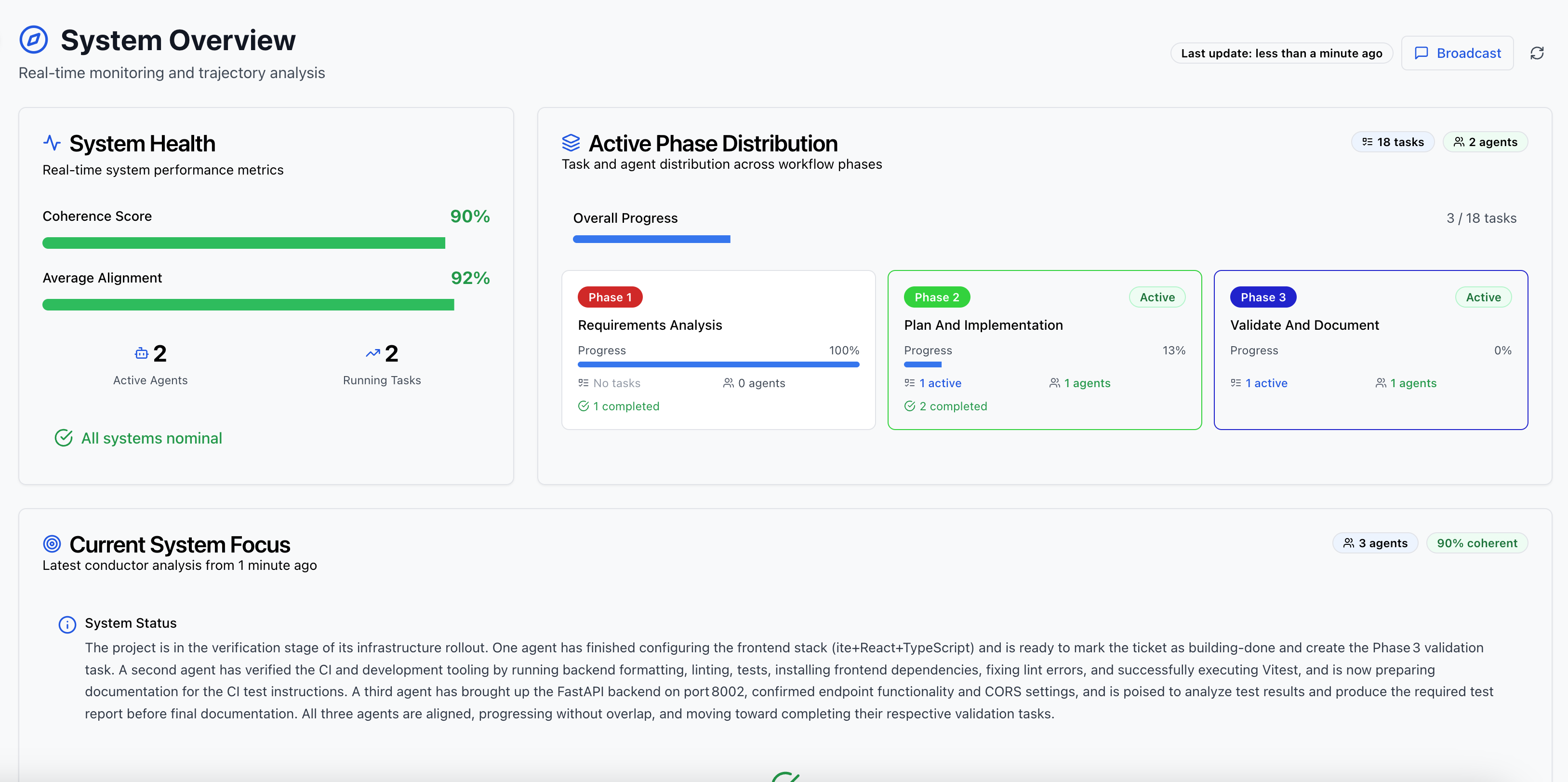
Real-time view: 2 agents working across 3 phases, Guardian monitoring at 90% coherence
A new Phase 1 agent spawns, investigates the caching pattern, confirms it's viable, and spawns a Phase 2 implementation task: "Apply caching pattern to all API routes."
Another agent implements it. Another agent validates it.
The workflow just branched itself. No one planned for this optimization. An agent discovered it during testing and created new work to explore it.
Meanwhile, a different Phase 3 agent is testing the authentication component. Tests fail. So it spawns a Phase 2 bug fix task: "Fix auth token expiry validation — current implementation allows expired tokens."
The fix agent implements the solution and spawns Phase 3 retest: "Validate auth fixes."
What Just Happened?
Look at what emerged:
graph TB
    P1[Phase 1: Analyze PRD<br/>Creates 5 tickets] --> P2A[Phase 2: Build Auth]
    P1 --> P2B[Phase 2: Build API]
    P1 --> P2C[Phase 2: Build Frontend]

    P2B --> P3B[Phase 3: Test API]
    P3B -->|discovers optimization| P1New[Phase 1: Investigate Caching<br/>NEW BRANCH]
    P3B -->|testing continues| P3Done[API Validated]

    P1New --> P2New[Phase 2: Implement Caching]
    P2New --> P3New[Phase 3: Validate Optimization]

    P2A --> P3A[Phase 3: Test Auth]
    P3A -->|tests fail| P2Fix[Phase 2: Fix Auth Bug]
    P2Fix --> P3Retest[Phase 3: Retest Auth]

    style P3B fill:#fff3e0
    style P1New fill:#e1f5fe
    style P2Fix fill:#ffebee
This workflow built itself:
- Started with 1 analysis task
- Branched into 5 parallel implementation tasks
- One testing phase discovered optimization → spawned 3-phase investigation branch
- Another testing phase found bugs → spawned fix → retest loop
- All coordinated through Kanban tickets with blocking relationships
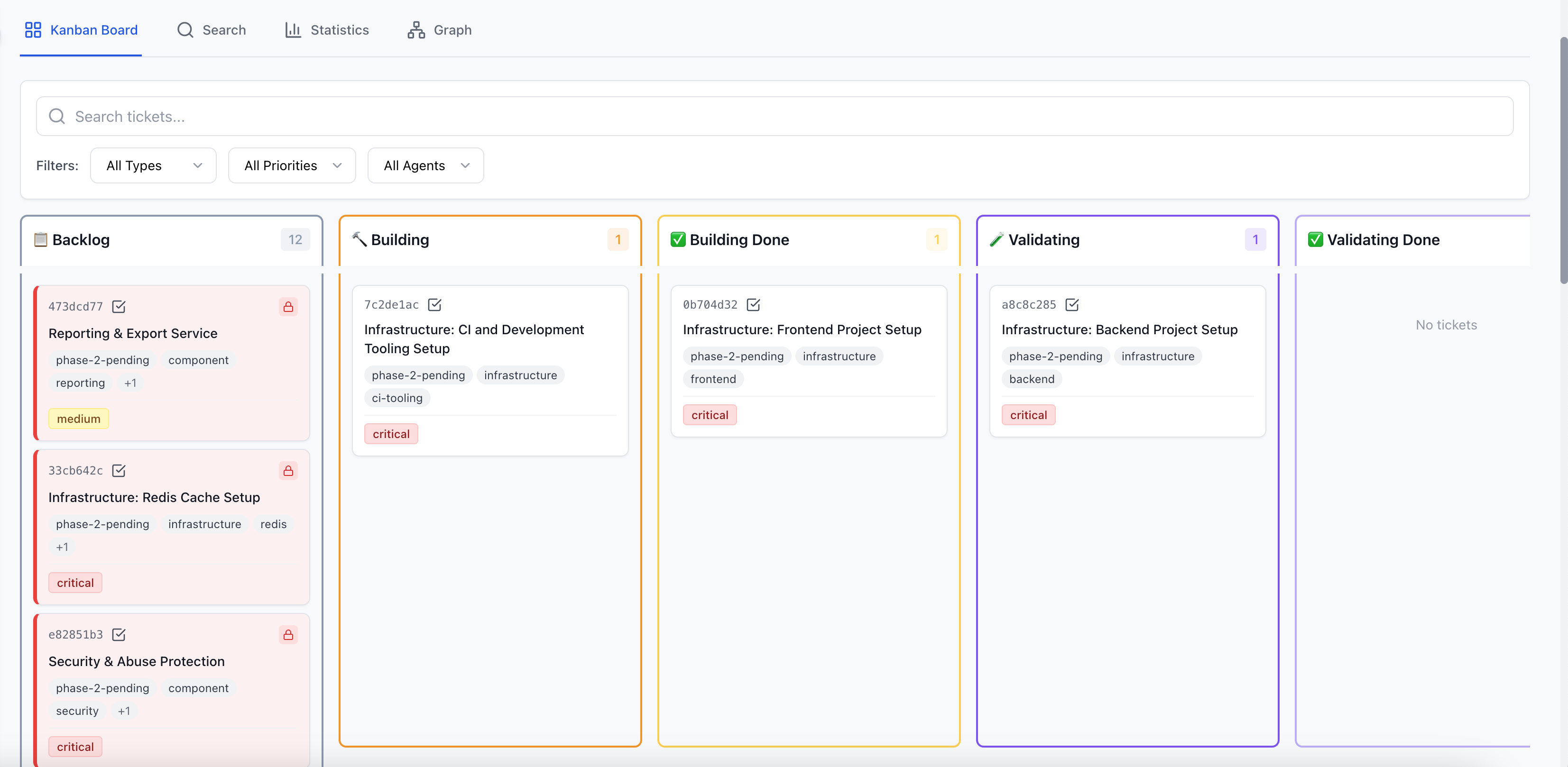
Kanban board automatically built by agents: Backlog → Building → Testing → Done
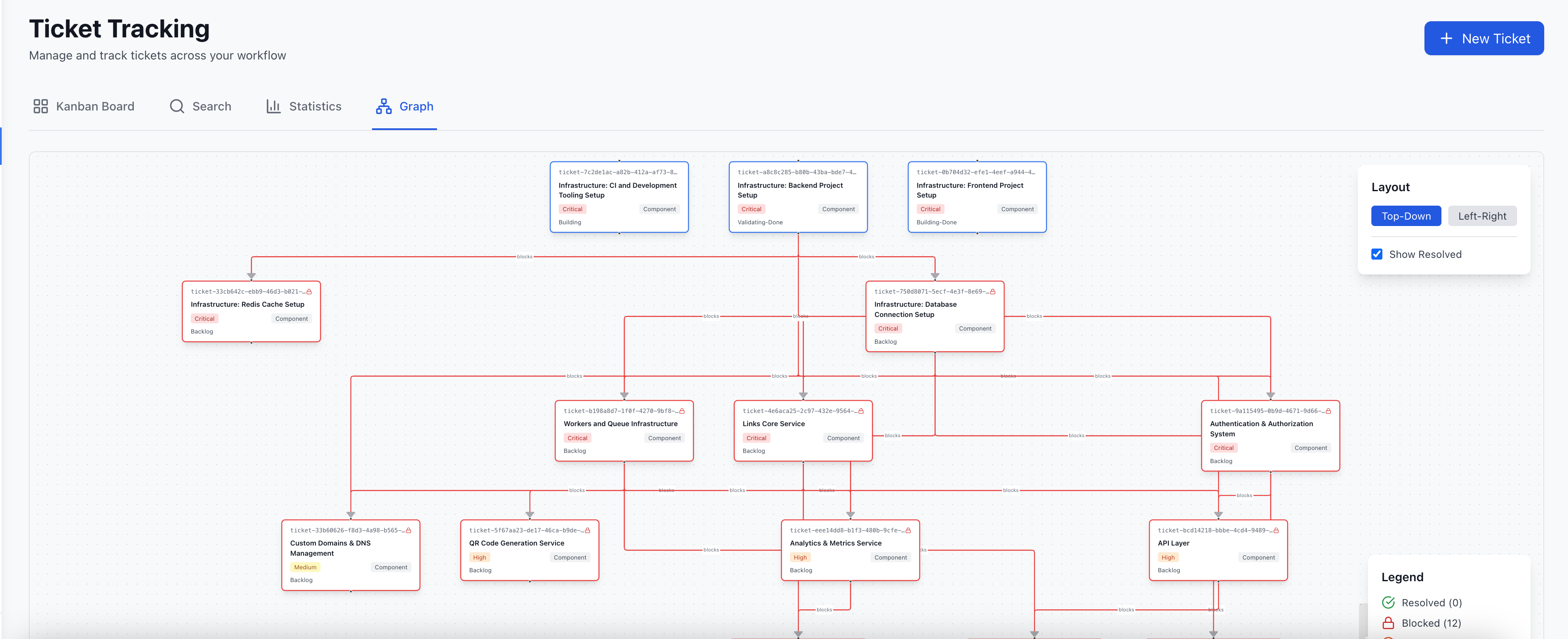
Dependency graph showing which tickets block others - the workflow structure Hephaestus discovered
Why This Changes Everything
Traditional workflows: Predict every scenario upfront → rigid plan → breaks when reality diverges
Hephaestus approach: Define work types → agents discover → workflow adapts in real-time
The workflow adapts in real-time based on what agents actually discover, not what we predicted upfront.
The Semi-Structured Sweet Spot
Here's why this is "semi-structured" and why that matters:
Fully structured workflows (traditional frameworks):
- ❌ Require predefined prompts for every scenario
- ❌ Can branch/loop, but need fixed instructions for each path
- ❌ Must anticipate all discoveries upfront
Fully unstructured agents (chaos):
- ❌ No coordination
- ❌ Duplicate work
- ❌ Contradictory changes
- ❌ No clear success criteria
Semi-structured (Hephaestus):
- ✅ Phase definitions provide work type structure and guidelines
- ✅ Agents write task descriptions dynamically based on discoveries
- ✅ Kanban tickets coordinate work with blocking relationships
- ✅ Guardian monitoring ensures agents stay aligned with phase goals
- ✅ Workflow adapts to what agents actually find, not what you predicted
You get structure where it matters:
- Phase types define what kind of work is happening
- Done definitions set clear completion criteria
- Guardian validates alignment with phase instructions
- Tickets track dependencies and prevent chaos
And flexibility where you need it:
- Agents create detailed task descriptions on the fly
- No need to predefine every possible branch
- Discoveries drive workflow expansion in real-time
- New work types emerge as agents explore
🚀 Quick Start
Prerequisites
- Python 3.10+
- tmux - Terminal multiplexer for agent isolation
- Git - Your project must be a git repository
- Docker - For running Qdrant vector store
- Node.js & npm - For the frontend UI
- Claude Code, OpenCode, Droid, or Codex - CLI AI tool that agents run inside
- API Keys: OpenAI, OpenRouter, Anthropic (also supports: Azure OpenAI, Google AI Studio - see LLM Configuration)
Validate Your Setup (macOS)
Before starting, validate that everything is installed and configured correctly:
python check_setup_macos.py
This script checks:
- ✅ All required CLI tools (tmux, git, docker, node, npm, Claude Code)
- ✅ API keys in
.envfile - ✅ MCP servers configured
- ✅ Configuration files and working directory
- ✅ Running services (Docker, Qdrant)
- ✅ Python and frontend dependencies
The script provides a color-coded report showing what's set up and what needs attention.
Get Started in 10 Minutes
Build your first self-adapting workflow:
The guide walks you through:
- Setting up API keys and LLM configuration
- Configuring MCP servers (Hephaestus + Qdrant)
- Setting your working directory
- Defining phases with dynamic task generation
- Running a workflow that adapts in real-time
- Watching agents coordinate and discover new work automatically
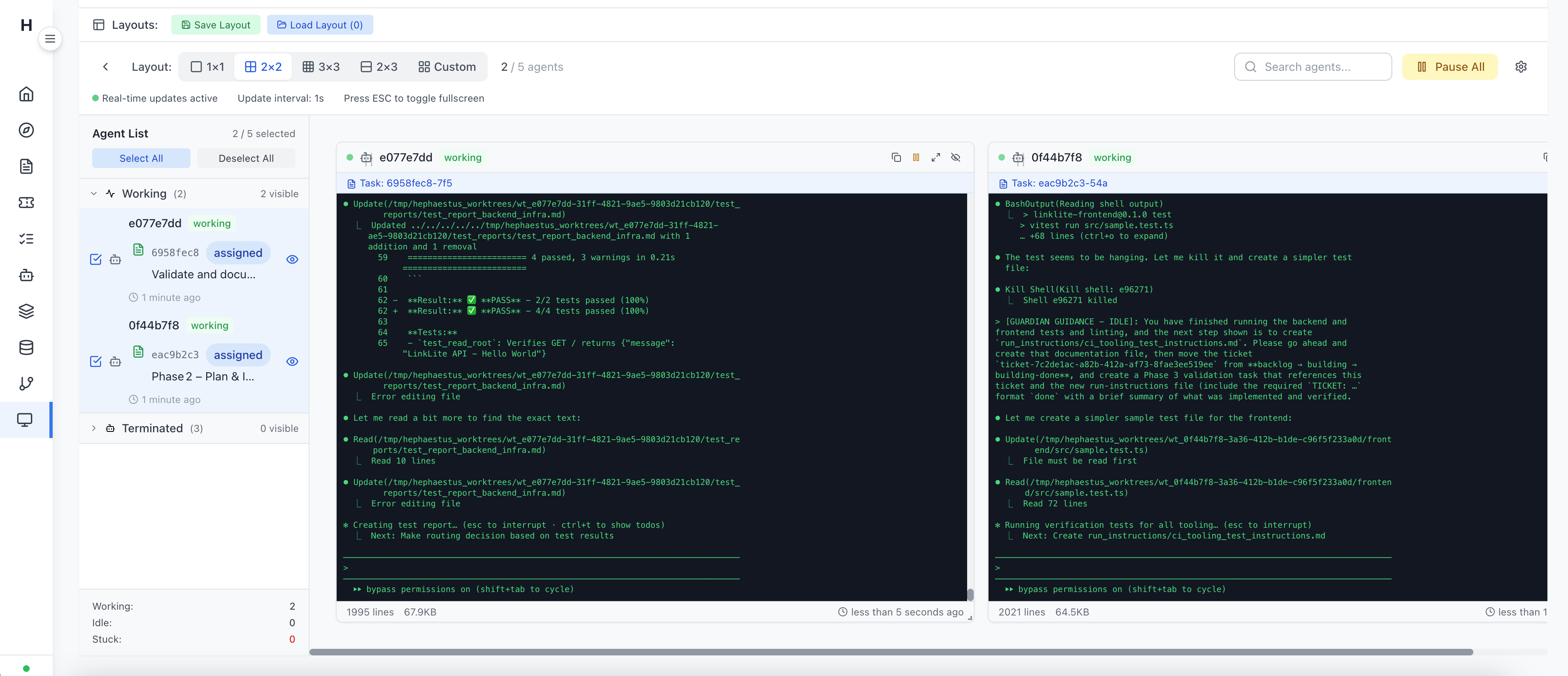
Real-time observability: Watch agents work in isolated Claude Code sessions as they discover and build the workflow
Want to learn more? Check out the full documentation for:
- Complete architecture and technical details
- API reference and SDK guides
- Example workflows and templates
- Best practices and advanced features
🤝 Getting Help
- 📖 Documentation - Complete guides, API reference, and tutorials
- 💬 GitHub Discussions - Ask questions and share ideas
- 🐛 Issue Tracker - Report bugs and request features
- 📧 Email - Reach out for support or collaboration
Hephaestus: Where workflows forge themselves
Named after the Greek god of the forge, Hephaestus creates a system where agents craft the workflow as they work
License: AGPL-3.0 • Status: Alpha - Active Development