
govctl






A governance harness for AI coding.
Turn prompts and patches into RFCs, ADRs, work items, and guarded delivery.
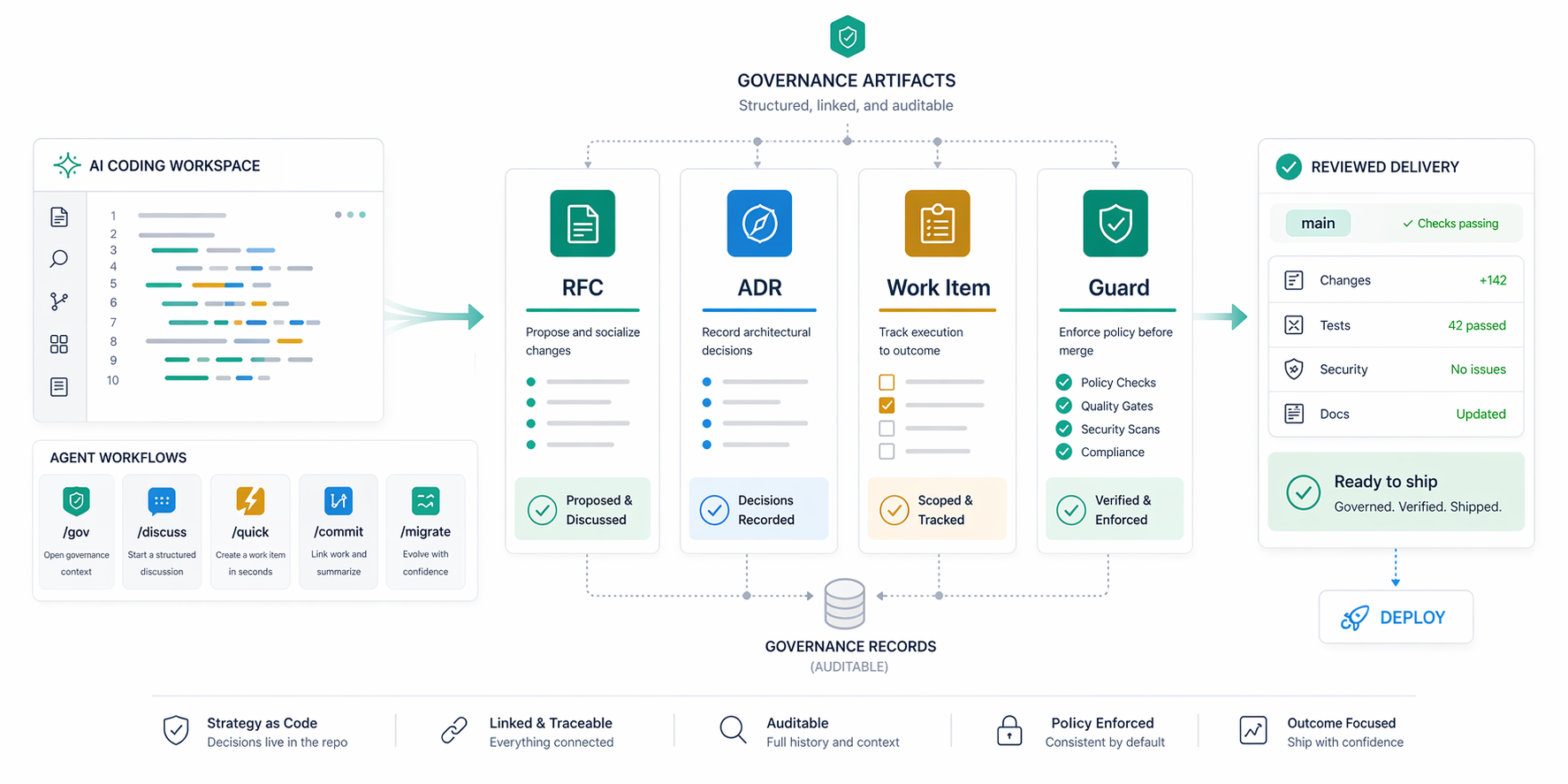
govctl is a governance-as-code CLI for teams using AI to build software seriously.
It gives AI-assisted development a control plane that lives in your repo:
- RFCs say what must be true
- ADRs record why a design was chosen
- Work items track execution and acceptance criteria
- Verification guards enforce executable completion gates
- Conformance cases map reusable acceptance scenarios to versioned RFC requirements and guards
The point is not bureaucracy. The point is that AI-generated changes become reviewable, traceable, and phase-gated.
Why govctl
Most AI coding tools optimize for generation. govctl optimizes for delivery.
Without explicit governance, teams drift into the same pattern:
- ideas jump straight into implementation
- decisions live in chat history instead of artifacts
- code and specs diverge silently
- "done" means "the agent stopped typing", not "the work passed verification"
govctl closes that gap by making governed artifacts, lifecycle, and verification part of the normal workflow.
Without govctl:
  prompt -> code -> drift -> arguments

With govctl:
  RFC / ADR -> work item -> guarded implementation -> stable history
What Makes It Different
1. Spec-first by default
govctl is built around the idea that implementation follows governed artifacts.
In practice, that means:
- RFCs describe externally relevant behavior and constraints
- ADRs record design choices and trade-offs
- work items execute against those artifacts
- verification guards and lifecycle gates decide when work is actually done
Instead of treating prompts as the source of truth, the source of truth becomes governed artifacts in the repository.
2. Artifacts are the control plane
govctl does not hide governance behind a web app or an MCP server.
Artifacts live in gov/ as TOML files with schema headers, references, and stable CLI access. That means:
- changes are diffable
- decisions are reviewable in PRs
- agents can operate against files and commands you already understand
3. One CLI agents can reliably operate
The CLI is the operating surface for agents:
list,show,get,edit- resource-specific lifecycle verbs like
adr accept,rfc advance,rfc supersede, andwork move - path-first mutation through
edit - explicit help text designed to act as a reliable command contract
Clauses remain first-class govctl clause resources even though their IDs and
storage are scoped by an RFC.
This matters because agent workflows get better when the interface is stable, local, and inspectable.
4. Works in brownfield repositories
This is not only for greenfield projects.
For existing repositories, the /migrate workflow helps you adopt governance incrementally: discover undocumented decisions, backfill ADRs, and establish governed artifacts without restarting the project.
Quick Start
CLI
# Install from source
cargo install govctl

# Or install a prebuilt binary (faster, skips compilation)
cargo binstall govctl

govctl init
govctl status
To update an existing installation:
govctl self-update
Then create your first governed artifacts:
govctl rfc new "Caching Strategy"
govctl adr new "Choose cache backend"
govctl work new --active "implement caching"
Agent workflow
Initialize governance, then install or load the agent workflows for your tool:
/discuss <topic>to draft RFCs and ADRs/gov <task>to execute governed implementation/quick <task>for intentionally small changes/committo record work with governance checks
Check that the target agent runtime is ready, then install the bundled integration:
govctl agent doctor claude
govctl agent install claude
For Codex:
govctl agent doctor codex
govctl agent install codex
Use govctl agent update <claude|codex|all> after upgrading govctl, then start
a new agent session. Both clients receive skills and hooks through their native
plugin mechanism. Claude also loads its Markdown reviewer agents from the
plugin; Codex receives standalone read-only TOML reviewer roles. Runtime-specific
hooks add compact context only in governed projects and advise, rather than
block, direct governance-artifact edits.
A concrete example
govctl rfc new "Verification Guard Policy"
govctl clause new RFC-0015:C-GUARD-REQUIREMENTS "Required guards" -s "Verification" -k normative
govctl adr new "Require clippy on parser refactors"
govctl work new --active "add parser lint guard"
Core Capabilities
Canonical artifact operations
Agents and humans work through a stable CLI contract.
Read the exact field you need:
govctl rfc get RFC-0001 status
For precise artifact mutation, govctl provides a canonical path-first interface:
govctl adr edit ADR-0038 decision --set --stdin
govctl work edit WI-2026-01-17-001 "acceptance_criteria[0]" --tick done
govctl clause edit RFC-0002:C-CRUD-VERBS text --set --stdin
This is not the product's identity. It is the low-level tool agents use to update governed artifacts precisely and consistently.
Project-wide search
Use govctl search to find governed artifacts across RFCs, clauses, ADRs,
work items, guards, and Conformance Cases:
govctl search cache
govctl search RFC-0002 --output json
govctl search migration --type rfc --type adr --tag cli -n 5
govctl search cache --type conformance
Search uses a disposable local index under .govctl/. The TOML artifacts remain
the source of truth, and --reindex forces a fresh rebuild when needed.
Execution loops and dependencies
Work items can declare hard execution dependencies with depends_on; keep
informational links in refs.
govctl work edit WI-2026-01-17-002 depends_on --add WI-2026-01-17-001
govctl check
For multi-work-item implementation batches, use a generated local loop ID and
record round evidence in .govctl/loops/ instead of work item notes:
govctl loop list open
govctl loop start WI-2026-01-17-001 WI-2026-01-17-002
govctl loop run <LOOP-ID>
Verification guards
Guards are executable checks that run when work reaches completion gates.
Define reusable project defaults in gov/config.toml:
[verification]
enabled = true
default_guards = ["GUARD-GOVCTL-CHECK"]
Keep expensive or domain-specific checks out of the universal default set and require them on affected work items. You can also waive a guard with an explicit reason. See:
Requirement traceability
Conformance Cases provide a stable, non-normative link from a versioned RFC Clause to a project-owned scenario and reusable Guards:
govctl conformance new "Cache expiry" \
  --path tests/conformance/cache.toml \
  --selector cache-expiry \
  --requirement RFC-0012:C-CACHE-EXPIRY@1.2.0 \
  --guard GUARD-CACHE-CONFORMANCE
govctl conformance trace RFC-0012
They declare traceability; they do not execute tests or override RFC authority. See Conformance Cases.
Brownfield adoption vs format migration
These are related, but different:
/migrateworkflow — adoptgovctlin an existing repository by discovering decisions, backfilling ADRs, and introducing governance incrementallygovctl migratecommand — upgrade existing TOMLgovctlartifacts to the current on-disk format and schema
For format upgrades:
govctl migrate
govctl check
Schema version 3 is the minimum supported repository format. Schema version 5
uses project .gitignore files plus .govignore for source-scan exclusions and
re-inclusions; govctl migrate upgrades supported repositories. Use a
compatible earlier govctl version for repositories below schema 3. Legacy RFC
and clause JSON storage is rejected explicitly.
Interactive TUI
govctl tui
Open the read-only cockpit for project overview, artifact browsing, search,
loop-state inspection with dependency DAG context, guards, releases, tags, and
govctl check diagnostics. Mutation remains owned by CLI commands.
Who This Is For
- Teams using Claude Code, Codex, Cursor, or similar agents for real product work
- Projects that want AI assistance without losing reviewability
- Brownfield repositories that need governance without a rewrite
- Engineers who want specs, decisions, and work tracking to live in the repo
Documentation
Community
Contributing
govctl is intentionally opinionated:
- features start with governed artifacts, not implementation-first
- RFCs and ADRs are part of the product, not side documentation
- verification and lifecycle are core behavior, not optional extras
If that matches how you want AI-assisted development to work, contributions are welcome.
License
MIT
Star History
"Discipline is not the opposite of creativity. It is the foundation."