Multi-Tenant AI Agent Platform
Multi-agent AI gateway built in Go. 20+ LLM providers. 7 channels. Multi-tenant PostgreSQL.
Single binary. Production-tested. Agents that orchestrate for you.
Documentation • Quick Start • Twitter / X








🌐 Languages: 🇨🇳 简体中文 · 🇯🇵 日本語 · 🇰🇷 한국어 · 🇻🇳 Tiếng Việt · 🇵🇭 Tagalog · 🇪🇸 Español · 🇧🇷 Português · 🇮🇹 Italiano · 🇩🇪 Deutsch · 🇫🇷 Français · 🇸🇦 العربية · 🇮🇳 हिन्दी · 🇷🇺 Русский · 🇧🇩 বাংলা · 🇮🇱 עברית · 🇵🇱 Polski · 🇨🇿 Čeština · 🇳🇱 Nederlands · 🇹🇷 Türkçe · 🇺🇦 Українська · 🇮🇩 Bahasa Indonesia · 🇹🇭 ไทย · 🇵🇰 اردو · 🇷🇴 Română · 🇸🇪 Svenska · 🇬🇷 Ελληνικά · 🇭🇺 Magyar · 🇫🇮 Suomi · 🇩🇰 Dansk · 🇳🇴 Norsk
Core Features
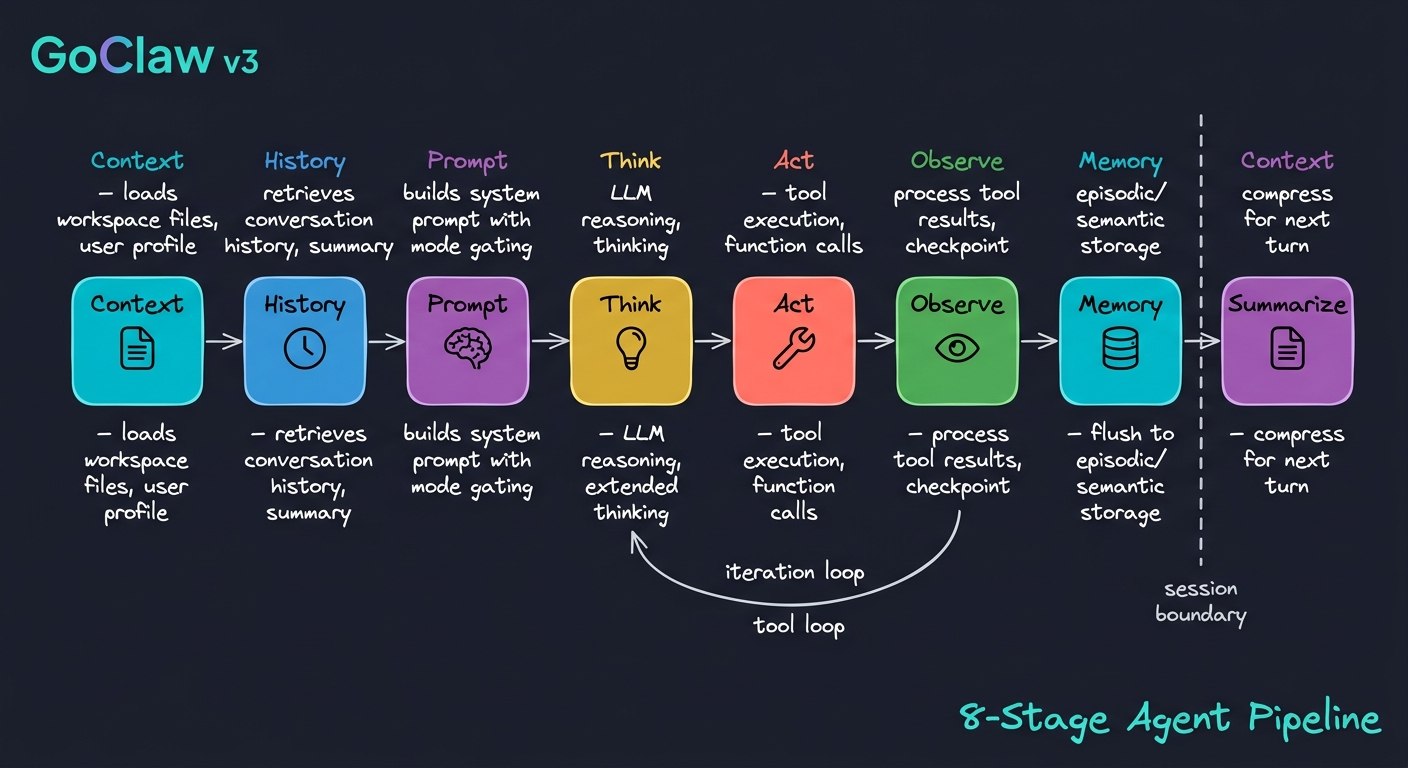
- 8-Stage Agent Pipeline — context → history → prompt → think → act → observe → memory → summarize. Pluggable stages, always-on execution
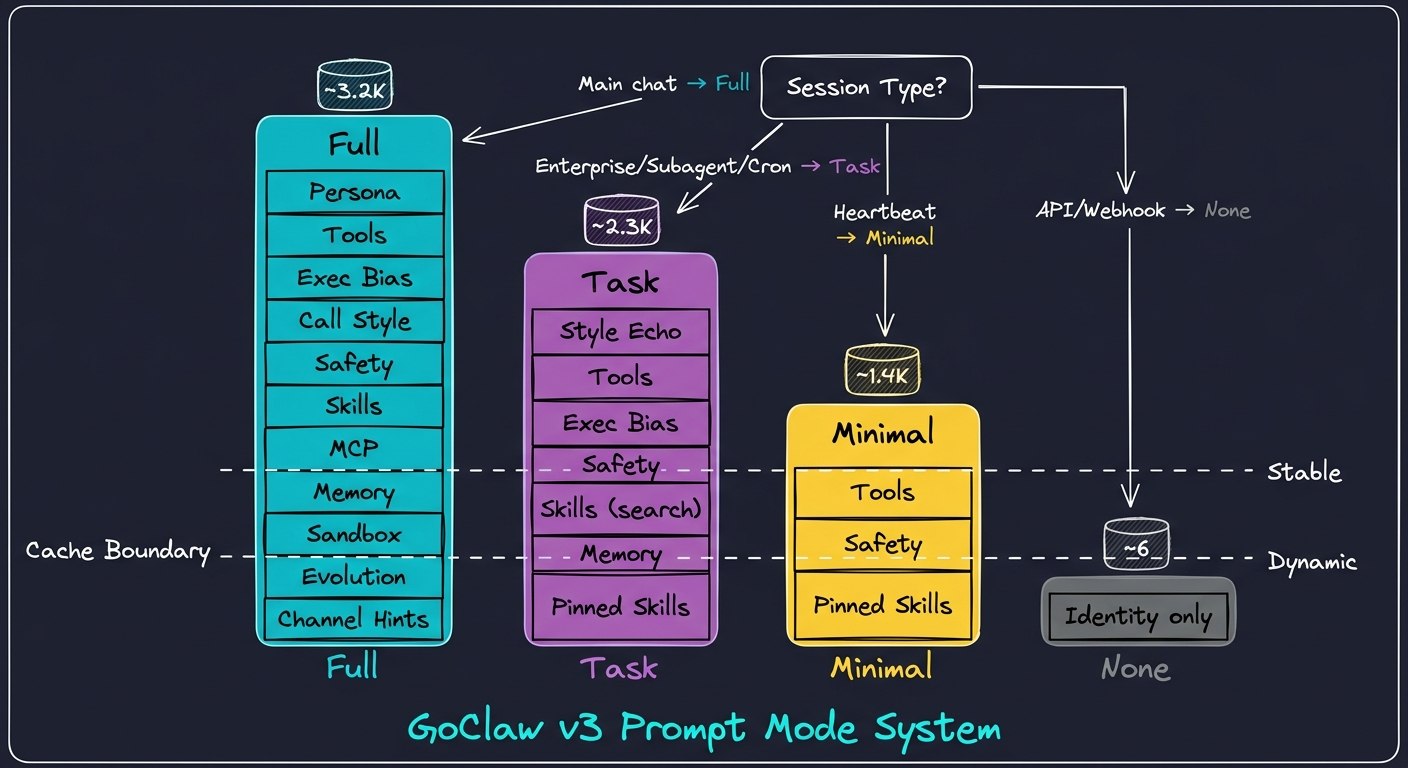
- 4-Mode Prompt System — Full / Task / Minimal / None with section gating, cache boundary optimization, and per-session mode resolution
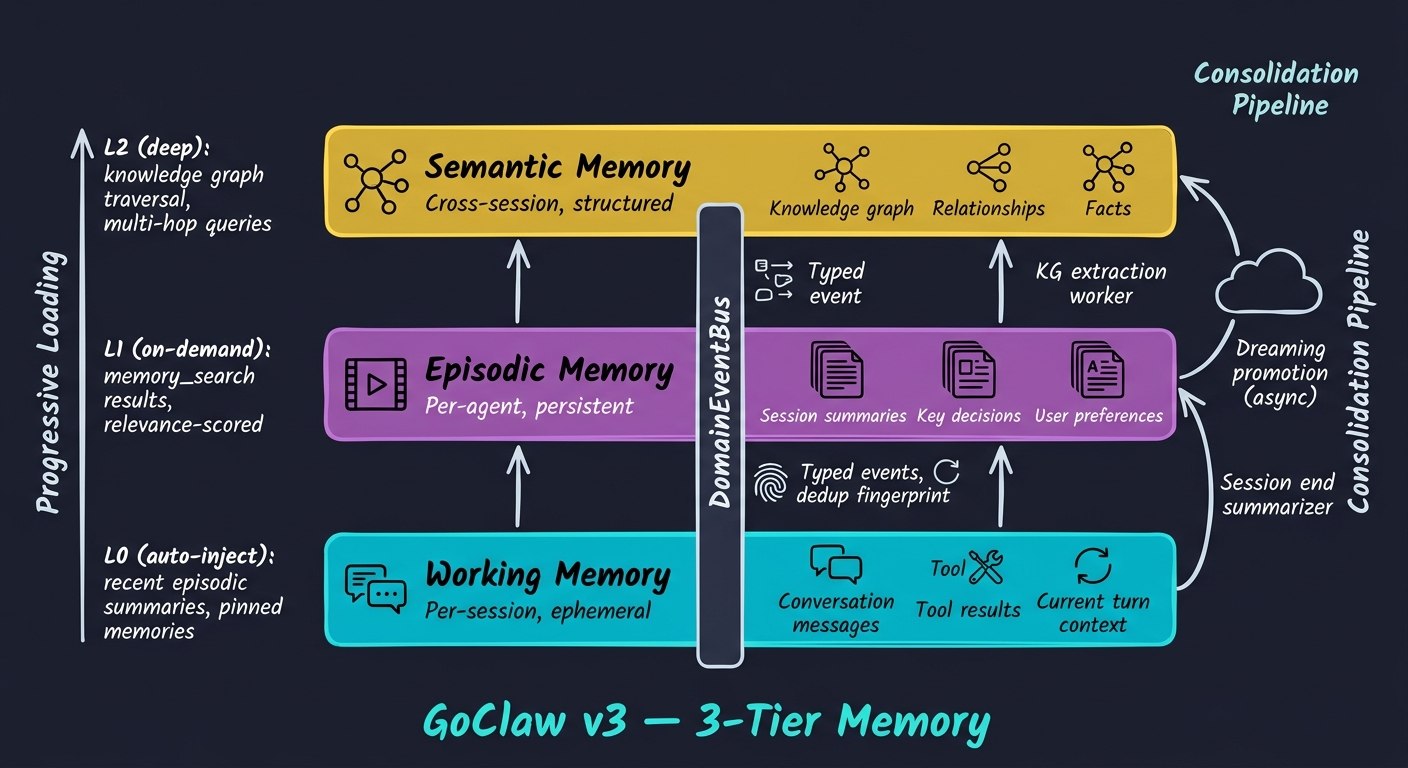
- 3-Tier Memory — Working (conversation) → Episodic (session summaries) → Semantic (knowledge graph). Progressive loading L0/L1/L2
- Knowledge Vault — Document registry with [[wikilinks]], hybrid search (FTS + pgvector), filesystem sync
- Agent Teams & Orchestration — Shared task boards, inter-agent delegation (sync/async), 3 orchestration modes (auto/explicit/manual)
- Self-Evolution — Metrics → suggestions → auto-adapt with guardrails. Agents refine their own communication style
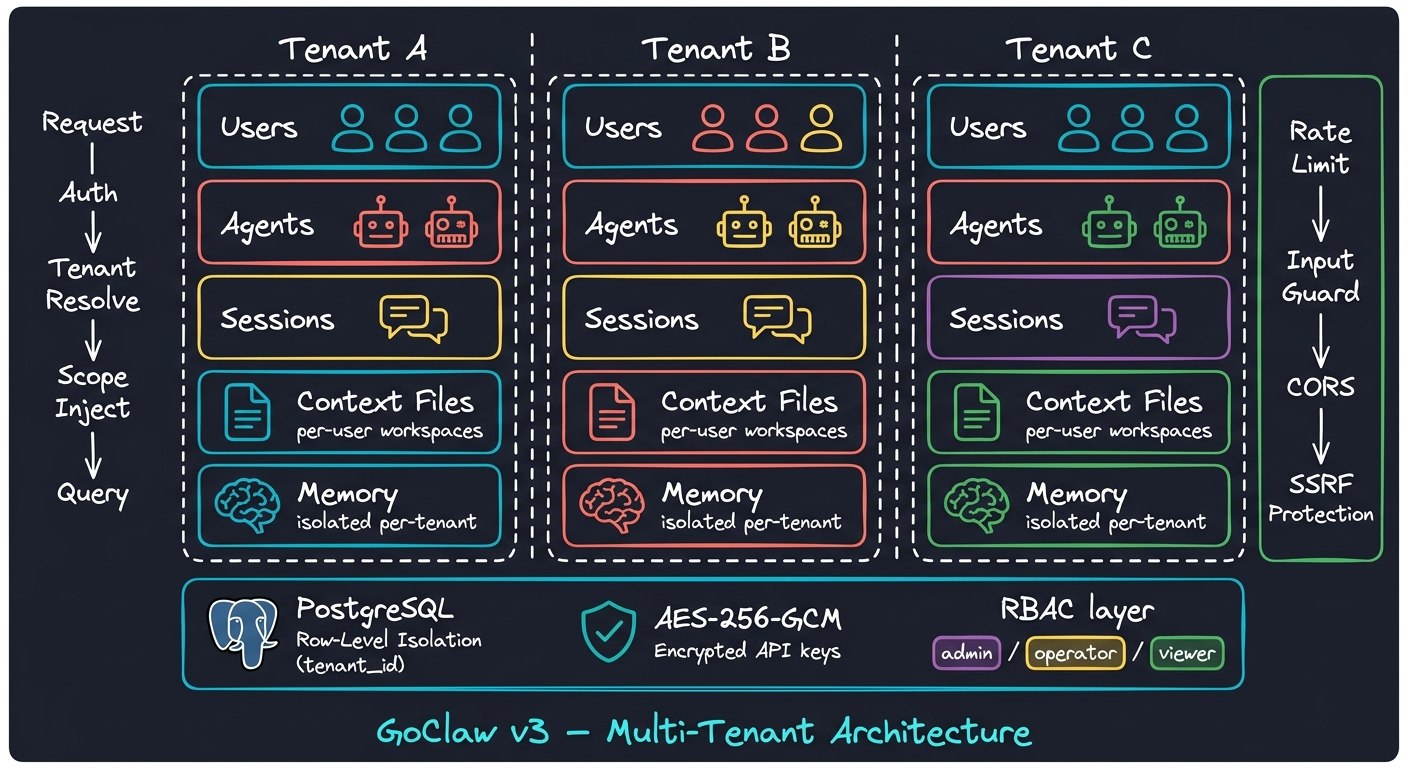
- Multi-Tenant PostgreSQL — Per-user workspaces, per-user context files, encrypted API keys (AES-256-GCM), RBAC, isolated sessions
- 20+ LLM Providers — Anthropic (native HTTP+SSE with prompt caching), OpenAI, OpenRouter, Groq, DeepSeek, Gemini, Mistral, xAI, MiniMax, DashScope, Claude CLI, Codex, ACP, and any OpenAI-compatible endpoint
- 7 Messaging Channels — Telegram, Discord, Slack, Zalo OA, Zalo Personal, Feishu/Lark, WhatsApp
- Production Security — 5-layer permission system, rate limiting, prompt injection detection, SSRF protection, AES-256-GCM encryption
- Single Binary — ~25 MB static Go binary, no Node.js runtime, <1s startup, runs on a $5 VPS
- Observability — Built-in LLM call tracing with spans and prompt cache metrics, optional OpenTelemetry OTLP export
Desktop Edition (GoClaw Lite)
A native desktop app for local AI agents — no Docker, no PostgreSQL, no infrastructure.
macOS:
curl -fsSL https://raw.githubusercontent.com/nextlevelbuilder/goclaw/main/scripts/install-lite.sh | bash
Windows (PowerShell):
irm https://raw.githubusercontent.com/nextlevelbuilder/goclaw/main/scripts/install-lite.ps1 | iex
What's Included
- Single native app (Wails v2 + React), ~30 MB
- SQLite database (zero setup)
- Chat with agents (streaming, tools, media, file attachments)
- Agent management (max 5), provider config, MCP servers, skills, cron
- Team tasks with Kanban board and real-time updates
- Auto-update from GitHub Releases
Lite vs Standard
| Feature | Lite (Desktop) | Standard (Server) |
|---|---|---|
| Agents | Max 5 | Unlimited |
| Teams | Max 1 (5 members) | Unlimited |
| Database | SQLite (local) | PostgreSQL |
| Memory | FTS5 text search | pgvector semantic |
| Channels | — | Telegram, Discord, Slack, Zalo, Feishu, WhatsApp |
| Knowledge Graph | — | Full |
| RBAC / Multi-tenant | — | Full |
| Auto-update | GitHub Releases | Docker / binary |
Building from Source
# Prerequisites: Go 1.26+, pnpm, Wails CLI (go install github.com/wailsapp/wails/v2/cmd/wails@latest)
make desktop-build                    # Build .app (macOS) or .exe (Windows)
make desktop-dmg VERSION=0.1.0        # Create .dmg installer (macOS only)
make desktop-dev                      # Dev mode with hot reload
Desktop Releases
Desktop uses independent versioning with lite-v* tags:
git tag lite-v0.1.0 && git push origin lite-v0.1.0
# → GitHub Actions builds macOS (.dmg + .tar.gz) + Windows (.zip)
# → Creates GitHub Release with all assets
Architecture
Quick Start
Prerequisites: Go 1.26+, PostgreSQL 18 with pgvector, Docker (optional)
From Source
git clone -b main https://github.com/nextlevelbuilder/goclaw.git && cd goclaw
make build
./goclaw onboard        # Interactive setup wizard
source .env.local && ./goclaw
Note: The default branch is
dev(active development). Use-b mainto clone the stable release branch.
With Docker
# Generate .env with auto-generated secrets
chmod +x prepare-env.sh && ./prepare-env.sh

# Add at least one GOCLAW_*_API_KEY to .env, then:
make up

# Web Dashboard at http://localhost:18790 (built-in)
# Health check: curl http://localhost:18790/health

# Optional: separate nginx for custom SSL/reverse proxy
# make up WITH_WEB_NGINX=1  → Dashboard at http://localhost:3000
make up creates a Docker network, embeds the correct version from git tags, builds and starts all services, and runs database migrations automatically.
Common commands:
make up                # Start all services (build + migrate)
make down              # Stop all services
make logs              # Tail logs (goclaw service)
make reset             # Wipe volumes and rebuild from scratch
Operator CLI:
The main goclaw binary can also inspect local or remote gateways:
goclaw traces list --status error
goclaw traces get <trace-id> -o json
goclaw --server https://goclaw.example.com --token "$GOCLAW_GATEWAY_TOKEN" traces follow --session <session-key>
Optional services — enable with WITH_* flags:
| Flag | Service | What it does |
|---|---|---|
WITH_BROWSER=1 | Headless Chrome | Enables browser tool for web scraping, screenshots, automation |
WITH_OTEL=1 | Jaeger | OpenTelemetry tracing UI for debugging LLM calls and latency |
WITH_SANDBOX=1 | Docker sandbox | Isolated container for running untrusted code from agents |
WITH_TAILSCALE=1 | Tailscale | Expose gateway over Tailscale private network |
WITH_REDIS=1 | Redis | Redis-backed caching layer |
Flags can be combined and work with all commands:
# Start with browser automation and tracing
make up WITH_BROWSER=1 WITH_OTEL=1

# Stop everything including optional services
make down WITH_BROWSER=1 WITH_OTEL=1
When GOCLAW_*_API_KEY environment variables are set, the gateway auto-onboards without interactive prompts — detects provider, runs migrations, and seeds default data.
Docker image variants:
Image Description latestBackend + embedded web UI + Python (recommended) latest-baseBackend API-only, no web UI, no runtimes latest-fullAll runtimes + skill dependencies pre-installed latest-otelLatest + OpenTelemetry tracing goclaw-webStandalone nginx + React SPA (for custom reverse proxy) For custom builds (Tailscale, Redis):
docker build --build-arg ENABLE_TSNET=true ...See the Deployment Guide for details.
Updating
Docker
docker compose pull && docker compose up -d
Binary (with embedded web UI)
goclaw update --apply # Downloads, verifies SHA256, swaps binary, restarts
Web Dashboard
Open About dialog → click Update Now (admin only). The update includes both backend and web dashboard when using the default latest image.
Multi-Agent Orchestration
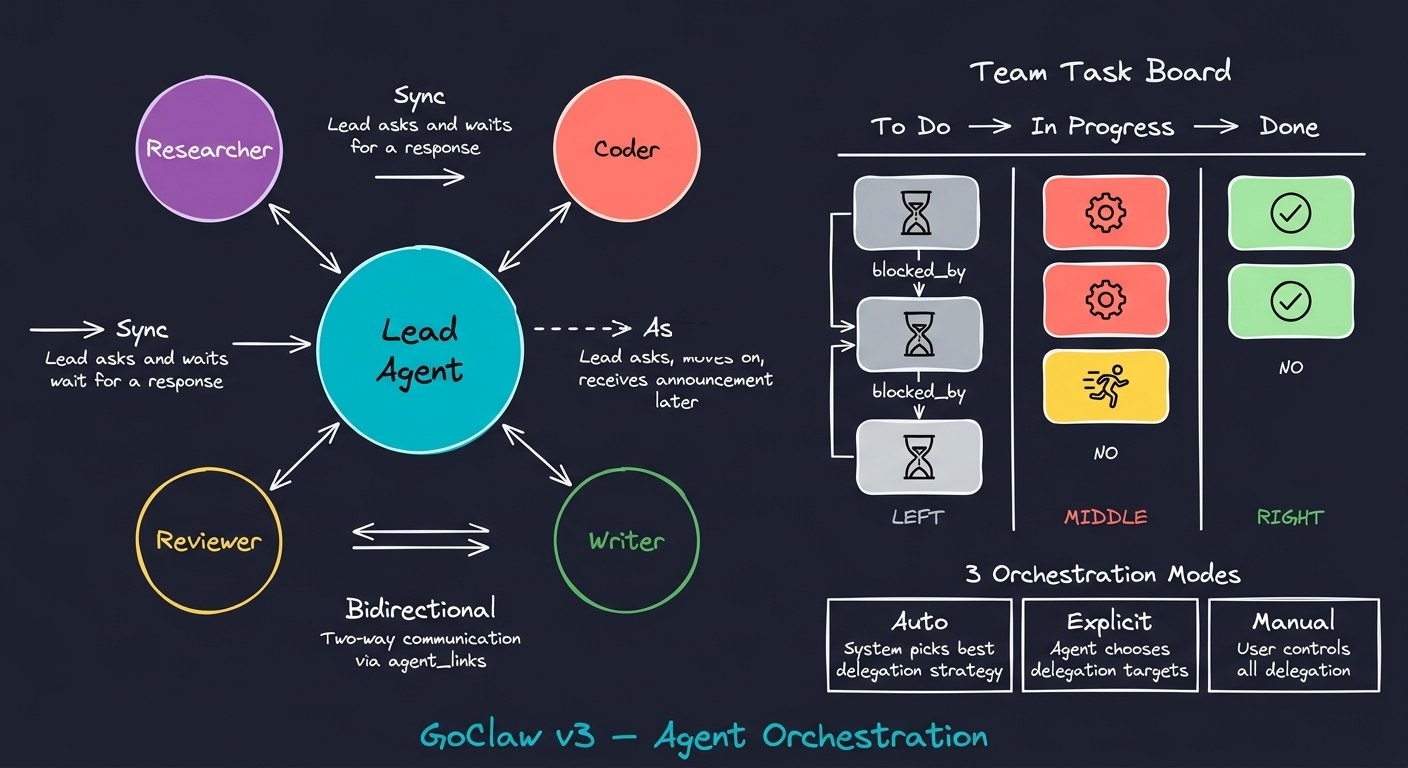
Each agent runs with its own identity, tools, LLM provider, and context files. Three delegation modes — sync (wait), async (fire-and-forget), bidirectional — connected through explicit permission links with concurrency limits.
Details: Agent Teams docs
Knowledge Vault
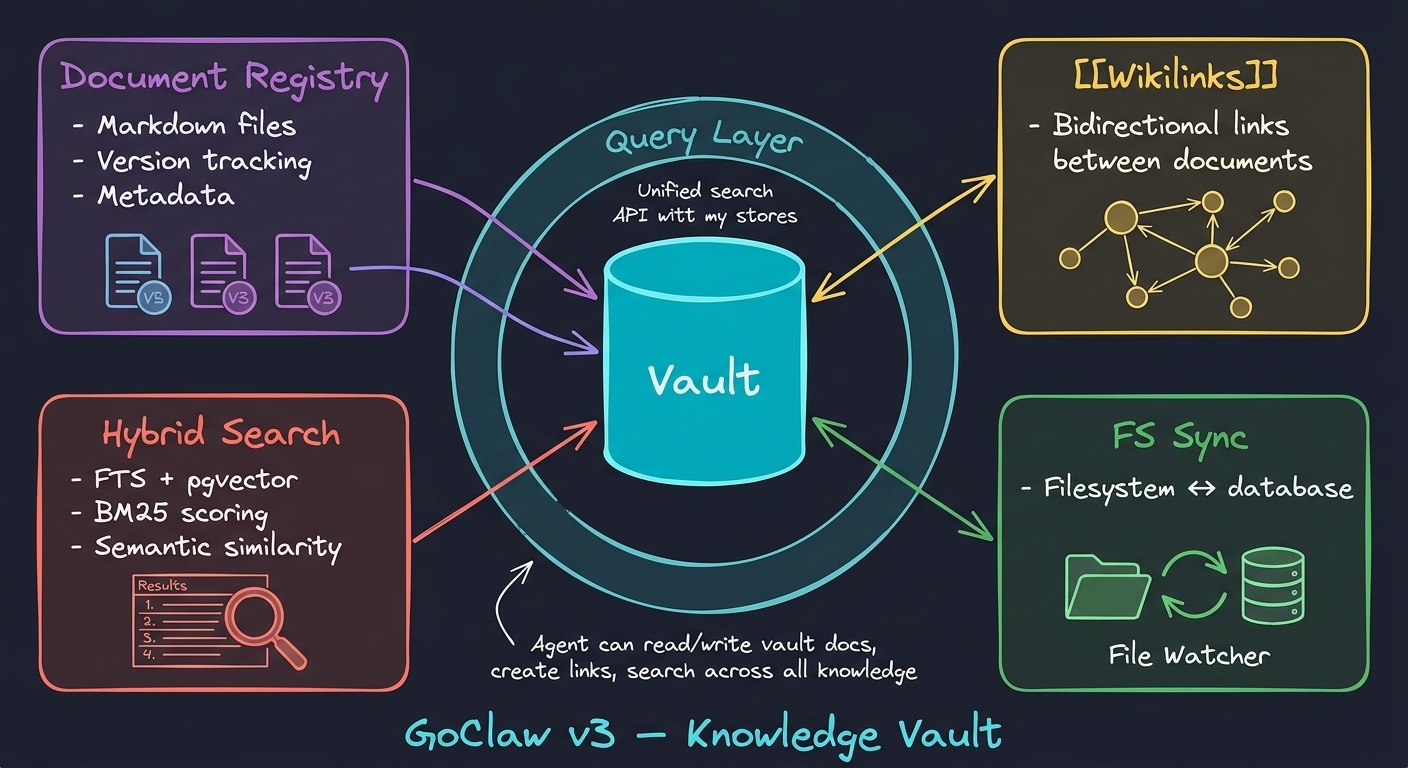
Document registry with [[wikilinks]] for bidirectional linking. Hybrid search combines full-text (BM25) and semantic (pgvector) for precise retrieval. Filesystem sync keeps vault in sync with on-disk files.
Self-Evolution
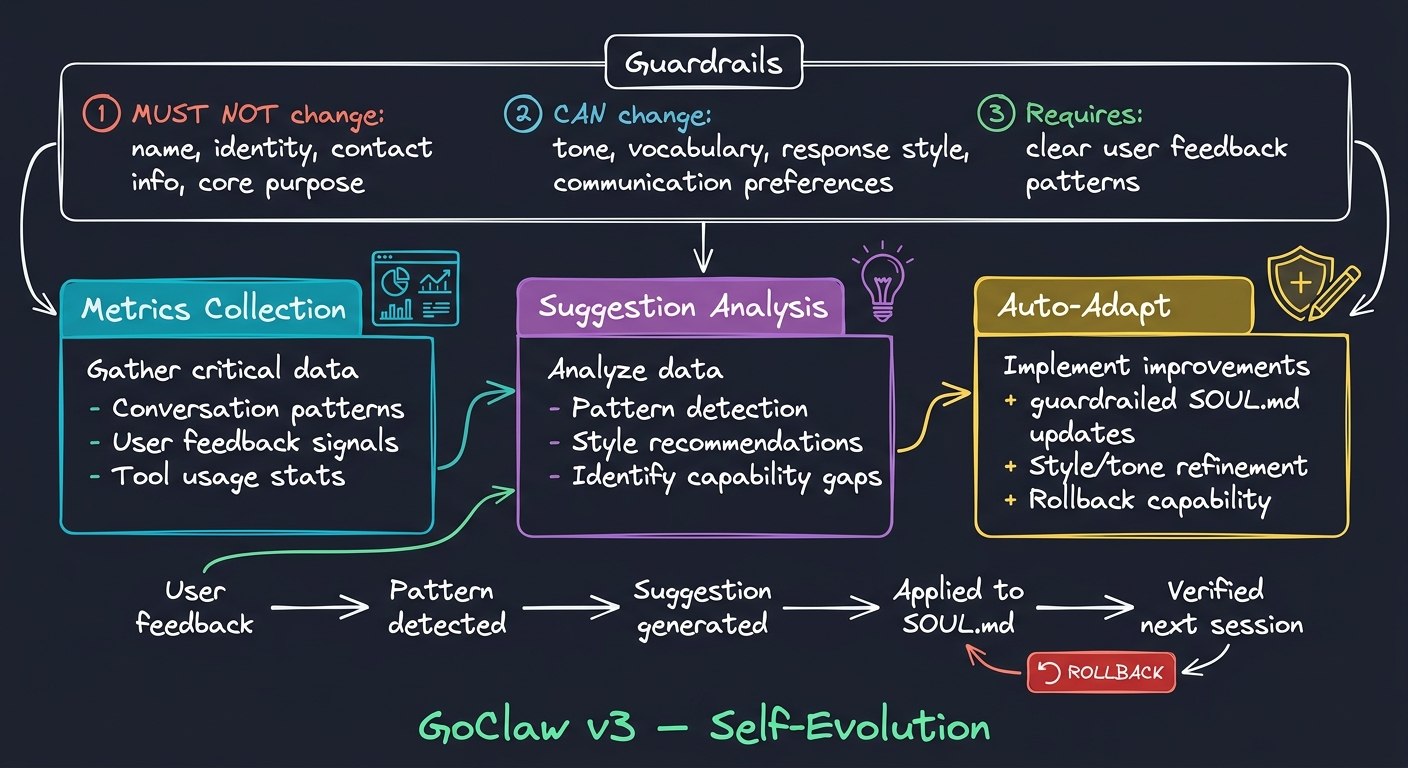
Agents improve themselves through a 3-stage guardrailed pipeline: metrics collection → suggestion analysis → auto-adaptation. Can refine communication style and domain expertise (CAPABILITIES.md) — but never change identity, name, or core purpose.
Provider Adapters
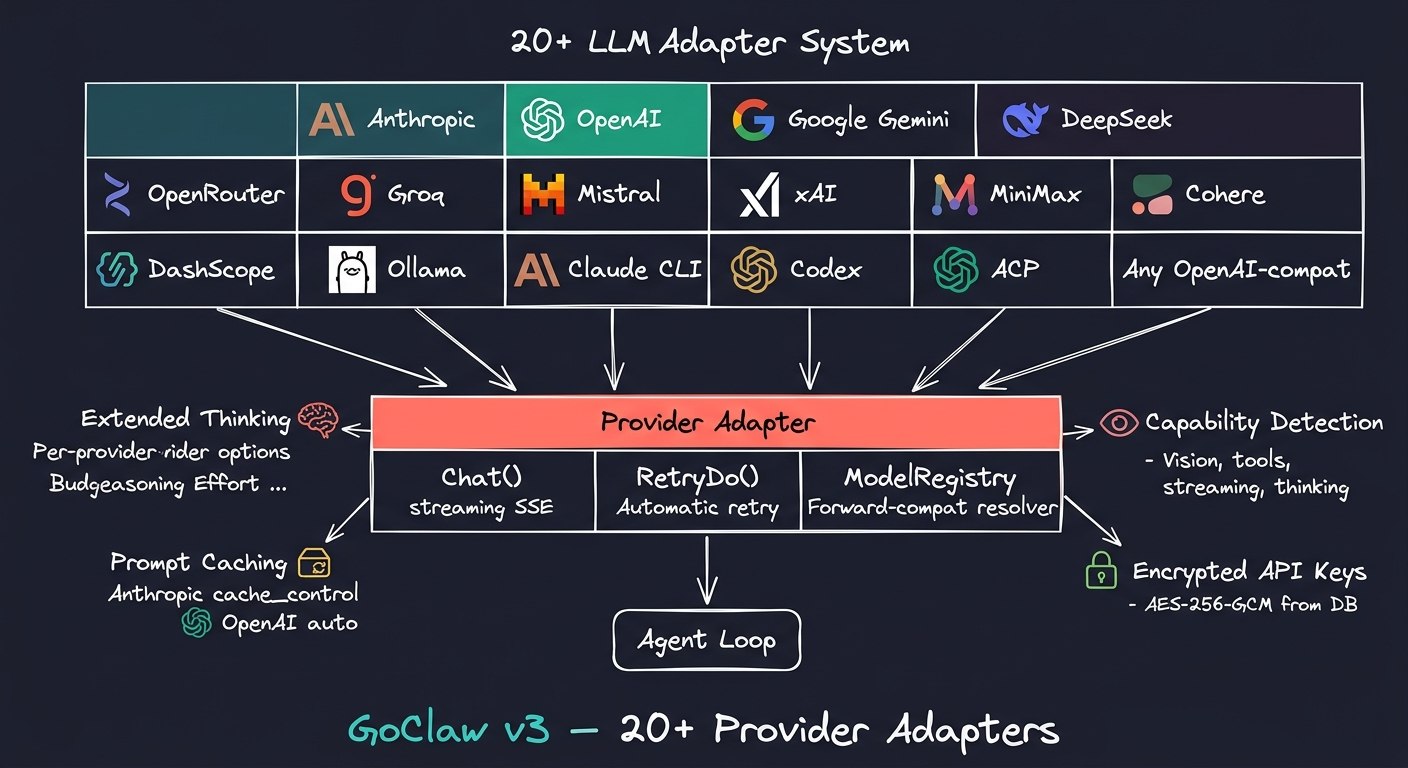
20+ LLM providers unified through a single adapter interface. Capability-based routing, encrypted API keys (AES-256-GCM), extended thinking support per-provider, and prompt caching for Anthropic + OpenAI.
Event-Driven Architecture
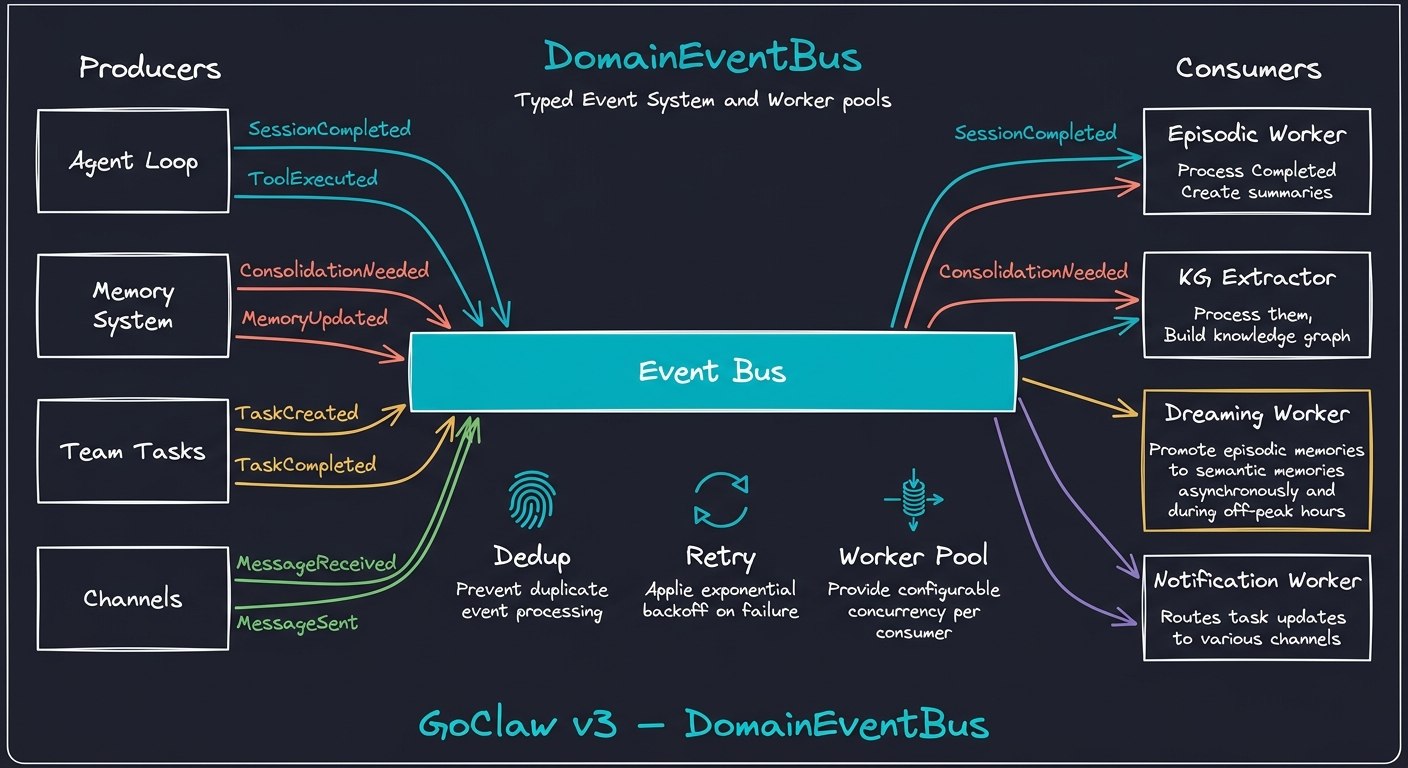
Typed domain events power the consolidation pipeline — session summaries, knowledge graph extraction, and dreaming promotion all run asynchronously via worker pools with dedup and retry.
Built-in Tools
30+ tools across 8 categories:
| Category | Tools | Description |
|---|---|---|
| Filesystem | read_file, write_file, edit_file, list_files, search, glob | File operations with virtual FS routing |
| Runtime | exec, browser | Shell commands (approval workflow) + browser automation |
| Web | web_search, web_fetch | Search (Brave, DuckDuckGo) + content extraction |
| Memory | memory_search, memory_get, knowledge_graph_search | 3-tier memory + KG traversal |
| Media | create_image, create_audio, create_video, read_*, tts | Generation + analysis (multi-provider) |
| Skills | skill_search, use_skill, skill_manage | BM25 + semantic hybrid search |
| Teams | team_tasks, spawn, delegate, message | Task board + orchestration + messaging |
| Automation | cron, heartbeat, sessions_* | Scheduling + session management |
Full tool reference at docs.goclaw.sh
Webhook API
Trigger agents or send channel messages from external systems without the gateway token.
# Bearer auth — sync LLM call
curl -X POST https://example.com/v1/webhooks/llm \
  -H "Authorization: Bearer wh_..." \
  -H "Content-Type: application/json" \
  -d '{"input":"Summarize today metrics","mode":"sync"}'

# HMAC auth — sign with hmac_signing_key from create response
TS=$(date +%s); BODY='{"input":"hi","mode":"sync"}'
SIG=$(echo -n "${TS}.${BODY}" | openssl dgst -sha256 -mac HMAC \
      -macopt "hexkey:${WEBHOOK_HMAC_KEY}" | awk '{print $2}')
curl -X POST https://example.com/v1/webhooks/llm \
  -H "Content-Type: application/json" \
  -H "X-Webhook-Id: ${WEBHOOK_ID}" \
  -H "X-GoClaw-Signature: t=${TS},v1=${SIG}" \
  -d "$BODY"
See docs/webhooks.md for the full reference: auth, async callbacks, retry schedule, HMAC examples, channel matrix.
Documentation
Full documentation at docs.goclaw.sh — or browse the source in goclaw-docs/
| Section | Topics |
|---|---|
| Getting Started | Installation, Quick Start, Configuration, Web Dashboard Tour |
| Core Concepts | Agent Loop, Sessions, Tools, Memory, Multi-Tenancy |
| Agents | Creating Agents, Context Files, Personality, Sharing & Access |
| Providers | Anthropic, OpenAI, OpenRouter, Gemini, DeepSeek, +15 more |
| Channels | Telegram, Discord, Slack, Feishu, Zalo, WhatsApp, WebSocket |
| Agent Teams | Teams, Task Board, Messaging, Delegation & Handoff |
| Advanced | Custom Tools, MCP, Skills, Cron, Sandbox, Hooks, RBAC |
| Deployment | Docker Compose, Database, Security, Observability, Tailscale |
| Reference | CLI Commands, REST API, WebSocket Protocol, Environment Variables |
Testing
go test ./...                                    # Unit tests
go test -v ./tests/integration/ -timeout 120s    # Integration tests (requires running gateway)
Project Status
See CHANGELOG.md for detailed feature status including what's been tested in production and what's still in progress.
Acknowledgments
GoClaw was originally inspired by the OpenClaw project architecture.
License
CC BY-NC 4.0 — Creative Commons Attribution-NonCommercial 4.0 International