
EvoTrace
Turn real-world Claude Code and Codex sessions into reusable training, evaluation, and verification assets.
A local-first trajectory compiler built on DeepSeek Harness.
Get started · What you get · Workflow · Architecture · 中文



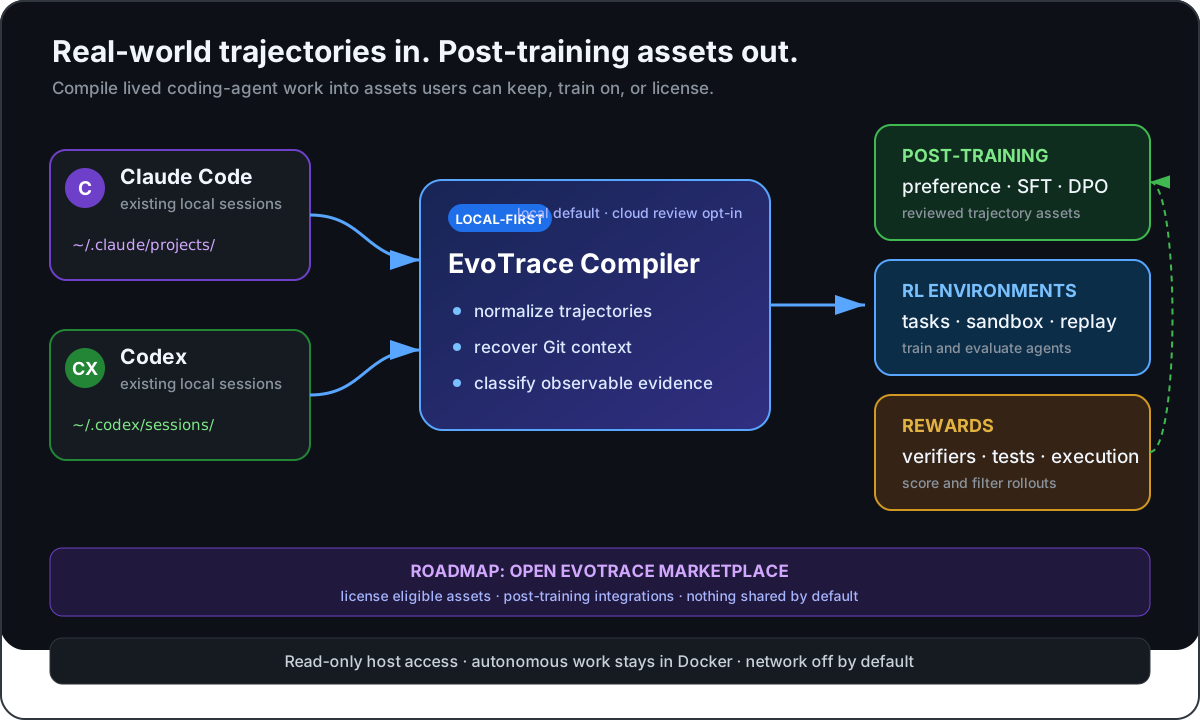
EvoTrace imports the coding-agent work already stored on your machine, finds the sessions worth keeping, and compiles them into evidence-backed preference data, replayable coding tasks, RL environments, and execution-reward candidates. You keep the source data and the resulting assets under your control.
It is not another coding agent and does not require you to change how you use Claude Code or Codex.
[!WARNING] EvoTrace is early alpha, and DeepSeek Harness is a developer preview. Generated tasks and verifiers remain candidates until they pass the documented evidence and Docker validation gates.
Get started
1. Install
macOS, Linux, or WSL:
curl -LsSf https://raw.githubusercontent.com/jinzijian/EvoTrace/main/install.sh | sh
Windows PowerShell:
irm https://raw.githubusercontent.com/jinzijian/EvoTrace/main/install.ps1 | iex
2. Launch
evotrace
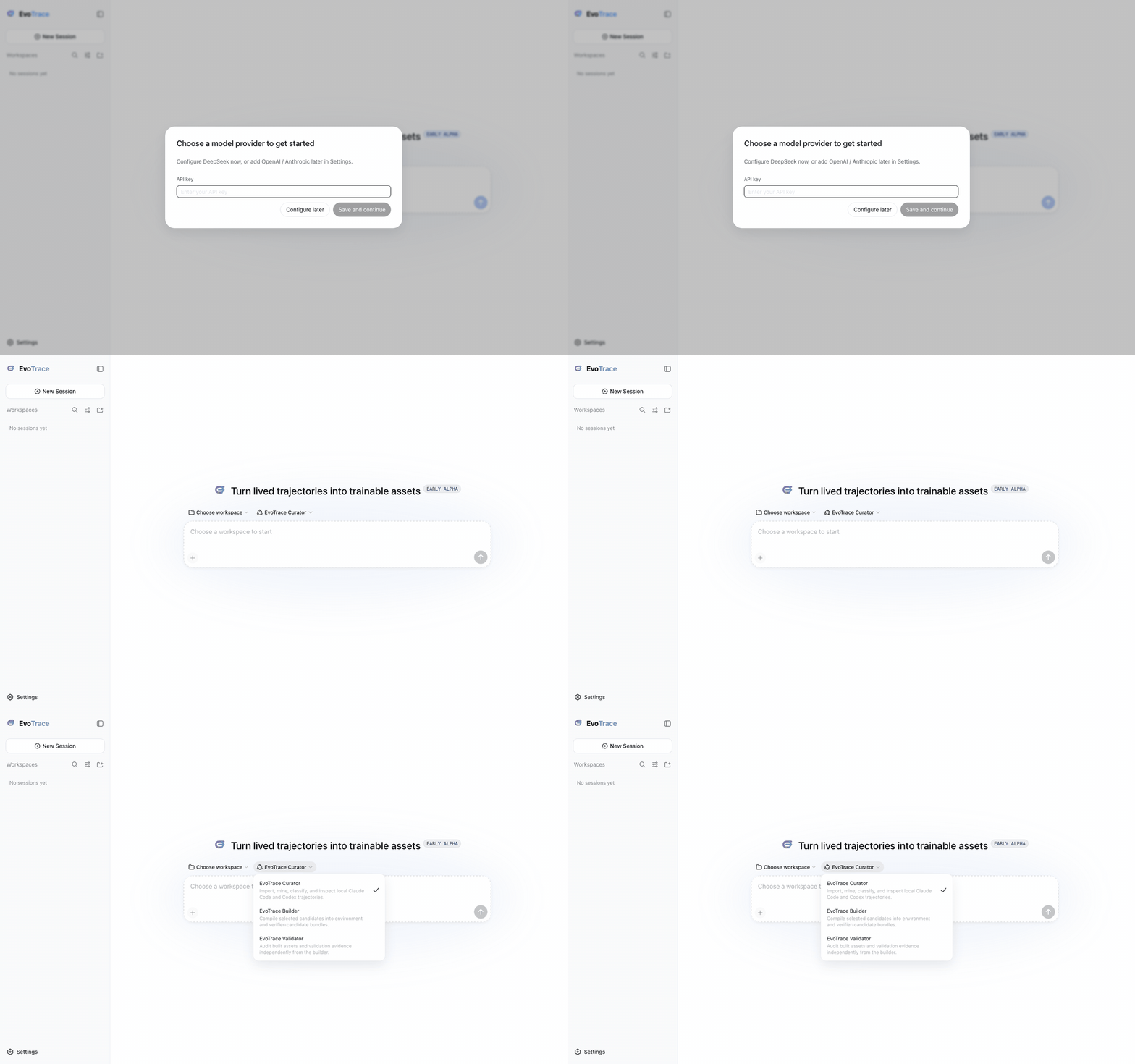
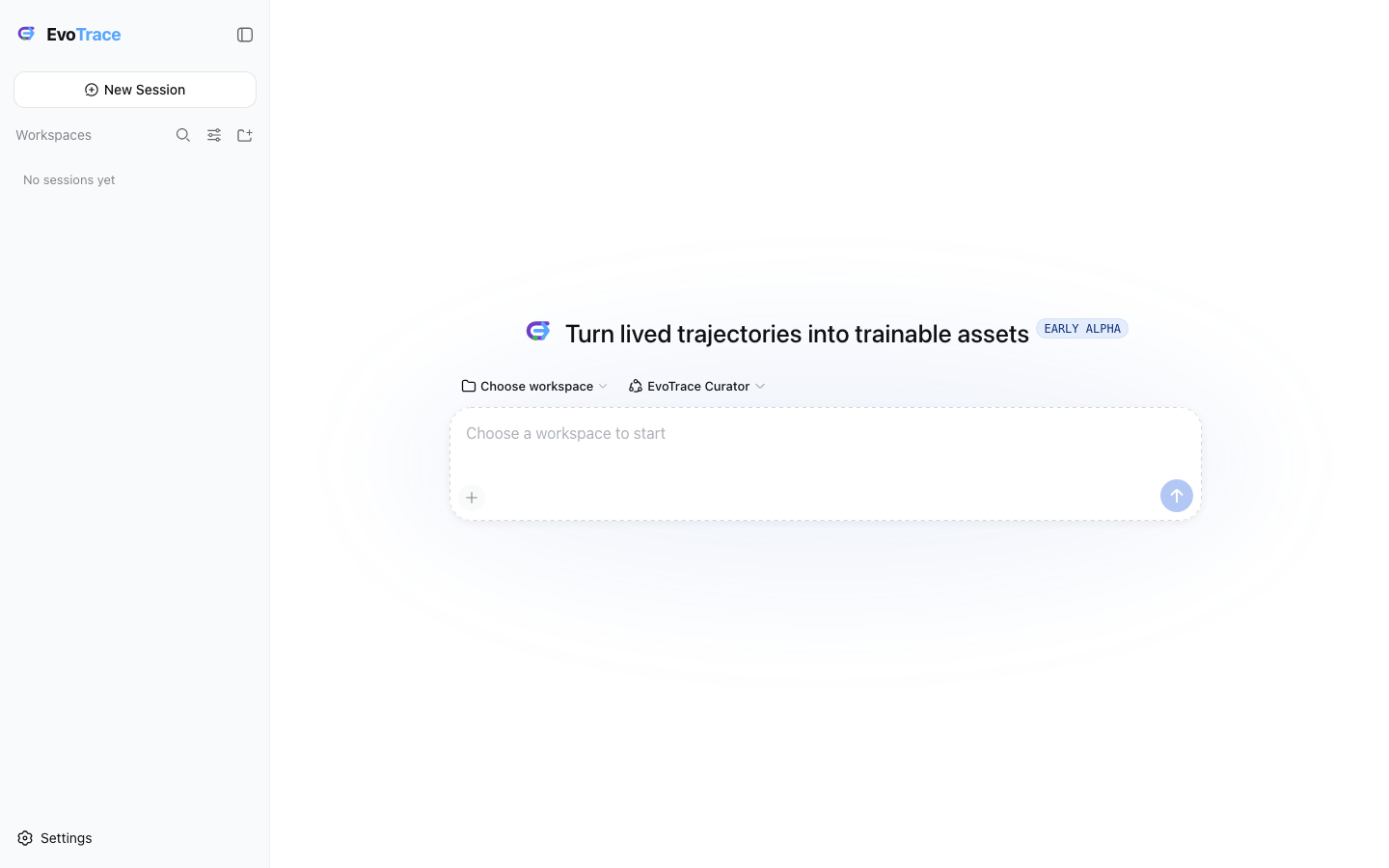
EvoTrace opens the DeepSeek Harness Web app. In Settings, choose any provider supported by your Harness setup, such as DeepSeek, OpenAI, or Anthropic. Local import and deterministic mining do not require a model; agent review, hardening, calibration, and evolution do.
New sessions start with Harness Full access by default. To use the narrower workspace sandbox:
DSH_PERMISSION_MODE=workspace-write evotrace
Docker is required only when you build or validate executable environments.
3. Build your first asset
Type / in the app and run:
/init              import existing Claude Code and Codex history
/candidates        show the strongest evidence-backed sessions
/show 1            inspect candidate 1 and its missing evidence
/review 1          run the sequential four-agent review
/assets            inspect anything that was compiled or verified
That is the main product loop. A review may build an asset, route the session to preference data, keep it only as a hardening seed, or reject it with explicit reasons. Rejection is a useful result: it prevents a long but weak trajectory from being mislabeled as training-ready.
What you get
| Output | Recovered or generated from your sessions | Useful for |
|---|---|---|
| Candidate catalog | task intent, repo, corrections, failures, effective actions, provenance gaps | finding the small fraction of history worth keeping |
| Preference and recovery data | rejected/chosen attempts, human corrections, successful recoveries | DPO, SFT, QA, failure-recovery training |
| Executable task bundle | repository base, initial state, dependency evidence, task specification | coding-agent evals, regression tasks, RL environments |
| Verifier and reward candidate | test commands, behavioral checks, policy, provenance | rollout scoring and execution rewards after validation |
| Difficulty evidence | fresh independent solver attempts and verifier outcomes | curriculum construction instead of guessing from patch size |
| Execution experience | grounded runtime facts compressed from exploration trajectories | training examples and held-out experience-transfer experiments |
The same validated task can evaluate an agent today, score newly sampled rollouts tomorrow, and produce verifier-grounded RL data later. The future opt-in EvoTrace Marketplace and fine-tuning integrations are intended to let users license reviewed assets on terms they control; they are roadmap products, not part of the current local release.
Why raw trajectories are not enough
A transcript may contain a prompt, messages, commands, and diffs, but post-training needs more:
- one coherent task boundary rather than an entire chat;
- the repository state from before the task began;
- a reproducible dependency and execution environment;
- an independent verifier that rejects the base state and accepts a known-good state;
- provenance tying every task, patch, verifier, and run together;
- difficulty measured by fresh attempts rather than token count or patch size.
EvoTrace automates that compilation gap with session import, Git/repository archaeology, deterministic gates, specialized agents, and isolated execution.
The core workflow
Claude Code / Codex history
           │
           ▼
        /init         import + normalize + Git archaeology
           │
           ▼
     /candidates      rank evidence, hide nested subagent duplicates
           │
           ▼
       /review        mine episode → gate route → build/harden → criticize
           │
      ┌────┴───────────────┐
      ▼                    ▼
preference/recovery   executable candidate
                           │
                           ▼
                    /validate in Docker
                           │
                           ▼
                 verified reward environment
Status means evidence
| Status | What it actually means |
|---|---|
| Mined | The session has useful signals. Nothing executable is implied. |
| Buildable | Task, repo base, reconstruction confidence, reference patch, verifier commands, and environment gates pass. |
| Bundle generated | A Docker-ready candidate exists. Its verifier is not yet trusted. |
| Verified | A conforming Docker run rejected the base, accepted the reference, and was recorded against the exact bundle digest. |
| Calibrated | Fresh solver attempts measured the task; the default target is two verifier passes in five attempts. |
EvoTrace fails closed on empty prompt wrappers, low-confidence reconstruction, missing reference patches, missing verification commands, unsupported environments, candidate switching, and mismatched asset lineage.
Common recipes
Mine useful history without sending it to a model
/init
/candidates
/show 1
Compile and independently validate an executable task
/review 1
/build 1
/validate 1
/runs
Make an easy verified task meaningfully harder
/harden 1
/calibrate 2
Hardening must add testable behavior, compatibility, edge cases, or failure constraints. Making a patch longer is not treated as making a task harder.
Test whether execution experience transfers
/evolve 1 2
Asset 1 is explored and compressed; asset 2 must be an independently built held-out task from the same repository.
Baseline and conditioned solver attempts are then compared using Docker rewards. Running /evolve 1 without a
held-out asset is only a wiring smoke test and cannot certify transfer.
Command reference
| Command | Purpose |
|---|---|
/init [all|codex|claude] | import history and refresh mining |
/candidates | browse ranked candidates |
/search payment retry | search tasks, repositories, and evidence |
/show 1 | inspect provenance and readiness gaps |
/review 1 | run the sequential review pipeline |
/build 1 | compile an execution candidate |
/validate 1 | run two-state Docker validation |
/harden 1 | derive and test a harder child task |
/calibrate 1 | measure and adapt difficulty with self-play |
/evolve 1 2 | test compressed experience on a held-out task |
/assets | list compiled assets and their states |
/runs | inspect saved validation evidence |
/doctor | check local integrations |
Built on DeepSeek Harness
EvoTrace is a specialized distribution of DeepSeek Harness. Harness supplies the Web UI, sessions, streaming, provider settings, permission surface, slash commands, and plugin runtime. EvoTrace adds the trajectory compiler and one managed Orchestrator with four foreground, least-privilege roles:
| Stage | Responsibility | Cannot do |
|---|---|---|
| Episode Miner | isolate one coherent episode and count effective actions | build or approve an asset |
| Candidate Gate | judge value, complexity, reconstructability, and record one immutable route | mutate data or change the route later |
| Task Builder / Hardener | build the exact routed candidate or derive a harder child | edit the source checkout or approve itself |
| Verifier Critic | audit Docker runs, verifier evidence, lineage, and difficulty | certify missing evidence |
The children run sequentially, never in parallel. Review-bound tools enforce the exact review token, candidate ID, route, and produced-asset lineage in code rather than relying only on prompts.
Install from source
Requires Git, Node.js 22.19+ or 24+, Python 3.9+, and optionally Docker.
git clone https://github.com/jinzijian/EvoTrace.git
cd EvoTrace
python3 -m venv .venv
.venv/bin/python -m pip install -e .
pnpm install
pnpm dev
The Python CLI remains available as a deterministic compiler and automation sidecar. Run et --help for its
machine-oriented commands; the DeepSeek Harness app is the primary interface.
Execution and trust boundaries
- Import and mining read local Claude Code/Codex history and Git evidence without changing source repositories.
- Codex subagent and fork trajectories keep parent lineage but are hidden from the default candidate list.
- The Orchestrator exposes fixed domain tools rather than arbitrary host shell or filesystem tools.
- Validation runs in disposable Docker worlds without source bind mounts, the Docker socket, host networking, privileged mode, or host credentials.
- Builder and Verifier Critic are separate child sessions; a builder cannot approve its own verifier.
- Self-play and evolution are explicit operations because they send selected task context to the configured model.
Read the normative sandbox contract, task quality standard, schema, and design.
Current release and roadmap
The current open-source release includes local Claude Code/Codex import, evidence mining, sequential agent review, environment reconstruction, Docker bundle generation, two-state validation, self-play calibration, semantic task hardening, experience compression, and held-out transfer measurement.
Still in progress:
- broader cross-language dependency repair and autonomous environment construction;
- stronger hidden behavioral verifiers and adversarial task mutation;
- validated DPO, SFT, and RL dataset exporters;
- opt-in Marketplace and managed fine-tuning integrations.
Acknowledgements
- DeepSeek Harness is the application and agent foundation.
- Microsoft RepoLaunch is a primary inspiration for reproducible repository-to-environment construction. EvoTrace begins earlier by mining tasks and learning signals from lived coding-agent work.