Arkana - Your Entire Malware Analysis Lab, Behind One AI Prompt


"Analyse asyncrat.exe and tell me what it does"
From a single prompt, Arkana opens the binary, triages it (CRITICAL -- 43/72 VT detections),
extracts the C2 server (cveutb.sa.com), identifies AES-256 encrypted communications via
MessagePack, maps 12 MITRE ATT&CK techniques, detects anti-VM checks for VMware/VirtualBox/
Sandboxie, finds the persistence mechanism (Registry Run key), and recovers the operator's
PDB path revealing a Vietnamese-speaking threat actor.
See the full report.
"Step through the unpacking stub and show me what it decrypts"
Arkana starts an interactive debug session, sets breakpoints on VirtualAlloc and VirtualProtect, steps through the decryption loop, snapshots state before and after, diffs the memory regions, and dumps the unpacked payload -- all driven by natural language.
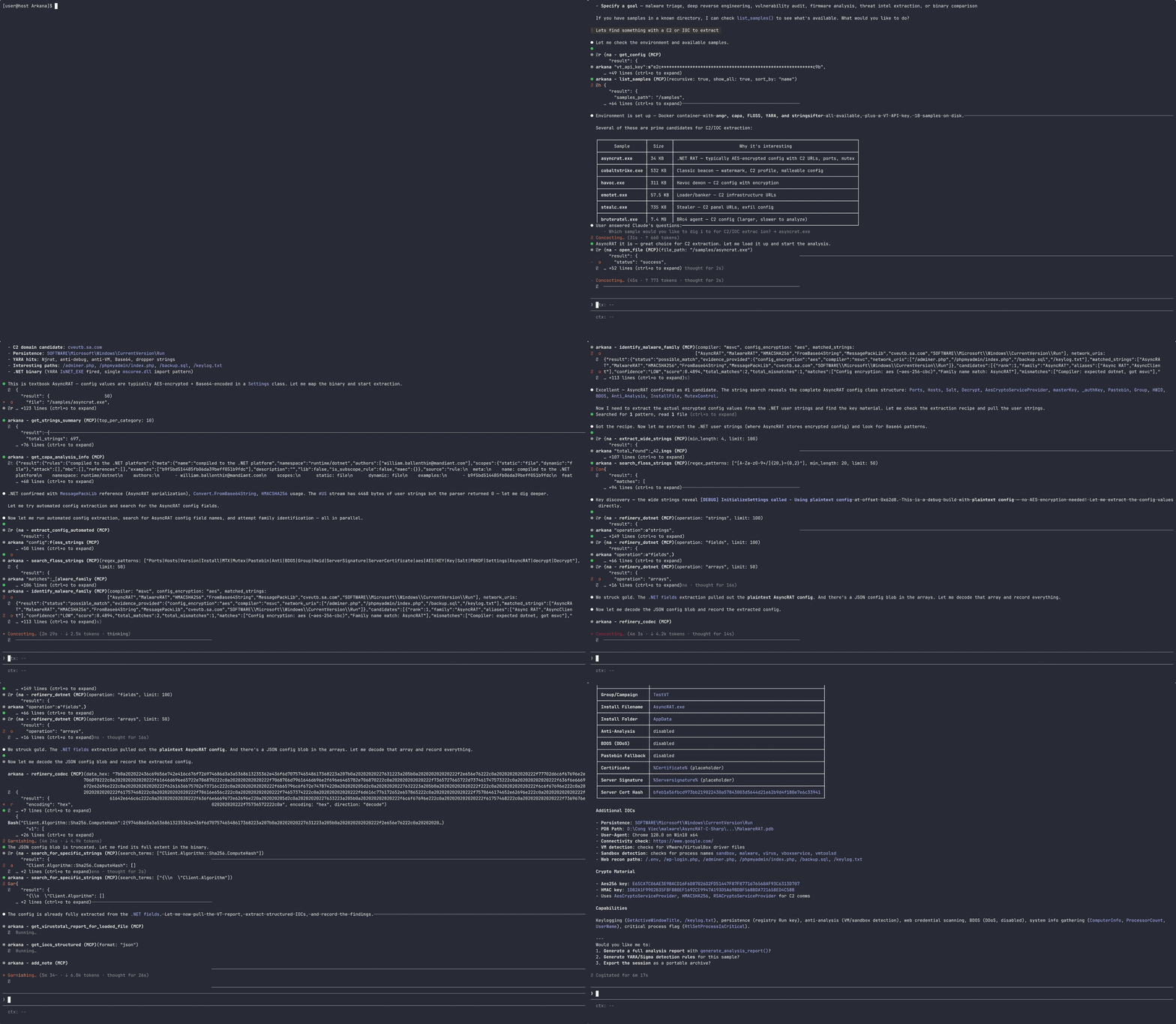
Arkana is a Model Context Protocol (MCP) server that gives Claude Code (or any MCP client) 308 analysis tools -- decompilation, symbolic execution, interactive step-through debugging, data-flow analysis, YARA/capa/FLOSS signatures, Binary Refinery data transforms, Qiling/Speakeasy emulation, .NET deobfuscation, function similarity matching, and a real-time web dashboard -- so you can investigate PE, ELF, Mach-O, .NET, Go, Rust, and shellcode samples by describing what you want to know. No Ghidra scripts, no CLI flags, no context-switching between a dozen tools. Just results.
Why Arkana
The problem: Malware analysis means juggling Ghidra, IDA, CyberChef, YARA, and a dozen other tools -- each with its own interface, scripting language, and learning curve. Investigating a single sample might mean switching between 5-10 tools, manually correlating findings across disconnected workflows.
Arkana eliminates this by putting 308 specialised analysis tools behind a single AI-driven interface -- the equivalent of an entire malware lab in one MCP server. Describe what you want to know in natural language and the AI orchestrates the right tools automatically.
What makes it different:
- Breadth -- 308 tools spanning PE/ELF/Mach-O parsing, angr-powered decompilation and symbolic execution, Binary Refinery's 200+ composable data transforms, YARA/capa/FLOSS/PEiD signature engines, Qiling/Speakeasy emulation, .NET/Go/Rust specialised analysis, .NET deobfuscation and C# decompilation, Frida script generation, vulnerability pattern detection, cross-binary function similarity search, and VirusTotal integration.
- AI reasoning over results -- Unlike tools that just produce output, Arkana feeds results back to an AI that can reason about them. When it decompiles a function and sees
VirtualAllocfollowed bymemcpyand an indirect call, it recognises the shellcode injection pattern, renames the function toinject_shellcode, and suggests investigating the source buffer. - Zero-config auto-enrichment -- Open a file and Arkana immediately begins background classification, risk scoring, MITRE ATT&CK mapping, IOC extraction, library identification, and a decompilation sweep. By the time you ask your first question, the answers are already cached.
- Interactive debugging -- Step through binaries instruction-by-instruction with breakpoints, watchpoints, memory inspection, execution snapshots, API call tracing, I/O capture, and custom API stubs. Explore alternative execution paths by snapshotting state, modifying registers or memory, and comparing outcomes.
- Session continuity -- Notes, function renames, custom type definitions, and tool history survive context window limits and server restarts, enabling investigations that span hours or days without losing context.
- Real-time web dashboard -- A visual companion that updates live as the AI works: function triage with XREF analysis, interactive call graph, strings explorer, MITRE ATT&CK matrix, hex viewer, and analysis timeline. Analyst flags set on the dashboard feed directly back into the AI's tool suggestions.
Who benefits:
- SOC analysts -- automated triage with risk scoring, MITRE mapping, and IOC extraction in seconds; web dashboard for visual review
- Malware reversers -- natural language drives decompilation, symbolic execution, interactive debugging, and data transforms across multi-stage payloads
- Incident responders -- rapid C2 config extraction, network indicators, and structured reports under time pressure
- Learners -- built-in interactive RE tutor with Socratic guidance, progress tracking, and hands-on exercises using real tools
- Threat intel teams -- automated similarity hashing, family identification, YARA rule generation, and cross-binary function matching
Key Features
- Multi-format support -- PE, ELF, Mach-O, .NET, Go, Rust, and raw shellcode with auto-detection and pre-parse integrity checks (truncation, corruption, null-padding detection). Unknown formats (ZIP, PDF, PCAP) fall back to raw mode with clear guidance instead of crashing. LIEF serves as a fallback parser when pefile cannot handle malformed PEs.
- Angr-powered analysis -- 46 tools for decompilation, batch decompilation, CFG, symbolic execution, data-flow, slicing, and emulation
- Comprehensive static analysis -- 27 PE structure tools, YARA/capa/PEiD/FLOSS signatures, crypto detection, hex pattern search, IOC export
- Binary Refinery integration -- 23 context-efficient tools wrapping 200+ composable data transforms (encoding, crypto, compression, forensics)
- Cross-platform emulation -- Speakeasy (Windows APIs) and Qiling (Windows/Linux/macOS, x86/x64/ARM/MIPS)
- Interactive debugger -- 29 tools for step-through emulation with breakpoints, watchpoints, memory inspection, snapshots, API call tracing, I/O capture, custom API stubs, and memory search -- up to 3 concurrent debug sessions
- Function similarity (BSim-style) -- Architecture-independent function matching across binaries using 8 feature groups (CFG, API calls, VEX IR, strings, constants, size, block hashes, call context). Auto-indexes every binary during enrichment; renames sync to the BSim DB so
transfer_annotationscarries your analysis to variants. Includes whole-binary triage, confidence scoring, and false-positive guards - Interactive annotation -- Rename functions and variables, define custom structs/enums, add address labels -- all persisted across sessions and applied automatically in decompilation output
- Session persistence -- Notes, renames, custom types, tool history, and analysis cache survive restarts and context window limits
- Auto-enrichment -- Opening a file automatically triggers background classification, triage, MITRE mapping, IOC collection, library identification, and a decompilation sweep -- results are ready before you ask
- AI-optimised workflow -- Compact triage, smart function ranking, batch decompilation, digest summaries, and guided next steps
- Robust architecture -- Docker-first, thread-safe state, background tasks, pagination, smart truncation, graceful degradation
- Brief descriptions --
--brief-descriptionstrims tool descriptions to first-paragraph summaries, reducing tool listing size by ~60% for clients without tool search - Web dashboard -- Real-time CRT-themed web interface on port 8082 with binary summary, function triage with XREF analysis panel, dagre-layout call graph with tabbed sidebar, analysis timeline, strings explorer, and notes browser -- analyst flags feed back into AI tool suggestions
How It Compares
| Arkana | Ghidra | IDA Pro | CyberChef | |
|---|---|---|---|---|
| AI reasoning | Native | No | No | No |
| Decompilation | Angr (multi-arch, batch) | Ghidra Decompiler | Hex-Rays ($$$) | No |
| Function similarity | BSim-style cross-binary | BSim (Java) | BinDiff/Lumina | No |
| Data transforms | 200+ via Refinery | Manual scripting | Manual scripting | 300+ (manual) |
| Emulation | Speakeasy + Qiling | Limited | No | No |
| Interactive debugging | 29-tool step debugger | Manual | Manual | No |
| Auto-enrichment | Background triage on open | No | No | No |
| Web dashboard | Real-time, 14 pages | No | No | No |
| Learning curve | Natural language | Months | Months | Moderate |
| Cost | Free & open source | Free | $1,800+/yr | Free |
Arkana complements rather than replaces Ghidra/IDA -- see Scenarios & Comparisons for detailed analysis.
Web Dashboard
Arkana includes a real-time web dashboard that launches automatically on port 8082. It provides a visual companion to the AI-driven analysis, letting you observe and interact with the investigation as it happens.
- Overview -- Binary summary with risk score, packing status, security mitigations, key findings with function pivot links, and recent notes
- Functions -- Sortable function explorer with triage buttons (FLAG / SUS / CLN), XREF analysis panel, inline notes, full-text code search, and symbol tree view -- click XREF to see cross-references with suspicious API badges, clickable callers/callees that navigate to the target function, and associated strings, all without requiring decompilation first
- Call Graph -- Interactive Cytoscape.js call graph with dagre hierarchical layout, tabbed sidebar (INFO / XREFS / STRINGS / CODE) on node selection, enrichment score-based border thickness, neighbourhood highlighting with marching-ant edges, search, bookmarks, and PNG/SVG export
- Sections -- PE/ELF section permissions with anomaly highlighting (W+X detection) and entropy heatmap
- Imports -- DLL import tables with export/function grouping and clickable export addresses
- Hex View -- Infinite-scroll hex dump with jump-to-offset navigation
- Strings -- Unified string explorer with FLOSS detail panel (type breakdown, decoded/stack string preview), type/category filtering, sifter scores, and function column with links
- CAPA -- Capability matches grouped by namespace with function links
- MITRE -- ATT&CK technique matrix with IOC panel
- Types -- Custom struct/enum type editor for binary data parsing
- Similarity -- BSim triage (whole-binary similarity against signature DB), BinDiff function-level comparison, and signature database management
- Timeline -- Chronological log of every tool call and note, with expandable detail panels showing request parameters and result summaries
- Notes -- Category-filtered view of all analysis notes (general, function, tool_result, IOC, hypothesis, conclusion, manual) with clickable address links
- Global status bar -- Active tool and background task progress visible from every page
- Real-time updates -- SSE-driven live refresh as the AI runs tools
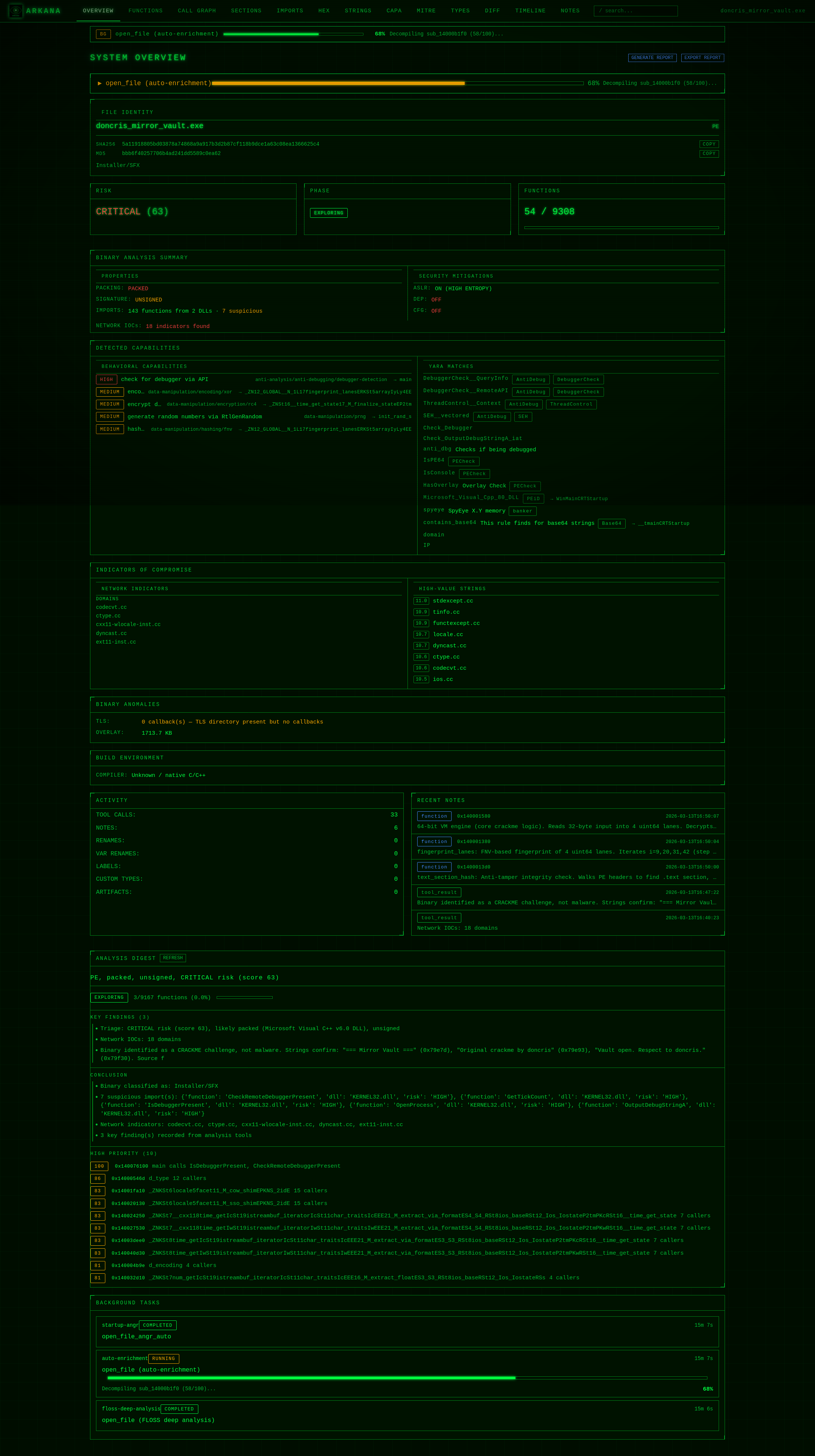
The dashboard uses token-based authentication (persisted to ~/.arkana/dashboard_token). Access URL with token is printed at server startup. See the Dashboard Gallery for screenshots of all views.
Example Reports
Every report below was generated from a single prompt: "Analyse this binary and tell me what it does."
| Report | Sample | Highlights |
|---|---|---|
| Trojan.Delshad BYOVD Loader | Multi-stage dropper | Payload carving, attack chain diagram, 12 ATT&CK techniques |
| LockBit 3.0 Ransomware | Packed ransomware | Entropy analysis, packing detection, stub extraction |
| AsyncRAT .NET RAT | .NET RAT | C2 config extraction despite obfuscated metadata |
| StealC Info Stealer | Credential stealer | 32 capa rules, browser/Steam targeting, crypto toolkit |
| ValleyRAT Multi-Stage Loader | Chinese APT RAT | 5-stage unpacking, custom ARX cipher reversal, C2 config extraction |
| Brute Ratel C4 Badger | Commercial C2 implant | PIC shellcode tracing, RC4 unpacking, C2 config extraction, 17 ATT&CK techniques |
| CrackMeZ3S CTF Challenge | PELock 6-key crackme | Interactive debugger with IAT patching, code-cave shellcode injection, encrypted blob decryption, manual XOR cipher reversal, MD5 hash cracking |
| Ternary Trap Neural Crackme | Neural network password lock | Custom NLI2 format reversal, ternary MLP reconstruction, SIMD assembly type discovery (cvtdq2pd), autoregressive inference, DFS password search |
| ACRStealer Go Loader | Go-compiled info stealer | Same-day Malware Bazaar sample, Go pclntab parsing, custom 5-stage cipher reversal, PEB-walking API evasion, zero static IOCs, encrypted payload extraction |
| SalatStealer 3-Layer Stealer | 3-layer Go stealer | AES-256-CBC payload decryption, UPX 5.02 LZMA manual decompression, Go module mapping, 16 browsers + 23 wallets + LSASS dump, dual Defender evasion, DoH C2 |
| StealC v2 7-Layer AutoIt3 Loader | 7-layer process hollowing loader | IExpress SFX → batch deobfuscation → PE fragment reassembly → RanRot PRNG decryption → 41-API process hollowing → RC4 + LZNT1 payload extraction → StealC v2 PE with encrypted C2 config, builder path, and credential targets |
| Elysium RAT (SheetRAT) | .NET plugin-based RAT | Same-day MalwareBazaar sample, custom 2-alphabet substitution cipher, 313 C# files recovered, AMSI/ETW patch bytes extracted, plugin-framework architecture with registry DLL storage, dual C2 with Dead Drop Resolver |
| CrySome RAT | .NET modular RAT | 124 C# files decompiled, 5-layer persistence with factory reset survival, BSOD-on-kill self-protection, 5-vector AV killer targeting 114+ products, HVNC for 6 browsers, DLL-injection credential theft, mutual watchdog processes |
| MBA-Obfuscated WinHTTP RAT | Same-day Malware Bazaar RAT | Full C2 protocol reversal (4 commands, versioned protocol, Cloudflare bypass), Mixed Boolean-Arithmetic obfuscation hiding XOR crypto, Base64+XOR encrypted C2, download-and-execute (EXE/DLL/custom), 27 anti-analysis techniques, embedded Chromium form injection, system profiling with author misspelling fingerprint |
How Analysis Works
Arkana follows a structured, evidence-first methodology -- the same phased workflow a professional malware analyst uses, orchestrated automatically across 308 tools. Every claim cites specific tool output, indicators are treated as leads (not conclusions), and the AI cannot attempt decryption without first decompiling the function that performs it.
Read the full methodology with annotated AsyncRAT walkthrough →
Get Started in 4 Commands
Arkana works with Claude Code and any MCP-compatible client. The fastest way to get running with Claude Code and Docker:
# 1. Clone and build (first build takes a few minutes)
git clone https://github.com/JameZUK/Arkana.git
cd Arkana
./run.sh --build

# 2. Add Arkana to Claude Code
claude mcp add --scope project arkana -- ./run.sh --samples ~/your-samples --stdio
# Optional: reduce context window usage with shorter tool descriptions
claude mcp add --scope project arkana -- ./run.sh --samples ~/your-samples --stdio --brief-descriptions

# 3. Start Claude Code and analyse a binary
claude
Then in Claude Code, use the /arkana-analyse skill to get the best results:
> /arkana-analyse suspicious.exe
Or just ask a question directly:
> Open suspicious.exe and tell me if it's malicious
There's also an /arkana-learn skill -- an interactive reverse engineering tutor that teaches you binary analysis hands-on using Arkana's tools.
For other MCP clients, local Python installation, and detailed configuration, see the Installation Guide.
Demos
AsyncRAT analysis -- single prompt to full triage, C2 extraction, and MITRE ATT&CK mapping:
Interactive playback: asciinema play docs/demos/demo-asyncrat.cast
Multi-phase investigation -- deep analysis with decompilation, emulation, and structured findings:
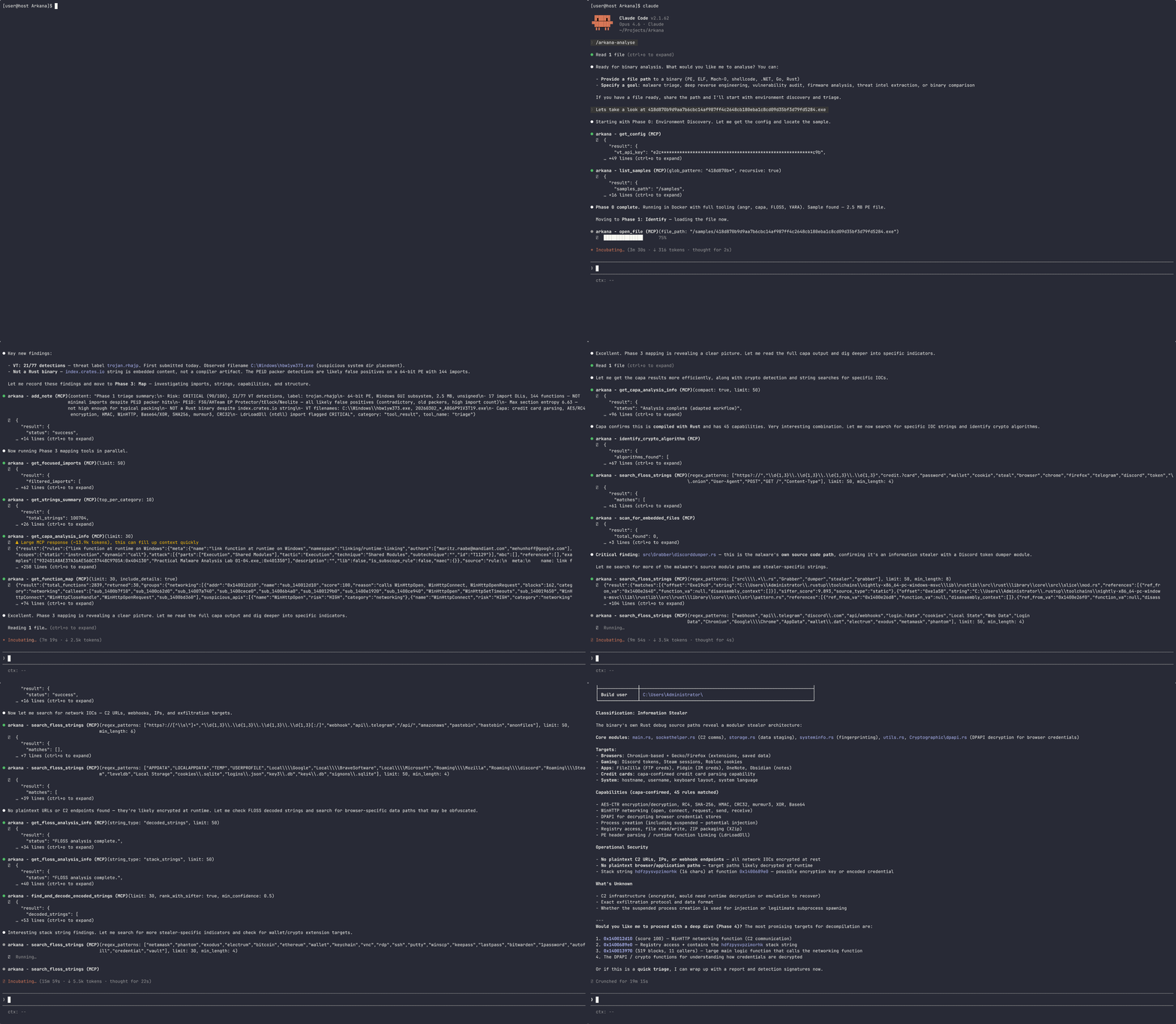
Interactive playback: asciinema play docs/demos/demo-analysis.cast
Documentation
| Document | Description |
|---|---|
| Installation Guide | Docker, local, and minimal installation; modes of operation; multi-format binary support |
| Analysis Methodology | Eight-phase analysis pipeline, tool-by-tool walkthrough, decision logic, built-in guardrails, annotated AsyncRAT example |
| Claude Code Integration | Setup via CLI and JSON config; analysis and learning skills; typical workflows and example queries |
| Configuration | API keys, analysis cache, and command-line options |
| Tools Reference | Complete catalog of all 308 MCP tools organised by category |
| VM-Protected Binaries | Analysing VMProtect/Themida/Enigma binaries with Frida DBI scripts; four-stage pipeline |
| Scenarios & Comparisons | Seven real-world analysis walkthroughs; Arkana vs Ghidra, IDA Pro, CyberChef |
| Architecture | Package structure, design principles, pagination and result limits |
| Security & Testing | Path sandboxing, security measures, testing and CI/CD |
| Web Dashboard | Real-time analysis dashboard on port 8082; function triage, call graph, timeline, notes |
| Qiling Rootfs Setup | Windows DLL setup for Qiling cross-platform emulation |
| Dependencies | Library dependencies and optional component details |
| Future Improvements | Roadmap and planned enhancements |
| Contributing | Contribution guidelines and development workflow |
Contributing
Contributions are welcome! See the Contributing Guide for details.
- Fork the repository
- Create a feature branch (
git checkout -b feature/your-enhancement) - Commit your changes
- Open a Pull Request
Licence
Distributed under the MIT Licence. See LICENSE for more information.
Disclaimer
This toolkit is provided "as-is" for educational and research purposes only. It is capable of executing parts of analysed binaries (via angr emulation and symbolic execution) in a sandboxed environment. Always exercise caution when analysing untrusted files. The authors accept no responsibility for misuse or damages arising from the use of this software.
If Arkana is useful to you, consider giving it a star -- it helps others discover the project.