AI Evaluation Platform
Self-hosted AI evaluation workbench for RAG, AI Agents, multi-turn conversations, LLM-as-a-Judge, endpoint evaluation, reports, and human blind testing.





AI Evaluation Platform helps teams evaluate LLM applications as an engineering workflow instead of a one-off metric script. It connects dataset management, scenario presets, native metrics, OpenAI-compatible judge models, live endpoint evaluation, report analysis, manual review, and A/B blind testing in one Web UI.
Screenshots
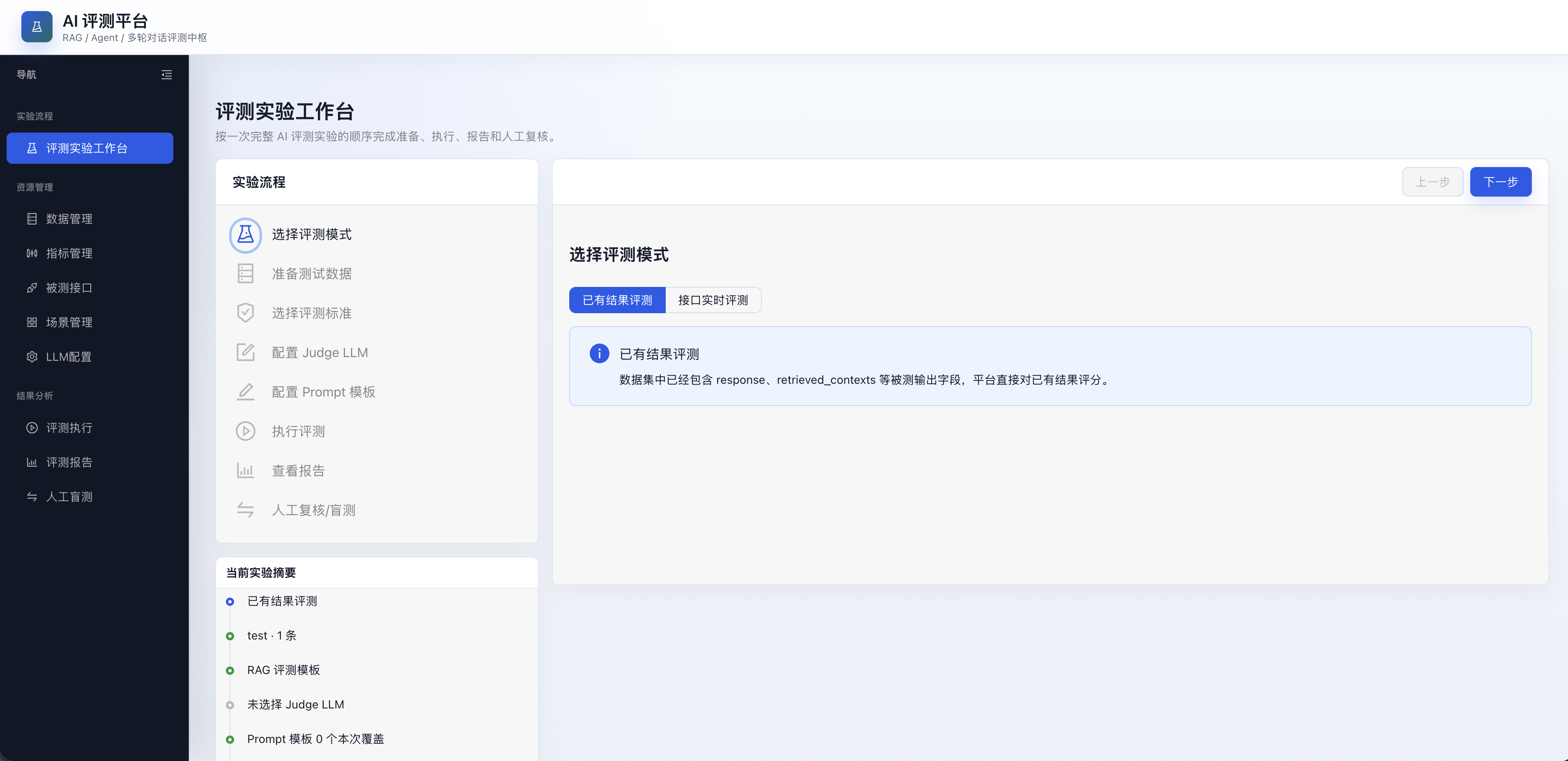
Evaluation Workbench
Configure dataset, scenario, judge model, endpoint target, metric overrides, debug validation, and task creation in one workflow.
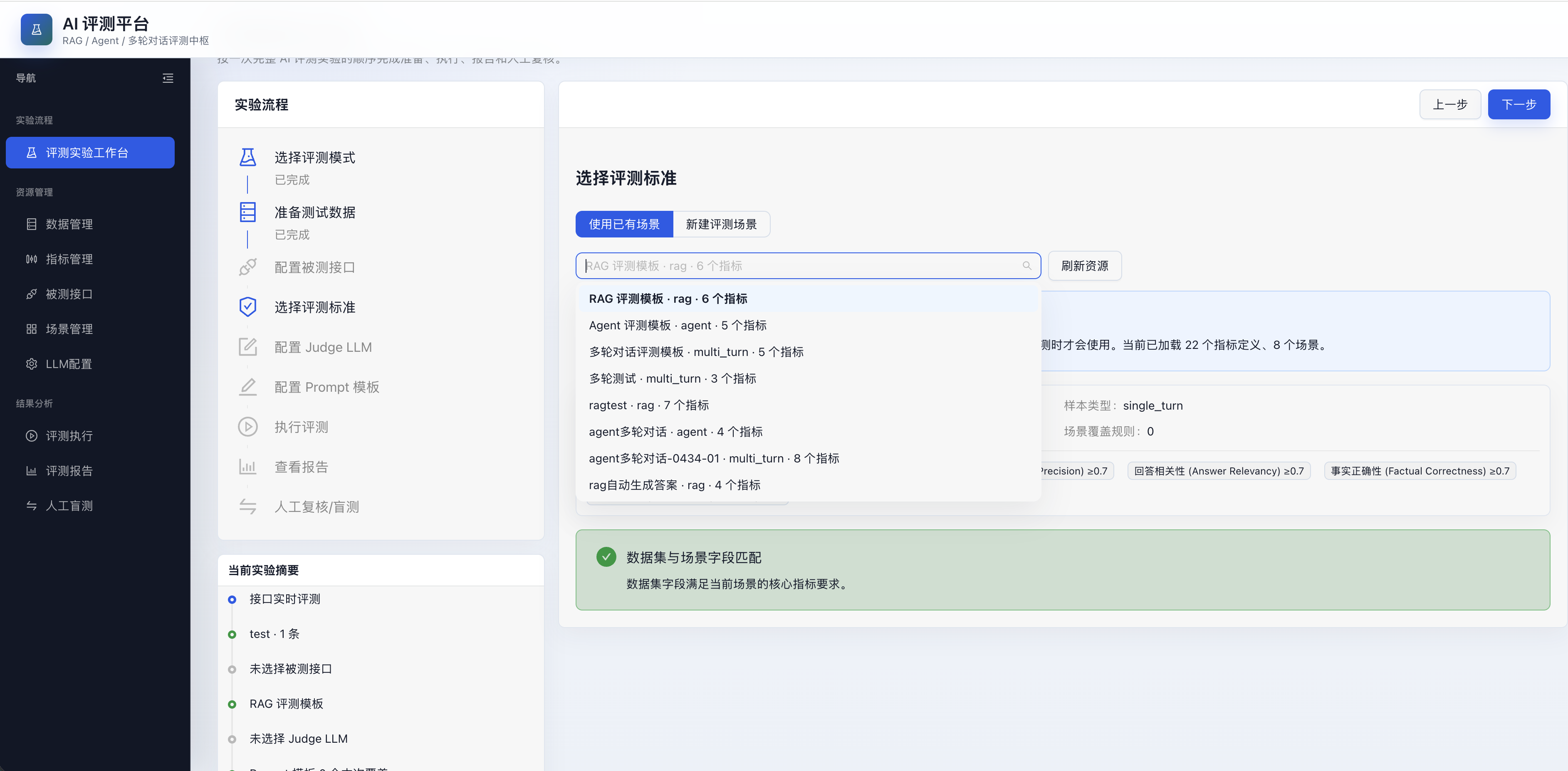
Evaluation Scenarios
Use built-in scenario templates for RAG, Agent, and multi-turn conversation evaluation. Teams can adjust metrics, weights, thresholds, and prompt overrides.
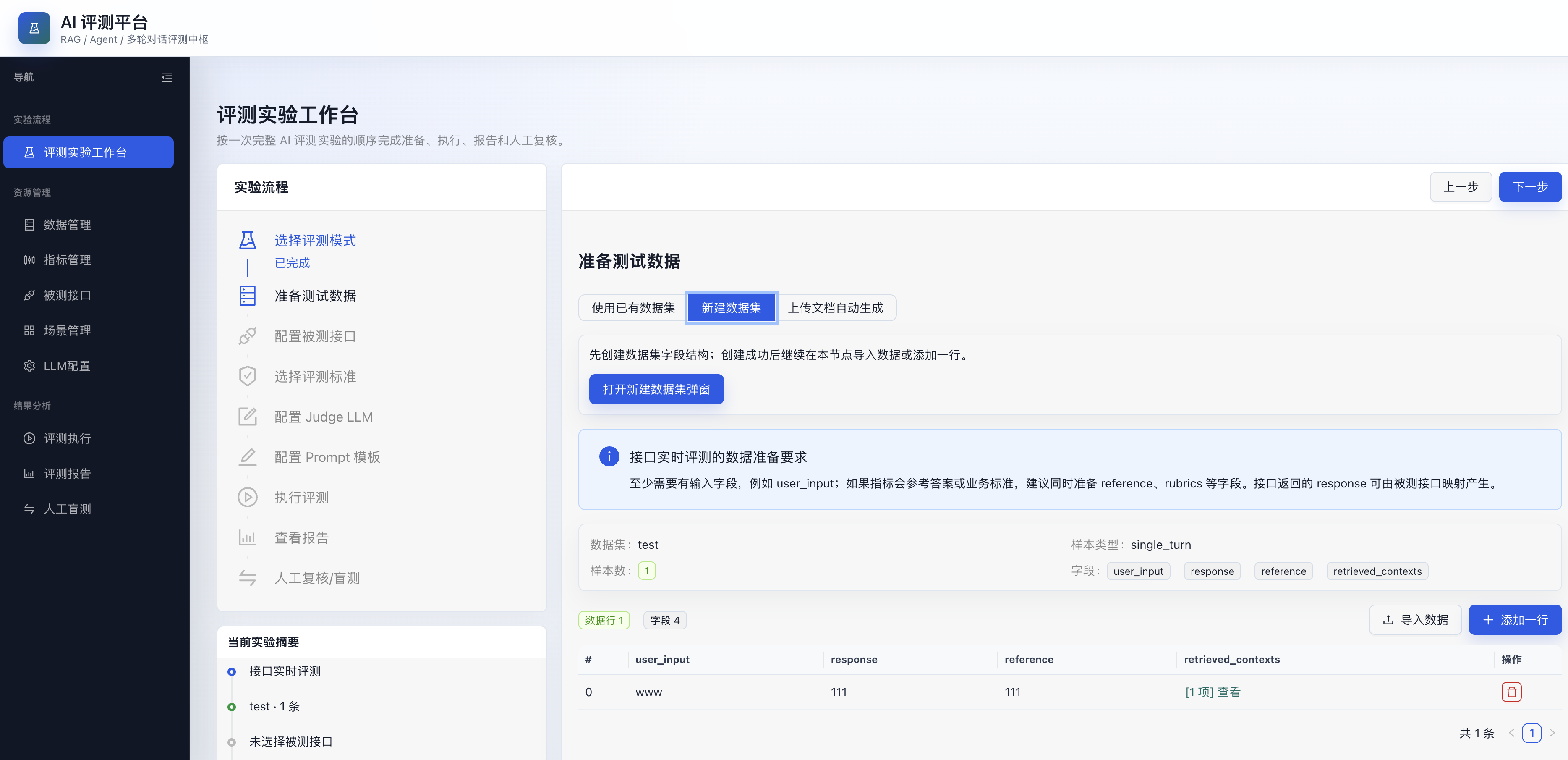
Custom Datasets
Model single-turn samples, multi-turn conversations, retrieved contexts, tool calls, reference answers, and custom business fields.
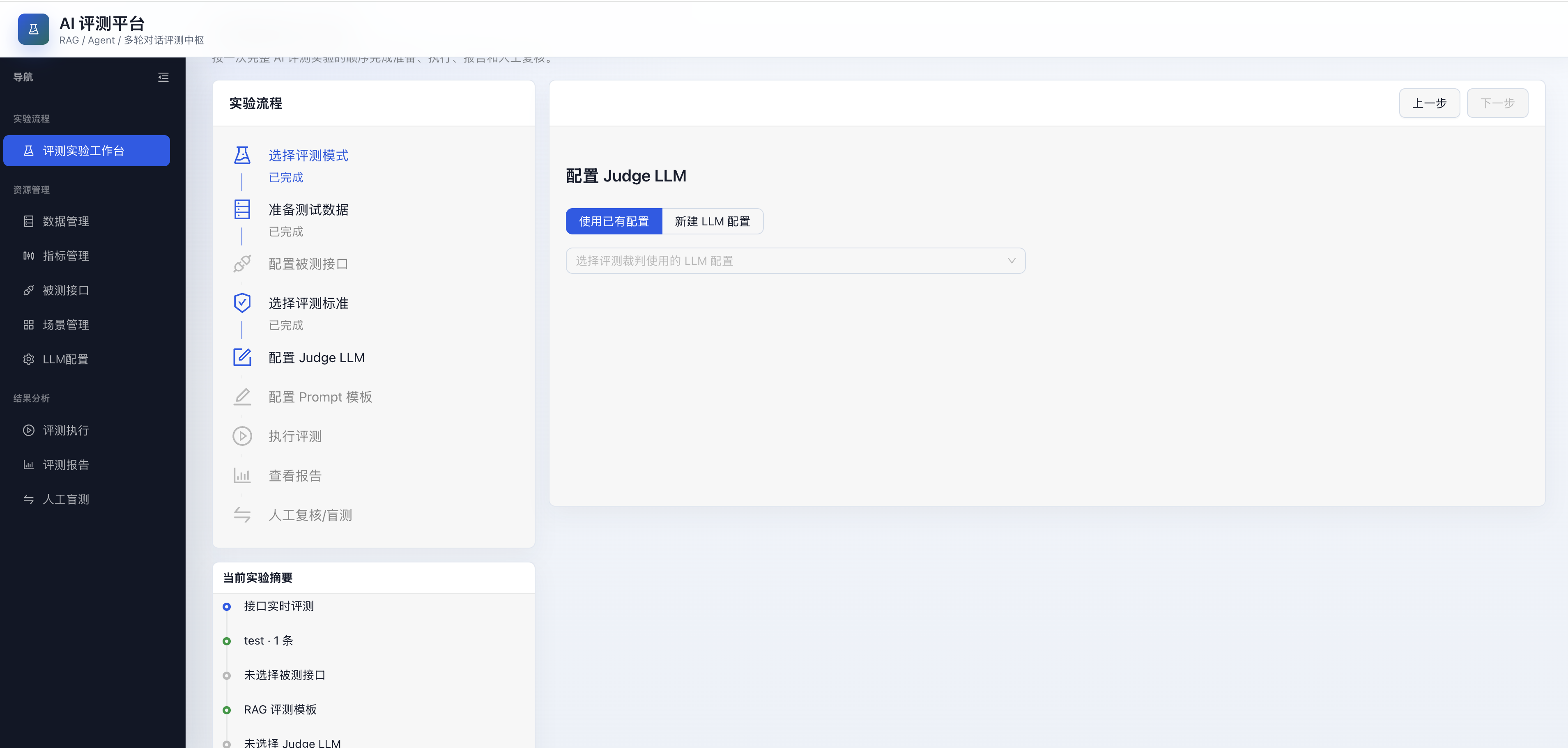
LLM Judge Configuration
Configure judge models through OpenAI-compatible endpoints, including Qwen, GPT-compatible services, and private compatible gateways.
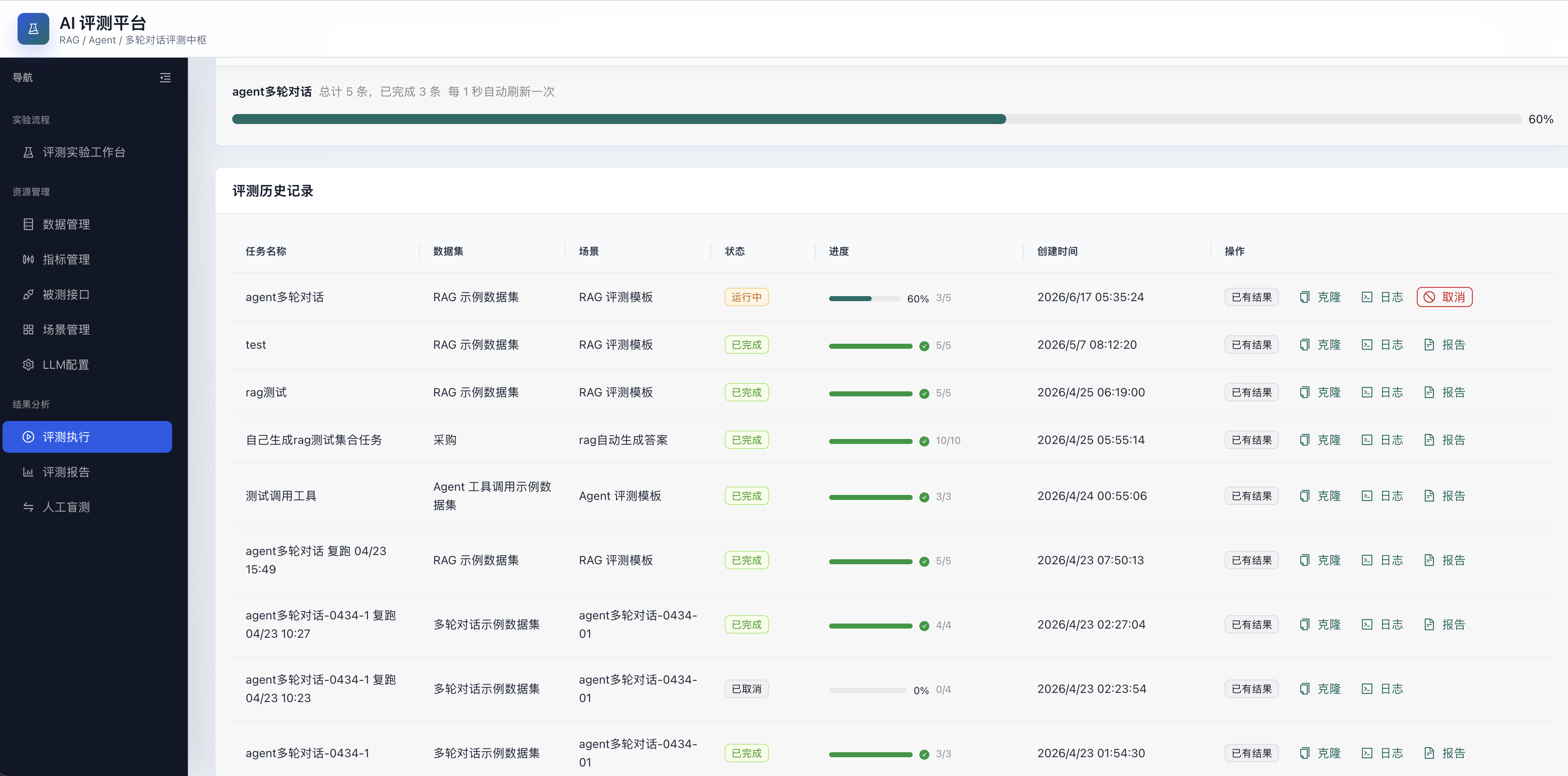
Evaluation Execution
Run offline evaluation on existing outputs or live endpoint evaluation by calling saved Chat, RAG, or Agent APIs.
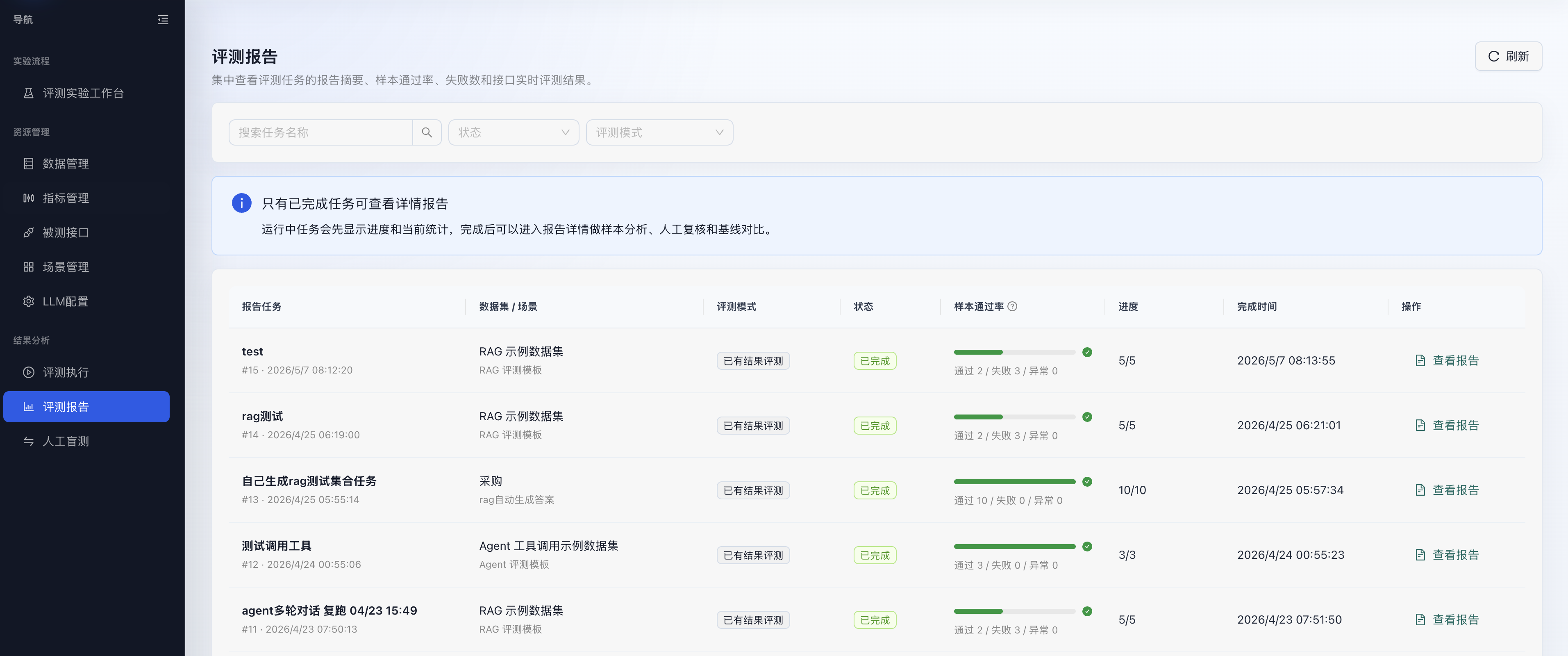
Reports
Inspect task status, pass rate, metric summaries, report comparison entry points, and evaluation progress.
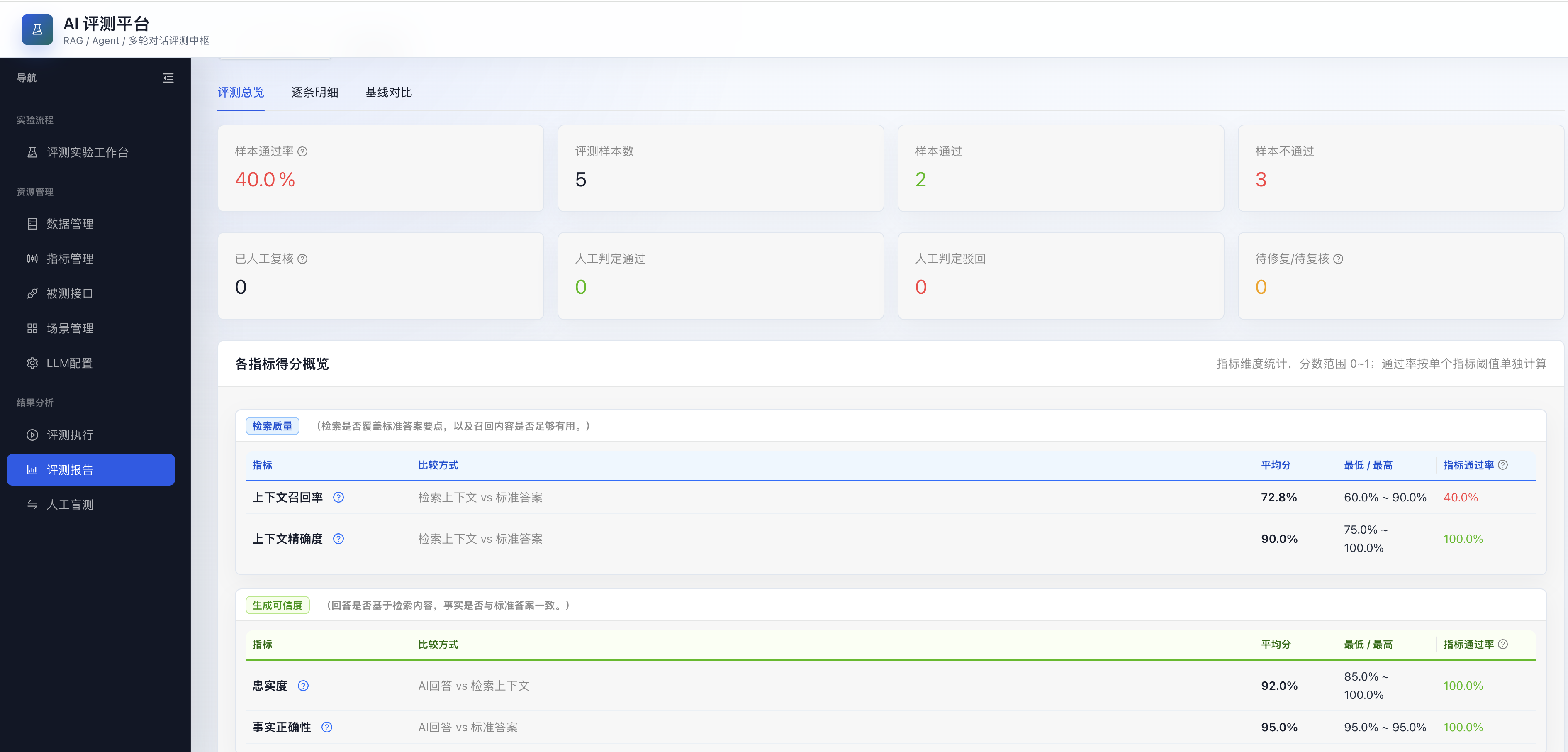
Report Detail
Review row-level metric scores, judge reasons, pass/fail status, endpoint traces, and manual review fields.
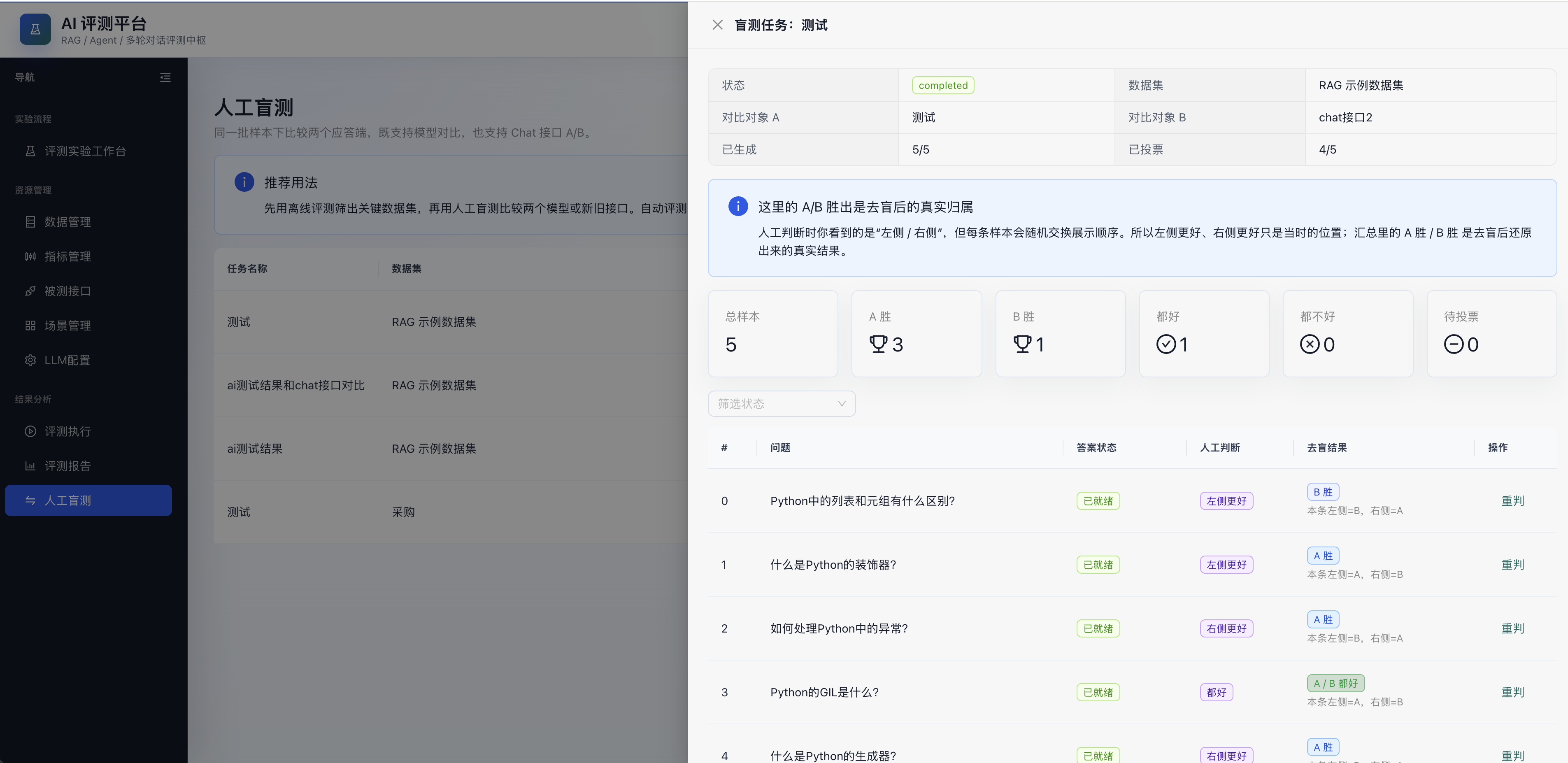
Human Blind Test
Compare two LLM or endpoint outputs with randomized display order, human votes, and summary statistics.
Why This Project
Many evaluation tools focus on only one part of the workflow: metric calculation, synthetic dataset generation, or prompt-level experiments. This project is designed as a product-oriented evaluation workbench.
- Web UI for datasets, scenarios, metrics, execution, reports, manual review, and blind tests.
- Offline evaluation and live endpoint evaluation for Chat, RAG, and Agent services.
- Built-in metrics for RAG, Agent, and multi-turn conversations, with custom judge prompts.
- Human blind testing and manual review for release decisions beyond automatic scores.
- Lightweight SQLite quick start, with SQLAlchemy
DATABASE_URLsupport for PostgreSQL and other relational databases.
Compared with library-first tools such as Ragas, rag_eval, or dataset-focused tools, this platform emphasizes repeatable evaluation operations: collect samples, freeze scenario snapshots, run comparable tasks, inspect row-level reasons, and combine automatic judging with human decisions.
Feature Highlights
| Area | What It Provides |
|---|---|
| Dataset management | Single-turn rows, multi-turn conversations, RAG contexts, tool calls, CSV/JSON import and export |
| RAG evaluation | Faithfulness, Context Recall, Context Precision, Answer Relevancy, HitRate@K, MRR, and more |
| Agent evaluation | Task Completion, Tool Correctness, Argument Correctness, Step Efficiency, Goal Accuracy |
| Multi-turn evaluation | Topic Adherence, Turn Relevancy, Conversation Completeness, Knowledge Retention, Role Adherence |
| Live endpoint evaluation | Call a target endpoint, extract response/contexts/tool calls, and evaluate the result directly |
| Human blind testing | Compare LLM vs LLM, endpoint vs endpoint, or LLM vs endpoint outputs |
| Reports and review | Task progress, summary score, row-level judge reasons, manual status, and report comparison |
| OpenAI-compatible judge | Default Qwen Plus through DashScope compatible mode; replaceable with any compatible chat model |
Core Scenarios
RAG Evaluation
Evaluate retrieval and generation together:
- Retrieval quality: Context Recall, Context Precision, Contextual Relevancy.
- Generation trust: Faithfulness and Factual Correctness.
- Answer quality: Answer Relevancy and Answer Completeness.
- Retrieval unit checks: HitRate@K and MRR when document IDs are available.
Agent Evaluation
Evaluate whether an Agent completes the task through correct tool use:
- Task Completion and Goal Accuracy.
- Tool Correctness.
- Argument Correctness.
- Step Efficiency.
This is useful for customer-service agents, task execution agents, workflow agents, and tool-calling systems.
Multi-Turn Conversation Evaluation
Evaluate conversation stability across turns:
- Topic Adherence.
- Turn Relevancy.
- Conversation Completeness.
- Knowledge Retention.
- Role Adherence.
This is useful for customer support bots, enterprise assistants, and continuous Q&A systems.
Endpoint A/B Blind Test
Compare two response sources with human preference:
- LLM config vs LLM config.
- Endpoint vs endpoint.
- LLM config vs endpoint.
This is useful before releasing a new model, RAG service, prompt version, or Agent implementation.
Result Output
Each completed evaluation produces:
- Overall pass rate and metric summary.
- Row-level score, pass/fail status, judge reason, and execution time.
- Endpoint trace for live endpoint evaluation.
- Manual review status, score, tags, and notes.
- Report comparison for regression checks.
Tech Stack
| Layer | Stack |
|---|---|
| Backend | FastAPI, SQLAlchemy, Pydantic, SQLite by default |
| Frontend | React 18, TypeScript, Ant Design 5, Vite |
| Evaluation engine | Native metric executors plus OpenAI-compatible judge prompts |
| Default judge model | Qwen Plus through DashScope compatible mode |
Quick Start
Prerequisites
- Python 3.9+, Python 3.11+ recommended
- Node.js 18+
uvorpip- An OpenAI-compatible model API key, such as DashScope
1. Configure Backend
cd backend
cp .env.example .env
Edit backend/.env:
LLM_API_KEY=your-api-key
LLM_ENDPOINT=https://dashscope.aliyuncs.com/compatible-mode/v1
LLM_MODEL=qwen-plus
Install dependencies:
python3 -m venv venv
source venv/bin/activate
pip install -r requirements.txt
Start the backend:
python3 run.py
Open:
http://localhost:8000/docs
2. Start Frontend
cd frontend
npm install
npm run dev
Open:
http://localhost:5173
Typical Workflow
1. Configure a Judge LLM
2. Create or import datasets
3. Select a scenario: RAG, Agent, or multi-turn conversation
4. Run offline evaluation or live endpoint evaluation
5. Inspect report summaries, row-level reasons, and failures
6. Use manual review or blind test results for release decisions
Roadmap
The first public release focuses on a complete local evaluation workflow. Upcoming work will make the project easier to deploy, operate, and extend in team environments.
- v0.2: Docker Compose quick start, GitHub Actions CI, and release checklist automation.
- v0.3: Alembic migrations, richer PostgreSQL deployment guidance, and indexes for larger evaluation datasets.
- v0.4: Authentication, RBAC, audit logs, and encrypted storage for sensitive fields.
- v0.5: More built-in scenario templates, import/export examples, and benchmark datasets.
- Later: SDK/CLI integration, pluggable judge providers, observability integration, and public demo assets.
Documentation
Configuration
| Variable | Description | Default |
|---|---|---|
LLM_API_KEY | Judge model API key | Required for real LLM calls |
LLM_MODEL | Judge model name | qwen-plus |
LLM_ENDPOINT | OpenAI-compatible API endpoint | DashScope compatible endpoint |
DATABASE_URL | SQLAlchemy database URL | sqlite:///./eval_platform.db |
UPLOAD_DIR | Uploaded document directory | ./uploads |
CORS_ORIGINS | Allowed frontend origins | ["http://localhost:5173"] |
SEED_ON_STARTUP | Seed demo data at startup | true |
RUN_EVAL_ON_CREATE | Run evaluation immediately after task creation | true |
For production or shared team environments, prefer PostgreSQL:
DATABASE_URL=postgresql+psycopg://user:password@localhost:5432/ai_eval_platform
See Database and Storage before changing the storage backend.
Development
Backend tests:
cd backend
source venv/bin/activate
python3 -m pytest tests/ -v
Frontend build:
cd frontend
npm run build
Security Notes
- Never commit
.env, SQLite databases, uploaded files, WAL/SHM files, or local IDE metadata. - API keys and endpoint authorization headers are stored for execution but masked in API responses.
- The current project is designed for trusted internal users. Add authentication, authorization, audit logs, and secret encryption before exposing it to untrusted networks.
- Before publishing an existing Git history, scan and clean historical commits that may contain databases or secrets.
See SECURITY.md for disclosure guidance.
Community
If this project is useful for your RAG, AI Agent, multi-turn conversation evaluation, or AI infrastructure work, a Star would be greatly appreciated. You are also welcome to watch the repository, open issues, contribute pull requests, or share real evaluation use cases.
The author has years of hands-on backend engineering and architecture experience in large-scale internet systems, and has recently been working in AI Agent, AI infrastructure, LLM application evaluation, and production-oriented AI engineering. Feel free to reach out for technical discussions, feedback, or collaboration.
- WeChat:
huangyiminghappy - Email:
huangyiminghappy@gmail.com
License
Apache License 2.0. See LICENSE.